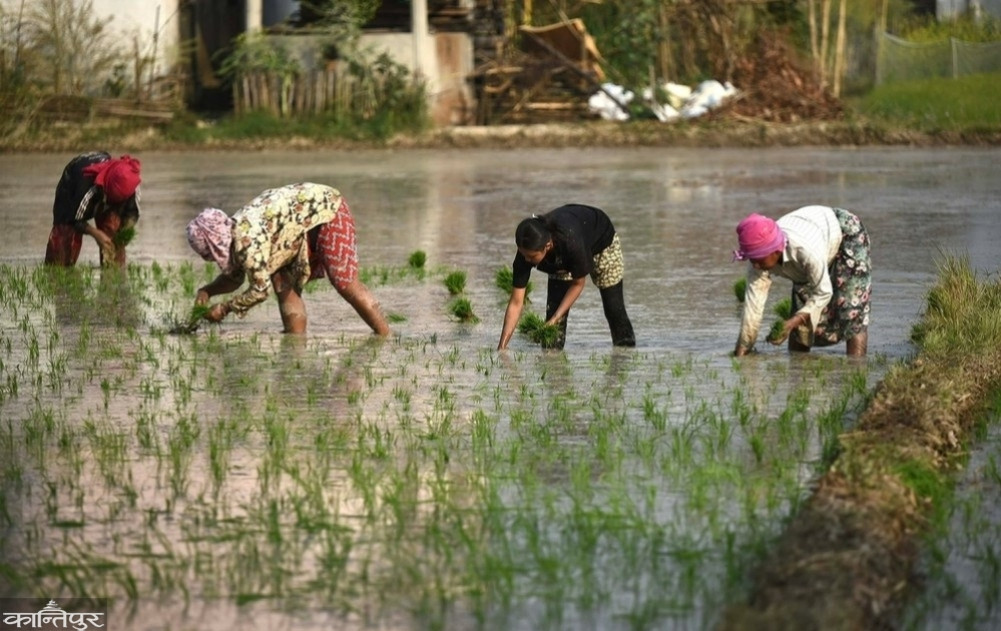
For sowing in Ashar, seeds should be sown by the first or second week of Jestha. However, farmers complain that when fertilizer is needed in their fields, government warehouses and local markets are empty.
We use Google Cloud Translation Services. Google requires we provide the following disclaimer relating to use of this service:
This service may contain translations powered by Google. Google disclaims all warranties related to the translations, expressed or implied, including any warranties of accuracy, reliability, and any implied warranties of merchantability, fitness for a particular purpose, and noninfringement.
Maharaja Yadav of Narainapur-5 in Banke produces 5 acres of land to feed her family and also earns salt and oil from the produce of her farm. Her family, which consists of a husband, three daughters and a son, depends on farming. She said that this farm is the only source of household expenses, children's education and daily needs. Two years ago, there was a long drought in the Narainapur area. Due to the lack of irrigation facilities, most of the rice crop withered. She said that she is still struggling to repay the loans taken to run the household after the crop failed at that time.
"I barely made enough for food. It was difficult to meet the expenses of my children's education. I was not able to apply fertilizer and seeds properly and irrigate on time, so my house will run well with good harvest," she said. As the sowing season approaches this year, Yadav is not only afraid of drought, but also stressed about getting fertilizer. She said that fertilizer is not easily available every year during the planting season and it is expensive. ‘Even if you stand in line, you don’t get the fertilizer you need,’ she said. ‘Without fertilizer, production is not good. If there is no production, investment is not paid off.’
Farmers have been complaining for years about having to endure the hardship of fertilizer, seeds and irrigation for planting. Other farmers in Narainapur also complain that they are not getting the income they deserve despite working from morning to evening. ‘Sometimes there is drought, sometimes we don’t get fertilizer when we need it,’ Yadav said. ‘Our hard work is also going to waste due to this situation.’ According to Pushparaj Shrestha, manager of the Agricultural Materials Company Limited branch office, Nepalgunj, there is 507 metric tons of urea, 484 DAP and 10 metric tons of potash in stock. Manager Shrestha informed that this fertilizer is not enough for the upcoming rainy season.
Sayeed Ahmed Shesh, 42, of Gularia-12 Dudha in Bardiya, has been farming on 10 bighas with his two brothers for the past 10 years. This time, he is also wandering around in search of fertilizer. For the past week, he has been running to the cooperative every morning to check whether the fertilizer has arrived. ‘It is too late to plant rice seeds, there is neither irrigation water nor fertilizer. Without water and fertilizer, seeds cannot be planted,’ he said.
He said that since there is a shortage of fertilizer every year during the season, he has not been able to find it even after searching. ‘Instead, seeds can be bought at the agrovet,’ he said, ‘But for fertilizer, we have always had to suffer.’ He said that when we have to wander around for fertilizer during the sowing of seeds after tillage, it is tiring and not possible to farm confidently. The fertilizer provided by the government as a subsidy is distributed to farmers through the cooperative. The cooperative provides one sack of fertilizer per member. ‘For 10 bighas of land, two sacks of fertilizer can be obtained by two brothers,’ he said, ‘Since we do not get enough here, we have to reach the Indian market.’
Rambali Tharu of Suhelwa, Gularia-5, says that it is even more painful not to get a fair price for the crops produced despite the lack of fertilizer, seeds and irrigation. Aite Karki of Sano Danfe, Badhaiyatal-1, said that the lack of fertilizer is not a new problem. “Even if we pay money, the government cannot provide fertilizer,” he said. “Since fertilizer is not available here, it has to be brought from the border market in India, Balaigaun.”
Pahadi Chaudhary of Rajapur-7 said that even though he has deposited money for fertilizer with the Salt Trading Corporation, it is not certain when he will receive it. He is the manager of Ganeshbaba Agrosit Company. Agrosit Company has been providing rice seeds and fertilizers. He said that 65 percent of the farmers have already planted seeds since irrigation facilities have been provided in Rajapur. "I have already collected the amount for 334 bags of urea and DAP," he said, "We are preparing to distribute the fertilizer once it arrives."
He said that the fertilizer received as per the quota set by the municipality is distributed to local farmers with the consent of 10 farmers in the ward. In Bardiya, 70 percent of chemical fertilizers come from agricultural material companies and 30 percent from salt trading companies. Since there is a shortage every year, farmers have been asking for an increase in the fertilizer quota, but no response has been received, said Prabin Jung Shah, head of Salt Trading Corporation Gularia. Urea is being distributed through cooperatives at Rs 894.50 per bag, DAP at Rs 2,344.50 per bag, and potash at Rs 1,744.50 per bag, Shah said.
‘From Shrawan to Baisakh of the current fiscal year, 33,070 metric tons of urea have been received and 31,441 metric tons have been sold through the cooperatives designated on the recommendation of the municipality,’ he said. ‘Out of 29,680 metric tons of DAP received, 27,936 have been sold.’ Dinesh Khanal, head of an agricultural materials company, said that 6,740 metric tons of urea have been received so far this year and 6,716 have been sold.
After not getting fertilizer when needed, locals in the border areas have been rushing to the Indian market across the border. Those who cannot reach there depend on fertilizer imported by evading customs. Farmers say that the price of such fertilizer is high and the quality is not good. Raghunath Sah, 61, of Gujra-6, Rautahat, is increasingly worried about finding fertilizer as planting approaches. Last year, after not getting DAP fertilizer in the district, he went to Ghoda Sahan market in India and bought two sacks of fertilizer and was returning.
‘After entering Nepal, the police stationed on the road stopped him and interrogated him like a criminal. They questioned him after questioning him. They even told him about the smugglers,’ he said.
After pleading several times at the first police post in Rampurkhap Bazaar on the border, he was released. However, the police stopped him again at another post near Katahariya Bazaar. ‘We crossed one post, and the same torture again at the next. It doesn’t work by telling the farmers’ plight. Should we farm to feed ourselves or scold the police?’ he said. This time too, Raghunath is visiting various cooperatives as it is the time to plant rice seeds.
However, he has not received fertilizer
till Tuesday.
The rush of planting in the district begins with the beginning of Asar. For that, the seeds should be planted by the first or second week of Jestha. DAP fertilizer is considered essential during planting to increase the fertility of the soil and make the plants stronger. However, when fertilizer is needed in the fields, the government warehouses and local markets are empty. When there is a shortage, security personnel in the border area say that they are forced to bring fertilizer from the Indian market on bicycles and motorcycles. Last year, most farmers in the district cultivated rice with the fertilizer brought from India. As the government has not been able to provide fertilizer on time under subsidy, farmers in the border area are forced to bring fertilizer secretly or by hiding from the police. “We do not want to become smugglers, but we are forced to not keep our fields barren,” said Sheikh Jabaher of Rajpur. “The state security apparatus has turned a blind eye to big smugglers and tortured honest farmers for two sacks of fertilizer.” Farmers say that fertilizer is expensive and in short supply in the Indian market this year due to the Iran-US war. Vivek Poudel, head of agricultural materials company Chandranigahapur, said that although the company has 2,000 bags of DAP in its warehouse, it cannot be distributed to farmers unless the provincial government orders it to be distributed. “We are waiting for a letter from the provincial government,” he said. “As soon as the letter arrives, we will distribute it through the cooperative recommended by the municipality.”
5,500 bags of DAP fertilizer are stored in the warehouse of Salt Trading in Gaur, the district headquarters. There is a provision that the provincial Ministry of Land Management, Agriculture and Cooperatives should issue a distribution order after determining a quota to deliver the fertilizer to farmers. Ministry spokesperson Manish Kumar Pal claimed that the delay in issuing the letter was due to the fear that it was not time to store rice seeds and that if the order was given now, it would be stored and sold at a high price later. “If we distribute DAP now, there is a fear that others will store it in the name of the farmers and later sell it in the black market,” he said. “Currently, there is less in the warehouse than what the farmers need. That is why we have delayed.' Rice is cultivated in 35,000 hectares of fields in Rautahat.
The okra planted three weeks ago in Ganga Basyal's garden of Pacluk, Rampur-6, Palpa, has not sprouted. He is a commercial vegetable farmer and is worried about where to get fertilizer from as the plants have grown a little. On the one hand, he is facing the problem of irrigation and on the other hand, he says that the farmer is suffering at every step. Basyal, who cultivates commercially on an area of 12 ropanis of his own land and the rest on lease, has many problems. Even if he produces, there is a lack of market, not getting price, and problems with transportation. 'Farmers keep facing one problem or another,' he said, 'Sometimes there is drought. Sometimes there is no fertilizer. There is also the problem of not getting price when selling the products he has produced.'
After living in Malaysia for 10 years, he returned to cultivate bananas in 2072 BS. After that, he has been cultivating rice, corn, wheat, and vegetables commercially. "I started farming to do something in my village, but the biggest problem is not getting fertilizer every year when it is needed," he said. There is a field in Rampur that produces good crops covering more than 15,000 ropanis. Farmers are forced to stand in line day and night to buy chemical fertilizer every year. This year, they have to face additional problems because fuel is expensive. "The youth are migrating because the government is not bringing relief programs for farmers," he said. "To solve this, the problems of farmers should be understood from the local level." He said that the problems of farmers as a whole are the availability of irrigation and fertilizers and seeds. As animal husbandry is declining, the need to rely on chemical fertilizers is increasing in the hills as well. ‘As soon as the cooperative gets to know that chemical fertilizers have arrived, we have to queue up from the night,’ he said, ‘otherwise, the government needs to give priority to the production of vermicompost fertilizer as an alternative.’
Krishna Bahadur Kunwar of Sunwal-13 in West Nawalparasi has been looking for urea and DAP for a week. He is visiting cooperatives in the district and veterinary shops in search of fertilizer before sowing rice seeds. He is disappointed as he has not received fertilizer so far. Farmers in the southern part of the district say that they are forced to secretly bring fertilizer from the Indian market. Farmers are now worried as the fertilizer brought secretly at the border is not enough. Farmers who are preparing to sow seeds as soon as it rains are facing delay in sowing due to lack of fertilizer. 70 sacks of chemical fertilizer had arrived at the Sunwal-based Sarvaangin Agricultural Cooperative Society. The organization, which has 2,600 members, said that it was used up in a day. He said that more fertilizer will be brought after the local level issues a notification setting a fertilizer quota. Fertilizers are being distributed through 77 cooperatives in West Nawalparasi. According to Tara Prasad Khanal, manager of the Parasi branch of the Agricultural Materials Company, 500 metric tons of urea and 200 metric tons of DAP currently in stock in the warehouse will be distributed as per the demand of the local level.
On the other hand, farmers who are preparing to store rice seeds in Kailali, the granary of the Sudurpaschim Province, are also worried about fertilizer. Sitaram Dagoura Tharu of Bhajani Municipality-8 in Kailali is currently visiting cooperatives and shops in search of fertilizer. ‘Urea has not been found, the villagers have already planted rice seeds by spraying pesticides, so I have also done the same,’ he said.
Ganesh Dutt Joshi, information officer of the Agricultural Materials Company, said that the fertilizer stock is less than required. According to him, there is a stock of 775 metric tons of urea, 215 potash, and 291 DAP. In addition, he said that there is still a shortage of 3 to 4 thousand metric tons of fertilizer in Kailali. "There is a lot of demand for flour, but we haven't been able to supply more because there hasn't been a new quota," he said.