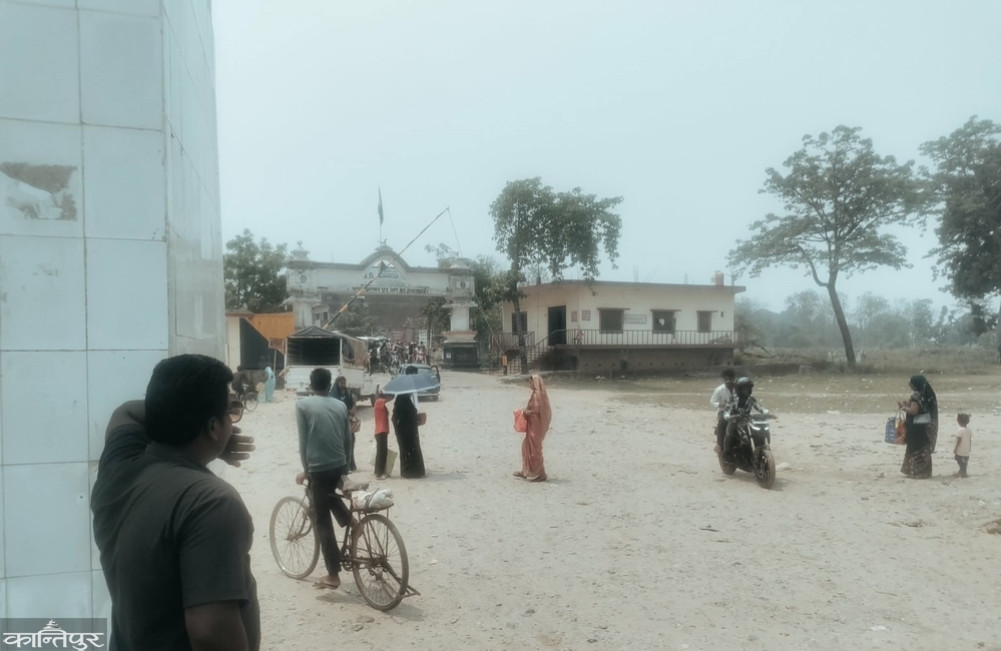
Nepali traders along the border are excited as the number of Nepalis visiting Indian markets to shop has decreased after the government imposed mandatory customs duty on goods worth more than Rs 100. Locals, however, are complaining of hardship and high prices.
We use Google Cloud Translation Services. Google requires we provide the following disclaimer relating to use of this service:
This service may contain translations powered by Google. Google disclaims all warranties related to the translations, expressed or implied, including any warranties of accuracy, reliability, and any implied warranties of merchantability, fitness for a particular purpose, and noninfringement.
The government has started collecting duty at the customs point when purchasing goods worth more than one hundred rupees from the border Indian market.
The Armed Police Force is using microphones in the border area to inform that customs duty has been made mandatory on goods worth more than one hundred rupees. Security personnel and customs officials have tightened the inspection of goods at the border. This has reduced shopping at the border market. After the restrictions on Nepal, the border Indian markets have started to become deserted. The Sunauli market in Rupandehi, India, on the border with India, has not been crowded for a week. Apart from those traveling between Nepal and India for other purposes, the number of people going across the border to buy goods has decreased.
The Sunauli market, which is always bustling with consumers who reach Sunauli from different districts for shopping, is now deserted. Bhairahawa Customs Office Chief Harihar Poudel said that strictness has been continued at the border checkpoint to discourage those who buy goods in large quantities without customs duties for household purposes. ‘Due to the strictness, the number of Nepali consumers who used to go to Indian markets for groceries has started decreasing,’ Poudel said. ‘Smuggling, which used to be carried out through the border checkpoint several times a day, has stopped.’ He claimed that the measures have also started having a positive effect on controlling revenue leakage. There is no problem in bringing goods purchased in normal quantities from the Indian market along the border. Customs officials and security personnel deployed at the border checkpoint are only strict on goods brought for business purposes in the name of household expenses.’ An employee of Hari Om General Stores in Sunauli, India, said that the number of Nepali customers has decreased by 75 percent compared to before. While Sunauli traders are disappointed with the restrictions imposed at the border checkpoints, Bhairahawa traders are excited, saying that it will encourage legal trade in the country.
Prachin Thayb, central president of the Customs Agents Federation Nepal, said that the restrictions imposed at the checkpoints have discouraged illegal trade. ‘Such restrictions are beneficial for Nepal and India,’ he said, ‘With the restrictions imposed at the border, the turnover of retail items at the customs has started increasing and the customs warehouses have started filling up.
He said that there will be restrictions at the main checkpoints, but there have been complaints that smugglers are taking advantage of the open borders on both sides. He said that with the restrictions imposed at the checkpoints, it is necessary to search the shops and warehouses of Nepali traders. He said that it is necessary to investigate the businessmen in Nepal who are supporting the smuggling by purchasing goods without customs and invoices that are being smuggled from the border Indian market.
Local consumers have complained that the prices of daily necessities have increased drastically in grocery and retail shops in Bhairahawa and surrounding areas after the restrictions were imposed. Netra Prasad Acharya, President of the Siddhartha Chamber of Commerce and Industry, said that the restrictions imposed at the border have started having a positive impact on domestic businesses. “If any businessmen increase prices without reason, the market should be monitored regularly and action should be taken,” he said, adding, “We are ready to support the government.” The general public should not face problems at the border. Business transactions cannot be done without customs clearance.’
The restrictions imposed on the border checkpoint at the Fareni market, which has been open to Nepali consumers for two days a week on the Meudihawa area of Siddharthanagar Municipality, have resulted in a very small number of Nepali consumers reaching India. Armed Police Force 27 Gulma Rupandehi Chief SP Nawaraj Bohara said that the restrictions at the checkpoint have been continued and there have been no obstacles or disputes in the checks. ‘In some cases, practical aspects have been considered,’ Bohara said, ‘Locals go to Fareni market only after evening for shopping. The number of people who go to shop from far away is not as high as before.’
The restrictions on the checkpoint have reduced the number of people going to India from Biratnagar and other areas in Morang to buy daily necessities. India’s Panitanki, Naxalbari, Siliguri and Jogbani checkpoints are not as bustling as before. Raghubir Gupta, a trader at the border Indian market Panitanki, said, "If the restrictions are strictly enforced at the border crossings towards Nepal, our markets will definitely dry up. Nepali consumers have already stopped coming." Tapan Ghosh, another trader at Panitanki, said that business has started declining with the decrease in the movement of Nepali consumers.
Locals have become angry, saying that it is impractical to impose taxes on ordinary purchases when prices are rising in the market. Some have also started complaining about the behavior of security personnel. "The price is so high that we used to get goods for two paisa less, now that too has stopped," a housewife from Mechinagar lamented, "Security personnel have started harassing us a lot even when we bring goods for our homes."
Demand to stop organized smuggling
Tensions have arisen at the border crossings in the border districts after customs duty was made mandatory on goods worth more than one hundred rupees imported from India for various purposes. After criticism of this decision, the customs office at the border is allowing household goods to be imported. However, they are tightening the rules on goods imported with the aim of evading customs. Although the strictness of paying customs duty on goods worth more than Rs 100 has discouraged Nepali consumers from shopping in the Indian market, it has not eliminated it.
A large number of ordinary people are going to the Indian market of Raxaul, connected to the country's main border, Birgunj, for shopping every day. Consumers are claiming that they are not aware of the government's strictness at the border. It is common to see arguments between consumers and the police, who demand that they be able to bring in any goods easily as in the past. Stakeholders have expressed concern that despite such strictness on the part of the general public, organized smuggling of clothes and daily necessities from India to Nepal has not been controlled.
Senior Vice President of Birgunj Chamber of Commerce and Industry Madhav Rajpal says that the government's strictness is welcome and that it will improve the economic performance of the border Nepali market. 'Such strictness will increase the trade of clothes and daily necessities in Birgunj,' he said, 'However, it will be meaningless if organized smuggling is not controlled on the 1,700-kilometer-long open border with India.'
Even though there are obstacles to transporting goods in wheelchairs and women bringing daily necessities, the new rules will not be meaningful until smuggling through the open border at night without the eyes of security personnel is controlled. He suggests that a list of daily necessities smuggled from India to Nepal should be made and an environment should be created for such goods to be legally imported by charging customs duty and value added tax equivalent to the GST levied in India. Rajpal says that revenue can also be collected by charging income tax and other fees from goods that are legally imported in this way.
The border restrictions have been tightened for years, and the 'destination weddings' held in Nepal's border hotels from Bihar, Uttar Pradesh and West Bengal in India have also stopped, which will also affect Nepal's hotel and tourism industry, Rajpal said. Armed police deployed on the border have been making people pay mandatory customs duty if they are found bringing goods worth more than Rs 100. DSP Mohan Niraula, spokesperson for the Armed Police Force here, claims that this strictness has reduced the crowd at the border. 'There is no longer the wave of people coming from across the border after shopping,' he said. 'We are making those who deliberately buy a lot of goods and bring them here pay customs duty.'
District Police Parsa spokesperson DSP Hari Bahadur Basnet claims that the Nepal Police is working to control illegal smuggling. Deepak Agnirath, a journalist based in Raxaul, an Indian city on the border with Birgunj, says that the excitement of Raxaul Bazaar has recently diminished as Nepali customers flock to Raxaul Bazaar. He said that although there are some shoppers in the Raxaul market right now because it is the wedding season, the charm of Raxaul may diminish once the season ends. He said that while the current rules directly affect ordinary Nepali consumers, it is not right to leave organized smuggling of clothes from India to Nepal unchecked. “Locals of Indian and Nepali villages on the border are directly involved in smuggling clothes,” he said. “Only if this is stopped can the Nepal government achieve its desired objective.”
An officer at the Birgunj Customs Office claimed that even if the new rules do not immediately increase revenue collection, their long-term effects will gradually be seen. ‘This rule increases local trade in the Nepali market, improves the economy in the domestic market,’ the officer said, ‘There has been an increase in awareness among the general consumer that domestic goods should be promoted and that they should shop in the domestic market.’ He said that the rule, which was published in the gazette in 2080, is now being strictly implemented. He said that with the current strictness, the general Nepali consumer will feel safe from being cheated, unsafe in the Indian market and will also feel protected from the mistreatment by the police at the border.
Demand for facilitation
After the government tightened the import of goods worth more than one hundred rupees from the Nepal-India border, residents of the border area of West Nawalparasi have demanded facilitation in this. The border residents have complained that they have been buying goods from the Indian market for household purposes for years and are being hit by the sudden tightening. Due to cultural ties across the border, citizens from both sides bring goods from each other's countries.
Now, even when vegetables, pulses, and household goods for household purposes are brought, the security personnel at the border or force them to pay customs duty, said Palhinandan Rural Municipality Munimlal Gupta. 'Even when we bring sugar, soap, sugar, and tea leaves for our homes, the armed police have stopped us at the border,' he said. 'We are forced to go to the Indian market to bring goods in the hope of saving some money.'
The administration has also tightened restrictions on household goods, saying that the same person has been bringing and selling goods for household purposes for the tenth time in a day at the border. After tightening restrictions at the border, people's representatives have demanded that the district security personnel facilitate the actual bringing of goods for homes and necessary goods for weddings and fasts. However, people who transport goods multiple times in a day with the intention of smuggling should be identified and dealt with according to customs rules, said Bikram Khanal, a member of the House of Representatives. ‘Nepal-India relations are like a relationship of bread and daughter.’ He said, ‘We should not restrict the normal gifts brought to relatives when visiting and visiting them.’ However, those who transport and sell goods repeatedly in the name of family members and smugglers should be prosecuted and made to pay customs duties.’
There are complaints that it is impractical for ordinary people coming from other checkpoints in the district except Maheshpur customs to cross a long distance to clear their goods. SP Gobinda Khati of Armed Police Force No. 26 Battalion, Nawalparasi, said that they have been working as per the Center’s instructions.
Banke Chief District Officer Dil Kumar Tamang said that strict checks have been carried out at the Jamuna checkpoint on the Nepal-India border to control smuggling. He informed that security agencies have intensified patrol operations in recent days by increasing surveillance. According to Pradya Tamang, the existing customs law has been strictly implemented as per the government's instructions. He clarified that although the system of mandatory customs clearance for bringing goods worth more than one hundred rupees is old, special emphasis has been placed on its implementation now. 'There is no complete ban on bringing goods from the Indian market,' he said. 'When bringing goods worth more than the specified limit, it should be done only after paying customs duty.'
He said that security agencies are working round the clock to control smuggling activities taking advantage of the open border and work is being done to seize suspicious materials and hand them over to the concerned agencies. He also said that the people involved in smuggling have been identified and urged the general public not to engage in such activities. He said that market monitoring would also be made effective. Stating that the role of industrialists and businessmen is important in maintaining a fair market system, he warned that the concerned agencies will take strict action if there are activities such as black marketing, artificial shortage (carteling) and others. Pradya Tamang has clarified that the Internal Revenue Office and other bodies will regulate businesses that do not issue invoices and urged all stakeholders to follow the rules.
Caption: Maheshpur checkpoint in West Nawalparasi. After stricter measures were taken at the checkpoint to prevent the transportation of illegal goods, traffic has now decreased. Photo: Navin Poudel