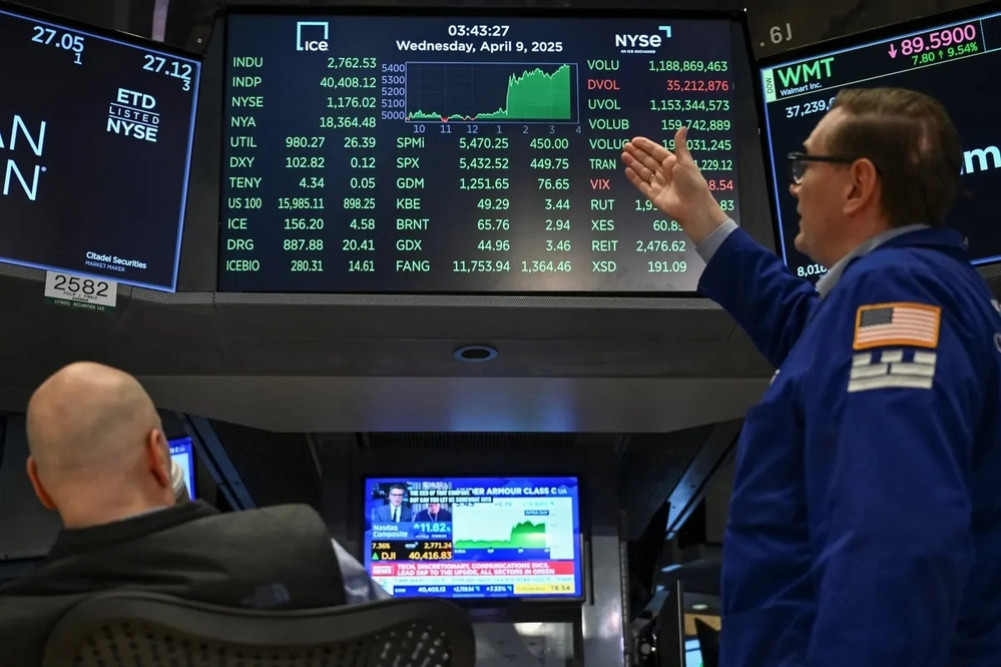
Shortly after becoming president, Donald Trump raised tariffs on several countries, aiming to reduce China's growing trade influence but also imposing tariffs on friendly countries. Trump then hesitated and reduced tariffs on some countries.
We use Google Cloud Translation Services. Google requires we provide the following disclaimer relating to use of this service:
This service may contain translations powered by Google. Google disclaims all warranties related to the translations, expressed or implied, including any warranties of accuracy, reliability, and any implied warranties of merchantability, fitness for a particular purpose, and noninfringement.
The global economy in 2025 saw neither a financial crisis to worry about nor any significant improvements to encourage. While not exactly optimistic, economists have pointed out that many aspects of the economy have been slow but stable this year. Amidst the slowdown, geopolitical interference, and policy tensions in the effort to recover from the impact of the Covid pandemic, global markets are seen as trying to stabilize themselves for 2026.
The World Economic Outlook released by the International Monetary Fund in July 2025 projected global growth of 3.0 and 3.1 percent in 2025 and 2026, respectively.
While this was lower than the historic 3.6 percentage points before the COVID pandemic, it was a sign of relative stability given the economic, political and other shocks the world has faced since then. The Fund’s analysis assessed a diverse and uneven pattern of economic growth. It showed relatively sluggish economic activity in major economies and rapid economic growth in emerging markets, albeit with challenges.
Looking at the markets since then, progress or failure has been determined by who has been able to adapt to the latest economic and political conditions. This year has been good for those countries and companies that have been able to prepare themselves for a time when money has become more expensive, geopolitics has become more volatile, and technological progress has been far ahead of regulation. David Rainey has analyzed the year spent trying to find that balance in The Economist's 'Drum Tower' podcast.
America's big and leading companies appear stronger and more stable than many expected, according to a Financial Times report. The year began with uncertainty about what the future would look like with a new president coming in. Wall Street moved forward with various small and big decisions by US President Donald Trump.
By the end of the year, major US indices, especially the technology sector, had reached a significant growth rate, and this year US companies touched a market value of 50 trillion. Immediately after taking office on January 20, 2025, Trump announced on April 2 that he would increase tariffs on many countries.
This impact on the global trading system was very profound. The US goal was to reduce China's growing trade influence. But it also imposed tariffs on its allies. As a result, other countries were forced to align with China. Then, Trump, who hesitated, gradually reduced tariffs for some countries.
As Bloomberg's news titled 'Big Tech 2025 CapEx May Hit $200...' said, rather than the market being buoyed by a surge in demand, it can be understood that earnings have increased as large companies have been able to adapt to fewer workers, more automation and tight supply chains amid the AI boom.
Rather than consumer optimism, positive indicators are being analyzed due to business price controls and cost savings. The US general market in the US is estimated to have risen by more than 2.7 percent. However, according to data through November, annual inflation was 2.7 percent, while in September this rate was 3.0 percent.
As expected, the biggest upheaval this year was seen in the technology sector. Silicon Valley's billionaires, who have been cutting jobs in large numbers since 2023, have become richer this year. Global interest in artificial intelligence and its growing use have boosted the profits and market value of companies like Nvidia, Meta, Microsoft, Amazon, and Google. American chipmaker Nvidia, which has been riding the AI boom since the beginning, has achieved unprecedented heights amid fears of an AI bubble.
The Wall Street Journal said in its annual review, “This year’s surge in AI companies and products is more like the dawn of cloud computing than the dot-com era, with very few winners but very high stakes.” Investment competition among big tech companies, believing that AI will revolutionize the technology sector, is still ongoing. However, after the market value of AI companies continued to decline in November, talk of an ‘AI bubble burst’ suddenly flared up. AI companies have reemerged in the capital market amid concerns that it will not only cause economic instability, but also cause financial instability.
While big companies announced hundreds of billions in new investments, infrastructure, data centers and partnerships, markets in various regions, especially smaller countries, struggled. Small and medium-sized businesses and startups in Europe, Asia and other parts of the world continued to face challenges due to weak consumer demand, rising borrowing costs and shrinking profits. Reuters’ analysis noted how rising borrowing costs and interest rates have prevented manufacturers and entrepreneurs, especially those who rely on credit, from moving ahead with their business expansion plans.
As billions in profits continue to be taken for granted by those with access to technology, significant capital and data, companies in many countries have resorted to measures such as halting hiring, delaying further investment and relying more on short-term work.
The social gap between the haves and have-nots has been evident in the global economy this year, and economists such as Joseph Stinglitz and Danny Rodrick have described it as a structural shift rather than just an economic cycle.
Analysts believe that in 2025, we will have to think about geopolitics many times more than we did a decade ago when making business decisions. The trade war between the US and China has expanded rather than subsided. Countries like India have also started to fall under its grip. After American companies reduced their advanced technology markets and exports to countries like China and Russia, China has continued to try to find alternatives and respond to American pressure.
Amidst the US-Russia-Ukraine tensions, neighboring India's trade relations with the US have also deteriorated. The lingering tensions in various countries in the Middle East, including Israel-Hamas-Houthi, have further affected this year's economy. This has led to concerns about new rules added to the 'investment principles' and increasing US intervention in the open market, according to Martina Bett's news published in 'The Sun' magazine.
The serious impact of AI on the demand and supply of the job market is also one of the main topics this year, according to ABC News' analysis. Advances in AI and automation have changed the way millions of people work, as well as the way workers are evaluated. The use of AI in creative markets like cinema, music, and writing has become a household name this year. The costs of advertising, journalism and media, software, customer service, design, and data processing have plummeted. These once-stable and secure jobs are at risk from AI, the New York Times wrote, “The decline in entry-level jobs has increased productivity and changed bargaining power.”
The ease of technology-friendly work has added to the challenges faced by traditional and commodity-producing industries this year. While Europe’s generally stable manufacturing sector appeared to face additional problems this year, the challenges of the real estate sector in countries including China continued. The work style that has become ‘remote’ since Covid has gradually moved towards a full return to the office. Bloomberg wrote, “The year 2025 was not easy for businesses established on the basis of cheap credit, large physical infrastructure and stable consumer behavior.”
Overall, this year was a tough one for big technology and multinational companies, energy businesses, security and arms businesses, and sectors with global political reach. Small exporters, more labor-intensive products, heavily indebted sectors, and countries with limited economic expansion access increased the challenge. Inequality between countries, companies, and workers became more pronounced. This led to a deepening of microeconomic tensions while macroeconomic indicators remained relatively stable.
The year 2025 was a mixed one for Nepal. While key economic indicators were positive, political instability, protests, and other events are said to have dampened market sentiment. The Asian Development Bank has projected Nepal's economic growth rate to be 4.4 percent for 2025, while the World Bank has estimated it at 4.6 percent and the International Monetary Fund at 4.3 percent. Currently, foreign exchange reserves have exceeded 3.5 trillion, covering 17.4 months of imports, while the average market price of goods and services purchased by the general public (consumer price inflation) was 1.11 percent in Kartik, according to the latest data from the National Bank.
Nepal's economy, which appeared to be externally positive in 2025, was affected by challenges such as non-increase in credit flow, failure to meet expectations for foreign direct investment, an increase in public debt by more than 1 trillion, and lack of improvement in capital expenditure. As the year 2026 approaches, Nepal's economic sector will watch the upcoming elections and the political stability they can provide with interest. In addition, the Nepalese economy will not be able to remain untouched by the increased AI race in the global economy, geopolitical risks, and the shrinking reach of globalization.