An announcement that the dual expenditure incurred by the state under various social health security programs will be integrated into the national insurance program
We use Google Cloud Translation Services. Google requires we provide the following disclaimer relating to use of this service:
This service may contain translations powered by Google. Google disclaims all warranties related to the translations, expressed or implied, including any warranties of accuracy, reliability, and any implied warranties of merchantability, fitness for a particular purpose, and noninfringement.
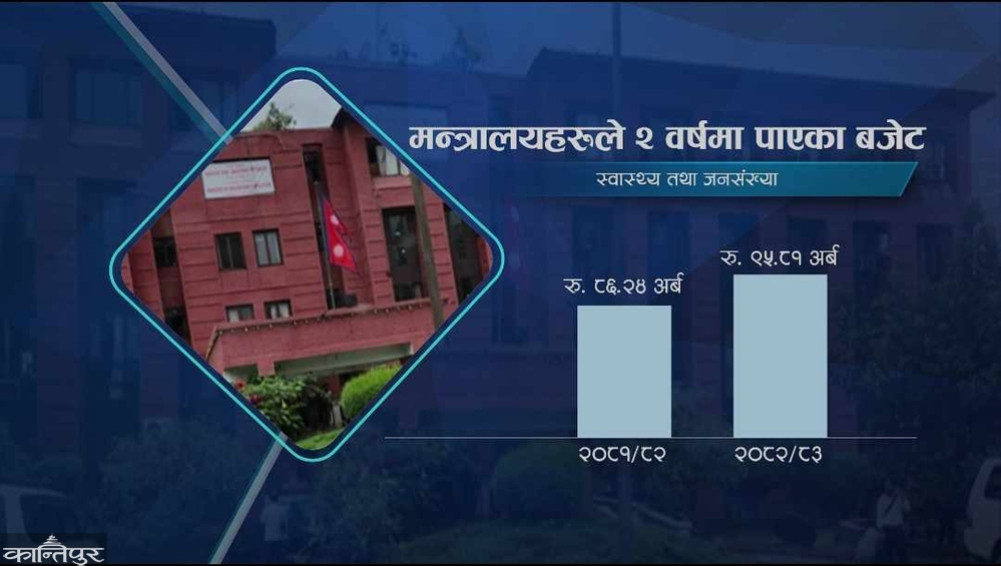
The government has increased the budget for the health sector by only 0.2 percent next year. The government has allocated 95.81 billion rupees for the health sector for the coming year. Compared to the current financial year, this amount is about 9.57 billion rupees more.
For the coming year, the government has allocated 4.88 percent of the total budget to the health sector. Although the government has put forward the slogan 'Healthy Nepali, Healthy Nepal' in the budget, it has not brought any other exciting programs and innovations. In the budget, the old promises of making health facilities convenient, accessible and accessible are only mentioned in new words .
It has been announced that the dual expenses incurred by the state will be integrated into the national insurance program under the social health security program under various titles run by the Ministry of Health and Population. It will be a challenge for the ministry to include the facilities that are currently being distributed under various titles under the health protection program in the insurance.
Although the National Health Insurance Board estimates that the amount to be paid will increase to 24 billion by the end of this financial year, 10 billion has been set aside for insurance. However, there is a promise of the budget that by the end of this financial year, the insurance claims will be tested by a third party. The health insurance program will be restructured. The effective implementation and scope of the legal provisions regarding this will be expanded . The benefits package of the insured will be gradually increased," the budget states, "the insured will be provided with the facility of choosing different policies . Duplication will be removed to prevent misuse of insurance facilities, leakage control and institutional governance will be maintained.
The government, especially in the National Health Insurance Program, hopes to make major structural reforms through this year's budget, but has not put forward any concrete plan. Apart from some changes in health insurance, the previous health programs have been continued in the next year's budget. It is mentioned in the budget that specialized services will be expanded with skilled doctors and modern equipment for the diagnosis and treatment of non-communicable diseases including high blood pressure, heart, diabetes, kidney, liver and cancer.
It is also said that the treatment of heart disease and cancer will be expanded in all seven provinces. These programs and plans were also mentioned in last year's budget. Although the services of heart disease and cancer treatment were started in some regional hospitals last year, their sustainable management has not been possible. In addition, arrangements for intensive screening of non-communicable diseases in Faguna have also been mentioned in this year's budget.
Health Minister Pradeep Poudel has been saying that all health services should be provided through the National Insurance Program, so 2 billion 60 million rupees have been allocated in the budget to ensure the free supply of medicines from basic hospitals. Which is a complete contradiction in itself . In addition, it is stated in the budget that the latest technology will be adopted for the diagnosis and treatment of sickle cell anemia, which is a serious health problem in the Tharu community. The most reliable treatment for sickle cell anemia is a bone marrow transplant. In developed countries, the use of gin therapy has also been started for its complete resolution. However, there is no mention of bone marrow transplant and gene therapy in the budget.
The government has prioritized burn treatment in the next year's budget like this year. "In order to provide quality burn treatment services in the country, a specialized burn treatment department will be operated in one government hospital of all provinces," the budget says, "a modern room will be expanded for the intensive treatment of burns at Veer Hospital." In this year's budget, the intensive treatment room for burn treatment will be expanded at Veer Hospital, but it has not materialized.
This year, the government has allocated more than 15 billion rupees for basic hospitals under construction and has allocated 11 billion 24 million rupees for the next year. Similarly, the government has arranged capital grants to increase the quality and service of Kirtipur Jalan Hospital, Dhulikhel Hospital, Kathmandu Institute of Child Health, Tilganga and Ranambika Eye Hospital in the coming year.
In the next year's budget, it is said that infrastructure development, equipment and manpower will be managed to upgrade the National Public Health Laboratory in Teku to an international level laboratory where all types of sample tests will be conducted. The government hopes that this will end the situation of having to send samples abroad for testing.
Health and Population Minister Pradeep Paudel has responded that he is satisfied that many of the programs announced and implemented earlier have been included in the budget. He expressed his happiness that the finance minister approved his proposal to increase the tax on tobacco products and increase the insurance allowance.