We use Google Cloud Translation Services. Google requires we provide the following disclaimer relating to use of this service:
This service may contain translations powered by Google. Google disclaims all warranties related to the translations, expressed or implied, including any warranties of accuracy, reliability, and any implied warranties of merchantability, fitness for a particular purpose, and noninfringement.
Butwal-Narayangadh road is being constructed since last 6 years. We are hopeful that the one-way road will be operational this year. But such an assurance does not run the business. Running a business requires a different speed.
If it takes too long to achieve any progress, that progress is meaningless . We need to increase our speed capacity . Everyone has heard that India is building 40 km of 6-lane road every year.
Unless we increase the pace of infrastructure construction, the competitiveness of our industries will not increase . Only after establishing an industry, the meaning of the industry is known to the businessmen . After starting the industry, its cost and operating expenses should be minimal . Nepal is a small country between India and China, whose consumption is also small. The capacity of the industry is also small . If the
industry is not supported by the cost of establishment and operating expenses, we cannot survive. Although the government provides two-level customs protection, the production cost of the goods is high, and the traders sell the goods by importing them.
Talking about slow infrastructure, in the first phase, ICP with trains should have been constructed at Lumbini after Veerganj . But without studying, the second phase was built in Biratnagar and the third in Nepalgunj.
If I have money, I will 'calculate' which business will bring the highest return . Then I invest . If the government has limited resources, it should also invest in a calculated manner.
Two industrial estates have been in Lumbini for 20 years . Which was inaugurated twice. But due to the unstable policy, the industry has not been able to be built there. Because there is only one basic mantra that motivates businessmen, profit .
When investing, I borrow this much amount from the bank and by earning this money, I will pay the bank loan and run the household, and no industrialist could fit in the industrial sector . The
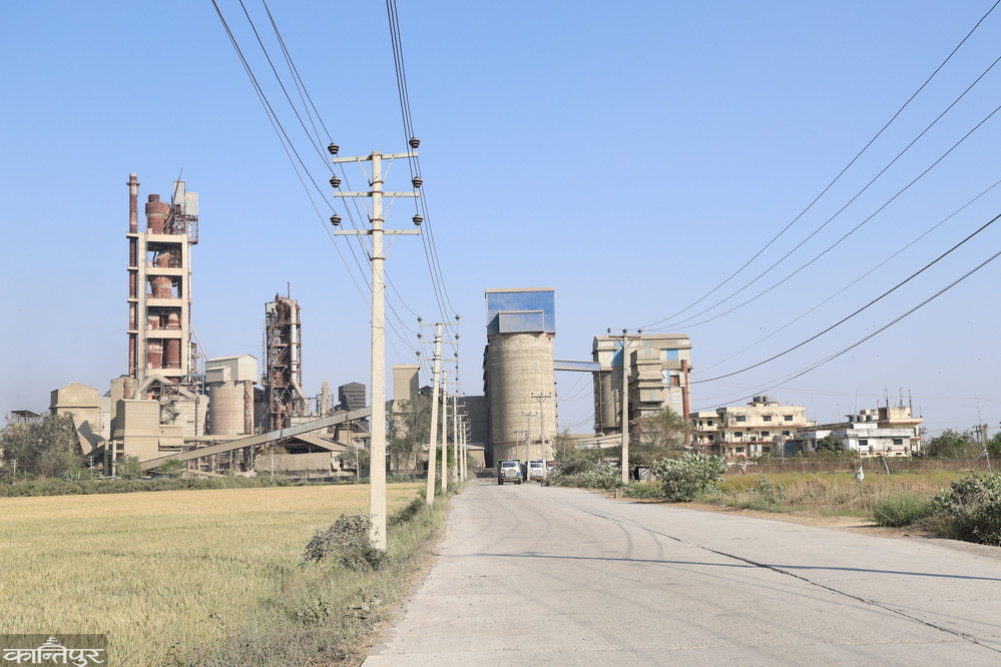
industry needs land, electricity, roads with railways . More than 50 percent of cement is produced in Lumbini province. According to the Department of Mines, there are approximately 1.1 billion tons of limestone mines in Nepal. Most of them are in Lumbini. Based on that, cement industries have been established here.
If you go south from Lumbini, there is a limestone mine only 1000 km away. Therefore, there is a great possibility of cement export from Nepal to India.
But there is no Integrated Security Checkpoint (ICP) network with rail . Although cement is a low-cost commodity, the cost of transportation has a major impact on it . If one bag of cement is placed in a truck and delivered to Delhi, India, the cost of transportation is 50 rupees per bag. Sending it by train costs only Rs. 25 .
By doing this, our competitive business increases . The government should reduce both the cost and operating expenses of the industry by facilitating the infrastructure . The industry will be limited in conversation until they see the certainty of profit . Industrial development is very difficult.
The first challenge for us to export cement in India is infrastructure. 15/20 years ago we were 100% dependent on cement imports . Gradually, the government promoted the limestone-based industries in Nepal.
As a result of delivering electricity to mines and industries, today we have become 100 percent self-sufficient in cement. We have replaced the import of cement worth one million metric tons. The challenge is that after we became self-sufficient, we started exporting cement to India.
Nepal Standard (NS) certificate is given in Nepal. The same type of cement has to be exported from India with a Bureau of Indian Standard (BIS) certificate. It has to be renewed every year. But since 6 months BIS certificate failed and not renewed. Cement is also a product of faith.
That market is gradually disappearing. With the support of the government, we became self-sufficient in cement from imports. At present, about 2 million metric tons of iron products are imported in Nepal . The price of which is equal to 12 thousand crores. Iron is the second most imported commodity after petroleum. Like limestone, there are plenty of iron mines in Nepal.
At the beginning of the government, the concept was that we would make industry and do business by ourselves . The government should facilitate business . Doing business is the job of a merchant. The government will collect taxes by making rules and laws. The government should pay attention to making rules and laws.
We replaced the entire cement import . If the government supports this too, we can make 70-80 percent import competitiveness of iron products within the next one and a half to two decades. Perhaps we can export it within two decades. We have such an abundance of minerals available . There are hundreds of cement-related mines in operation now. Thousands of trippers have run on it . Drivers are employed . Machines are used .
If one industry runs, other industries also run . Classification of industries is necessary. If 80 to 90 percent of Nepal's raw materials are used, that industry will run . If less than 30-40 percent of Nepal's raw materials are used, such an industry will not always be competitive.
There should be strong infrastructure to export cement to India and there should be a permanent solution to BIS. Now there is a market of 500 million metric tons in India . 50 million tons of cement goes through Nepal . There is not much problem if it is coordinated. In this, the government of India should do homework for a long time and create an environment to move forward.
(Thoughts expressed by Agarwal, Chairman of the Industry Committee of the Federation of Nepalese Chamber of Commerce and Industry in the first session of the interactive program on 'Lumbini's Power', 'Slow Infrastructure and Unstable Policy, Challenges of Production')