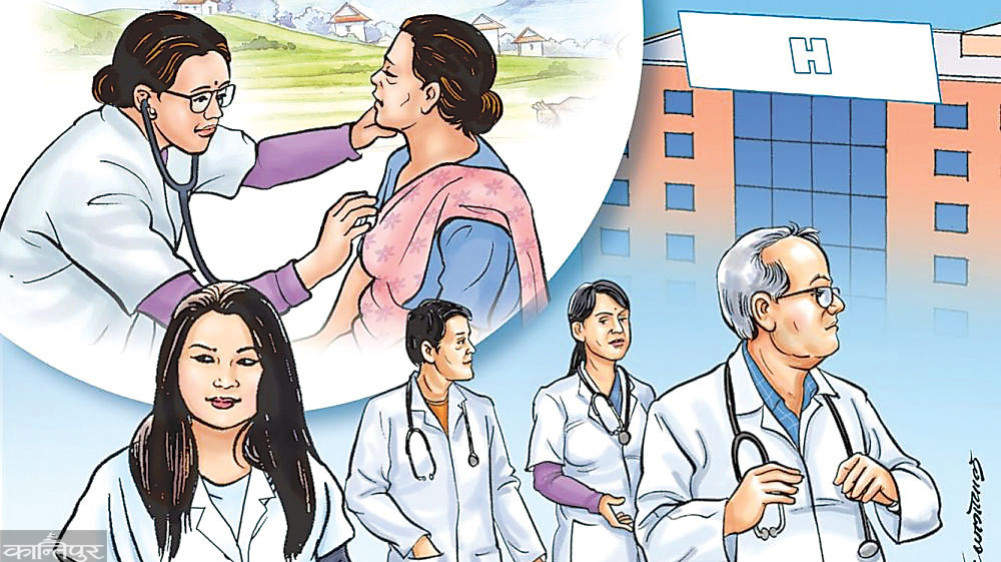
Patients can be tested more efficiently than before, time can be taken through the online system, there has been some relief in the situation of having to wait for years for operations, hospitals have become relatively clean, it has become somewhat easier to get morning and afternoon services.
We use Google Cloud Translation Services. Google requires we provide the following disclaimer relating to use of this service:
This service may contain translations powered by Google. Google disclaims all warranties related to the translations, expressed or implied, including any warranties of accuracy, reliability, and any implied warranties of merchantability, fitness for a particular purpose, and noninfringement.
They are trying to establish a commentary that nothing has happened in the country now. Here, only dissatisfaction is heard, different from the reality that something can be done, it is possible, it is us who do it. Maybe not everything is as we thought. We have yet to make progress to meet the expectations of the common man.
But in the meantime, the country has achieved many important achievements, creating an environment for building a beautiful future. However, we have not been able to establish that reality.
There is a tendency to portray only the negative so that the good things that happen in the country are overshadowed. However, something must be done to overcome adversity and turn despair into hope. We believe that it will take time but success will definitely come. For this one or the other should make a sincere and meaningful effort. In the midst of problems, complications and disappointment, we have started the same sincere efforts in the health sector. As we know, something has happened but it is not complete.
There have been problems in the health sector for years. Complexity in service delivery, increasing number of patients in hospitals, inadequacy of manpower and resources, poor performance of health insurance, all these are our present. These problems cannot be solved in a day or two or a month like a magic wand. When the citizens hope more than we can, the result may not be as expected. However, we are making sincere efforts day and night to bring some change to the point of raising hope. Even if it does not transform, our steps will be positive to some extent in the way of increasing citizens' access to Nepal's health services and making them relatively standard and diverse.
Citizens who have experienced many problems may feel the same even now. The line at the hospital may look similar. However, to be honest, the efforts started to reduce queues in the hospital have already started yielding some meaningful results. Patients can be examined in a greater capacity than before, they can take time through the online system, there has been some relief in the situation of having to wait for years for operations, hospitals have become relatively clean, it has become somewhat easier to get services in the morning and afternoon.
Our government hospitals are moving towards reducing the pressure on health services by providing maximum services with limited resources by offering two shifts and even overtime for some fee. We are trying to give a decisive path to the campaign of service expansion and quality improvement, which has been started by making additional arrangements through the budget. Attraction is increasing in government hospitals.
is because of trust in government service. It is necessary to organize it. Our steps are moving towards it. We have launched Hello Health 1115, a free mechanism to listen and address citizens' complaints. It has a system where citizens can submit their complaints through any available social media and digital technology. This will help to solve the complaints of the citizens who have not reached our attention immediately and in the long term.
has not been an effective mechanism for problem solving in the past. Now the mechanism we have established has instilled in the citizens the belief that there is a government that at least listens to us. The hope it has raised in the early days has given us confidence that this mechanism will be effective in reducing healthcare complaints in the future.
Some topics may not give results as well. Such changes require policy reforms. And, far-reaching policy changes can have even more tangible results. In the case of health insurance, reaching the 500,000 limit that we have put forward may seem like a pipe dream now. But we have not only said that it should be delivered, we have also shown the way that it is possible. In order to reach that goal, we have started policy reforms.
Even if you become a member of insurance, the problem of not getting medicine at the hospital, having to wait in long queues, not getting as much treatment as you want, having to go to your permanent address to get treatment at your place of residence, etc. can only be reduced by policy reforms. Based on the suggestions of the working group formed to implement this, we have made a policy decision to ensure that insurance is a basic point at every level.
It has ensured that everyone can get basic facilities through insurance at their own level. In addition, we have now started the homework to carry out the necessary policy reforms for those who live outside their permanent address to get services from their place of residence.
The lack of resources provided by the state and the lack of capacity of the Health Insurance Board to effectively monitor the use of resources has resulted in the problem of not being able to pay the health insurance amount on time. For this purpose, building a safe insurance fund based on citizens' contributions, integrating all health assistance programs that are invested by the state, providing the assistance currently provided by the state to citizens through health insurance, but developing a one-door system, all state representatives and employees becoming members of the insurance, provided by the state through tax funds. If the amount to be increased and the contribution of the three levels of government to the health insurance will continue, even without more investment than now, a single insurer will be able to get health facilities within the limit of 5 lakhs announced by us. is.
Once health insurance coverage is expanded and implemented to full capacity, we will have two major health systems. First, free basic health care through the local level. Second, the health insurance system for the treatment of expensive, complex and serious diseases (secondary and specialized). Through these two systems, an integrated and strong health system will be developed in the country by providing necessary health services to the citizens. To make it more effective, the duplication of medicine and treatment services provided through both systems should be eliminated and organized.
As discussed above, an important starting point for providing universal healthcare to the general public is – health insurance. Standing on this foundation, we can ensure the quality of 'Universal Health Coverage', UHC. For that, we should all have the same opinion - there should be an integrated policy of the state in the health sector, massive investment, implementable action plan and strong will.
Based on the positive motivation and commitment of the Prime Minister himself, I can now say that if the resources spent by the state on health are integrated, there is strong cooperation between the three levels of government and some policy, legal, structural and procedural issues are met, the goal of providing health insurance worth 500,000 will be achieved. We are hopeful. This means that decisive steps will be taken in the field of insurance management of citizens in the distant future without burdening the state.
Although it looks like something ambitious, I am confident that Nepal will be successful in successfully implementing health insurance, which has been implemented by around 150 countries in the world. The past experience of me and my family receiving services in government health institutions in most cases is also prompting us to diversify and specialize the services of government health institutions, which have more trust and expectations of the general public. Currently, we have succeeded in taking the heart treatment, organ donation and cancer treatment services focused on the federal capital and some big cities to the provincial level in a short period of time.
cancer treatment services have now reached all seven provinces of the country. The journey to reach the regional level of heart and organ donation services has already started. In this way, according to the concept of federalism, we believe that if specialized treatment services can be reached at least up to the state level, the expenses of common citizens will be reduced and the capacity of those hospitals will also be increased. The state has been collaborating with the private sector in the specialization of services.
There has been an attempt to develop some hospitals as models. Diversification, specialization and expansion of this level of service is very difficult in terms of availability of resources and managerial challenges, but we are determined for its successful implementation considering the needs of the country and the state's commitment to the health of citizens. Due to the pressure of limited financial resources, we are not able to deliver enough equipment to our hospitals. However, we have implemented a policy of maximum utilization of available resources. Even after purchasing in the hospital, the unused and damaged equipment is being repaired at a very reasonable price with indigenous skills and resources, which is helping to improve the service.
If the National Innovation Center, which is engaged in building manpower to repair health equipment and repairs in the country, with the support given in our campaign, in the future, it will reduce the state's funds to foreign countries and open the way for the indigenous manpower to show the future in this field, that day will be a moment of joy for us. The role of the private sector in the production of manpower and service delivery in the health sector is commendable. In state building, the private sector and the government are two sides of the same coin. We should not forget the fact that the investment made by the private sector is also the investment of the state. We are worried about the growing number of doctors and health workers who are prepared by the state's large investment and do not want to stay in the country. It also intends to further emphasize our efforts to reduce
s. Keeping this situation in mind, we are emphasizing on the honest implementation of the minimum salary and services set by the state for the private sector doctors and the government-like subsistence allowance for the PG students. Along with increasing the salary, there is a need to pave the way for more students to study medicine without compromising on the quality of the existing structure. For this, we will work based on the suggestions of experts.
MBBS quota has been added this year in government hospitals with large investment such as Pokhara Institute of Health Sciences and Rapti Institute of Health Sciences. The provision brought by the National Academy of Medical Sciences to increase the number of faculty and students so that more than a thousand post-graduate health personnel can be trained is also raising more hope in us.
Apart from this, we are taking other necessary steps to build the trust of doctors, increase the quality of services and provide more services to the citizens. The suitability of Gandaki province in the health sector is quite evident. Due to the past experience and unique topography and favorable climate, there is a strong possibility to make Gandaki as a medical city.