We use Google Cloud Translation Services. Google requires we provide the following disclaimer relating to use of this service:
This service may contain translations powered by Google. Google disclaims all warranties related to the translations, expressed or implied, including any warranties of accuracy, reliability, and any implied warranties of merchantability, fitness for a particular purpose, and noninfringement.
The role of the state in all sectors of the economy remains as a facilitator and regulator. Therefore, it is always said that there should be improvement in all sectors of the economy. We want to increase production and productivity. However, there seems to be improvement in many places. Many efforts have been made to improve the economy. Our policies are very good. Problem three is the lack of effective implementation.
Nepal Rastra Bank as the economic advisor of the government has also been giving various suggestions to the government through 'Pre-Budget'. For 'pre-budget' suggestions, the National Bank collects suggestions locally in every province, consolidates them and submits them to the government. Many of these suggestions have been implemented.
Industry and business are interdependent. Also to trade Goods had to be produced, for that industry was needed. In order to operate the industry, it was necessary to do business to gather the means of production including raw materials. Therefore, industry and trade should be promoted together rather than separated from each other. Export promotion and import substitution can only be done by increasing domestic production.
There should be an increase in capital expenditure required for economic reform. However, the capital expenditure has gradually started to increase . Along with this, the work of connectivity and infrastructure construction should be accelerated. Policy stability is essential for protecting, developing and expanding industries. The role of the state is big in making energy assurance, investment-friendly environment . For overall economic development, all sectors in the economy should be developed in parallel. Although the main role of the government is in that, it is possible only through the coordination between all the agencies of the state . This is the responsibility of all of us. However, the role of the state is big for this.
Nepal Rastra Bank has made many efforts for the development and expansion of the industry sector. Various policy arrangements have been made by the National Bank, including the facility to allow industrialists to take loans in foreign currency for the payment of LCs, the facility to easily match foreign currency, the industries are allowed to import only one percent of raw materials as a bond. Foreign investors are also facilitated to bring in and withdraw money. Through this year's monetary policy, with the aim of developing and expanding the industry and business sector, what kind of interest loans, rescheduling and restructuring of loans have been arranged.
Indicators in the external sector of the economy are very strong. We have foreign exchange reserves equal to 21 trillion 52 billion rupees to cover 16 months of goods and 13.8 months of goods and services imports . We should be happy about this. Imports were banned during covid . That is why foreign exchange reserves have reached a very encouraging state. Its role is very important as foreign currency is needed for importing. Now the National Bank wants the foreign exchange reserves to be used for the import of materials that can be added domestically including industrial raw materials, machinery tools. Rastra Bank is only keeping foreign exchange reserves . It is the industrialists who use it for import.
The various dimensions of the domestic economy have to be looked at. Those dimensions are interrelated . There is a large number of people leaving the country for study and migration. Thus domestic demand has decreased as many young people leave. Due to the decrease in demand, the market has not been able to run as expected. However, many initiatives have been taken by the government and Rashtra Bank to overcome this slowdown in the economy. While making the monetary policy, we collected suggestions by separately interacting with the stakeholders of dozens of economic sectors including entrepreneurs, farmers, bankers. We have included in the monetary policy all the suggestions that the National Bank can make within its limits so as not to disturb the financial stability. Due to the easy monetary policy, the loan interest rate has now dropped to single digits. We have provided facilities for restructuring and rescheduling of loans. is given . We have arranged not to be blacklisted only on the basis of check dishonor.
Bank's capital has been eased. This has increased the lending capacity of banks and financial institutions. Overall, the National Bank will facilitate the economy to move forward through interest rates and loans. Financial stability and inflation control are also the main tasks of Rashtra Bank. The government has to work mainly for economic growth. The National Bank will only support through policy arrangements to achieve the target economic growth rate . The role of Rashtra Bank is not leading in that. Financial stability should not be forgotten while the National Bank is doing policy easing . Don't expect regulatory bodies to make everything easy. The regulatory body must always remain in balance. While we are easing policy, we keep in mind the safety of depositors . Rashtra Bank's first priority is saving savers' money.
Current capital loan guidance has made borrowers somewhat uncomfortable. After getting a loan from the bank, there is going to be a difficult situation that will never come back. In order to correct it, guidance on working capital loans has been issued. Before issuing the guidance, we collected suggestions from all government officials, including industrialists, banks and financial institutions. Even after the implementation of the guidance, some arrangements have been modified based on the suggestions of the stakeholders. Rashtra Bank is ready to make necessary changes based on interaction and discussion.
The National Bank can only improve the supply side of the economy, but not the demand side. It is the responsibility of the government to improve the demand side. In order to improve the demand, the government should take the lead and work in coordination with the subordinate agencies. For this, all the agencies should be disciplined, there should be vigilance in policy implementation . It seems that our economic environment (meaning ecosystem) is not on the right track. Therefore, if the stakeholders of the economy move carefully to improve the economy, the Rashtra Bank is always ready to 'hostemahaise'.
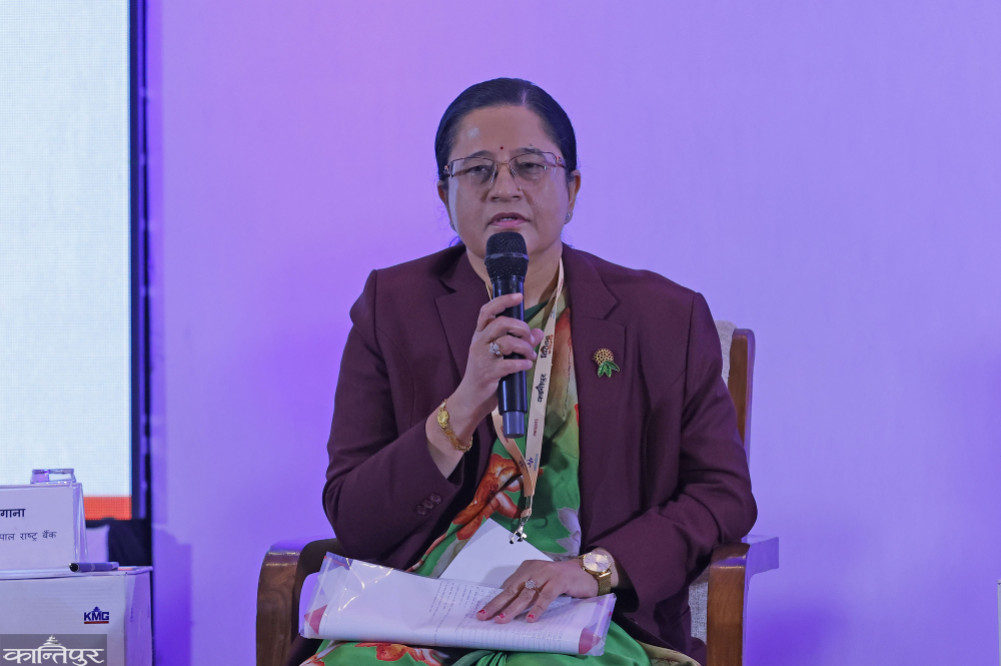
-An edited part of the views expressed by the Permanent Governor of Nepal Rastra Bank Timsina in the program 'Chitwan Chintan' organized by Kantipur Media Group.