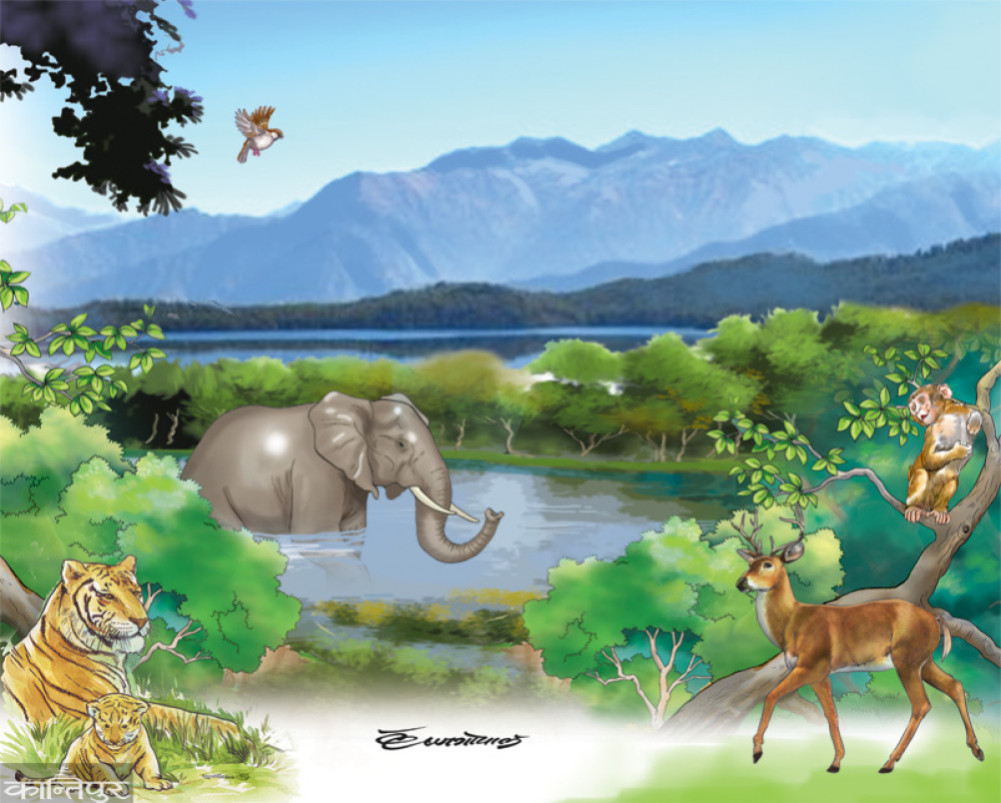
If you don't know how to walk while climbing mountains and swim in the sea, bad luck will begin, just like in conservation, if you don't make timely changes and strategies, human-wildlife conflict may increase and rare wild animals may disappear.
We use Google Cloud Translation Services. Google requires we provide the following disclaimer relating to use of this service:
This service may contain translations powered by Google. Google disclaims all warranties related to the translations, expressed or implied, including any warranties of accuracy, reliability, and any implied warranties of merchantability, fitness for a particular purpose, and noninfringement.
Chitwan National Park has been listed as a World Heritage Site due to its rare wildlife habitat and natural diversity. Chitwan was inhabited by tribal/tribal communities even before the establishment of the park. They lived around forests. It is understood that people choose forest for water source and grass growth because it is easy to earn a living from agriculture and animal husbandry.
The development of human civilization also looks like this. Water, forest and land are indispensable for the development of human civilization. Therefore, there has been an interdependent relationship between the national park and its nearby residents since tradition. Such relationships sometimes prove to be a boon for people. Sometimes it becomes a curse. How we can take advantage of natural opportunities makes it easy to explain the pros and cons of wildlife-human relationships. If wildlife and nature can be turned into opportunities, it will make the country towards prosperity. Wildlife tourism is the first sector that our country can benefit from.
There are many examples of countries in the world that have only deserts and seas and became rich from oil production by making use of them. Therefore, if the natural resources are used in a balanced manner, there may be benefits and if not, losses may be incurred. Talking about Chitwan Park, human-wildlife conflict was less till 17/18 years ago. 5/6 people die every year due to wild animal attacks. At present, the number of deaths due to wild animal attacks is up to 20 people every year. Lately, damage from wildlife has increased in the intervening area. This is a great loss. This increases the resentment of humans towards wildlife. The
is therefore an added challenge to preservation. It is necessary to unite the stakeholders to reduce the damage caused by wildlife. Tourism has flourished from Chitwan to Nawalpur because of the wildlife. In this way, the opportunity created by wildlife is seen to be greater than in other areas. In the case of Chitwan, wildlife and natural diversity are great gifts. Even before the establishment of Chitwan Park, its wildlife had become an attraction for the world. 8 years before the establishment of the park, Tiger Tops Hotel was started to attract tourists through safari tourism. Tiger Tops has laid the foundations of safari tourism in Chitwan and has 'branded' parks and wildlife tourism. Even now, Chitwan Park is a major destination for wildlife safaris. It has been possible to benefit the residents of this place through 'Eco-tourism'.
The forest area of Chitwan is protected in a very systematic way. Chitwan Park and surrounding forests are protected to balance the ecosystem, water solution and climate change. Conservation in such an intensive manner would not have been possible without wildlife. The park is adjoined by an intermediate community forest. The consumers of the park are local residents. Local residents have protected the community forest. Now community forests have become habitats for wildlife and birds.
Tourism activities have increased in community forests. Valmiki Tiger Reserve of India is connected to Chitwan and Parsa Parks. 4,000 square kilometers of forest area has been created by all the three protected areas. It has widened the wildlife habitat and playground. All the three protected areas mentioned are suitable habitats for spotted tigers. They are attracting wildlife lovers. The damage that humans have to do with wildlife is huge. The loss of livestock, human life and material damage is dire. In this way, despite suffering damage from heritage, the common people here are loving and protecting wildlife. This is a positive part of the wildlife-human relationship. Wildlife is a boon if used
. Fair benefits can be taken by protecting them. Earlier, the tourism area of Chitwan and its surroundings is expanding by providing accommodation to the guests who came to visit from abroad. With the expansion of the area, the number of tourists visiting the park is increasing. In the last financial year, the number of tourists who bought tickets for the park entry was 366,000. It seems that tourist arrivals will increase if there are no road improvements, disasters and epidemics. Seeing the attraction towards wildlife, hotels/resorts of internationally renowned brands with large investments are being operated in the central area. By operating such hotels, the tourist consumption capacity is increasing as well as the revenue income is increasing. There is an increase in the quality of infrastructure and services.
Chitwan's tourism, which started from a hut, has now become an international level. The hotels that were previously inside the park are now open in the middle. The Tiger Tops Hotel is still in a dilapidated condition inside the park. Machan, Island and other hotels are providing services by operating resorts outside the park. Locals are getting job opportunities due to such hotels.
Here, people who go for foreign employment after learning skills in hotels/resorts get quality jobs abroad. We need to diversify tourism. Tourism services should be improved. Profits from tourism should be distributed equitably to the community. It helps in wildlife conservation. Wildlife should be protected by controlling natural calamities. Diseases should not be transmitted from pets to wild animals.
A change in traditional ways/work is necessary for sustainable conservation of wildlife. Stakeholders should move forward together to solve the challenges in conservation. In the future, the focus should be on wetland and grassland management and poaching control. Migration to Chitwan is rapid. In a period of 10 years, the population of Chitwan has increased by 34 percent. Likewise, if the population increases, it seems that Chitwan and Nawalpur will not be able to support the human pressure. Uncontrolled infrastructure is being built now. It is necessary for the metropolis, municipality and rural municipality to pay attention to this. It cannot be believed that the infrastructure being built like this will keep the river system healthy.
Rapti and Narayani flow through Chitwan Park. If these rivers are polluted it will affect the wildlife. It seems that there will be a big problem due to lack of attention to river cleanliness. We should get out of the mentality of protecting the park like that. Every square meter must be systematically protected. For that, our conservation officers should send them to major universities in the world where conservation education is taught and give them an opportunity for further study after obtaining higher education. Gaining knowledge in this way leads to additional initiatives in conservation. Wildlife-friendly farming systems and enterprises should also be developed in the intermediate. To attract tourists with organic and nature-friendly farming
can be done. Attention should be paid to increase the quality of the product. Just like if you don't know how to walk while climbing a mountain and how to swim in the sea, bad luck starts, if you don't decide on a timely modification and strategy in conservation, human-wildlife conflict may increase and rare wild animals may disappear. If the forests, flora and fauna are not used efficiently, our misfortune may begin. It is necessary to explain to farmers, consumers and citizens about the utility and relationship between humans and wildlife.