We use Google Cloud Translation Services. Google requires we provide the following disclaimer relating to use of this service:
This service may contain translations powered by Google. Google disclaims all warranties related to the translations, expressed or implied, including any warranties of accuracy, reliability, and any implied warranties of merchantability, fitness for a particular purpose, and noninfringement.
The discriminatory, cruel and inhumane caste system based on the Hindu unscientific caste system, which is the basic character of South Asian society, has been exercising uncontrollable power for centuries. The poisonous caste system, which has spread like wildfire, has not only humiliated and disgusted the lives of millions of people, but has made it a disaster.
This social malpractice has not only imposed a serious challenge on the process of human creation, the principle of natural justice, individual self-respect and universal human rights, but it has been completely attacking human existence. The practice of unscientific untouchability in the religio-cultural sphere is desecrating and contaminating a large number of human beings, and at the same time pushing the South Asian society towards complete disintegration and deep division psychologically. In addition to caste untouchability, Hinduism, developed on the foundation of Aryan civilization, seems to have institutionalized gender discrimination, religious extremism and delusional belief in fatalism and unequal-exploitative economic-political relations. As a result, crores of human communities of this geography are doomed to face terrible economic, social, political, religious and cultural discrimination due to being untouchable.
Being a self-proclaimed upper caste (untouchable/pure) means that a certain group or class of society has monopolized power, power, productive resources or wealth. This group has been suppressing the right of free existence and natural justice of the common people under the guise of state power, power and wealth and keeping them within their grasp. Finally, the caste system based on the Hindu caste system seems to be producing basically two distinct human beings in South Asia. First, the production of high, touchy, pure, aristocratic, ruling, feudal and supposedly superior human beings who have existence, influence and access to society. Secondly, the production of inferior, lowly and base human beings such as slaves, Shudras, Pariganas, Untouchables, Harijans or Dalits who are non-existent, ineffective and inaccessible in society. It is clear from this that the Hindu religious society of South Asia is basically a factory for the production of two separate human races based on the caste system. Not only in the social, cultural and religious structure that has been promoting the Hindu caste system for centuries, but also in the basic structure of production and governance, it is certain that caste-based factories will continue to create two different human races, high and low, for ages.
The legacy of the caste system of South Asian society since the Atharva Vedic era, the Hindu-majority Nepalese society is considered not class-based but caste-based. The caste system based on caste system is the basic character of Nepali society. The Nepali society, which has the largest population of Hindus in the Indian subcontinent after India, is making a wonderful contribution to the centuries-long process of raising, strictly implementing and handing down the caste system based on the caste system under the strict guidance and direct involvement of the state power. From the Vedic period through the feudal era to the capitalist era, we have not seen any decrease in the influence, pressure and practice of the caste system. Before and after the creation of modern Nepal, whether it is in the democratic republican system with the monarchy or presidential system, the unscientific and discriminatory caste system followed by the Hindu society seems to have affected the modern state system itself.
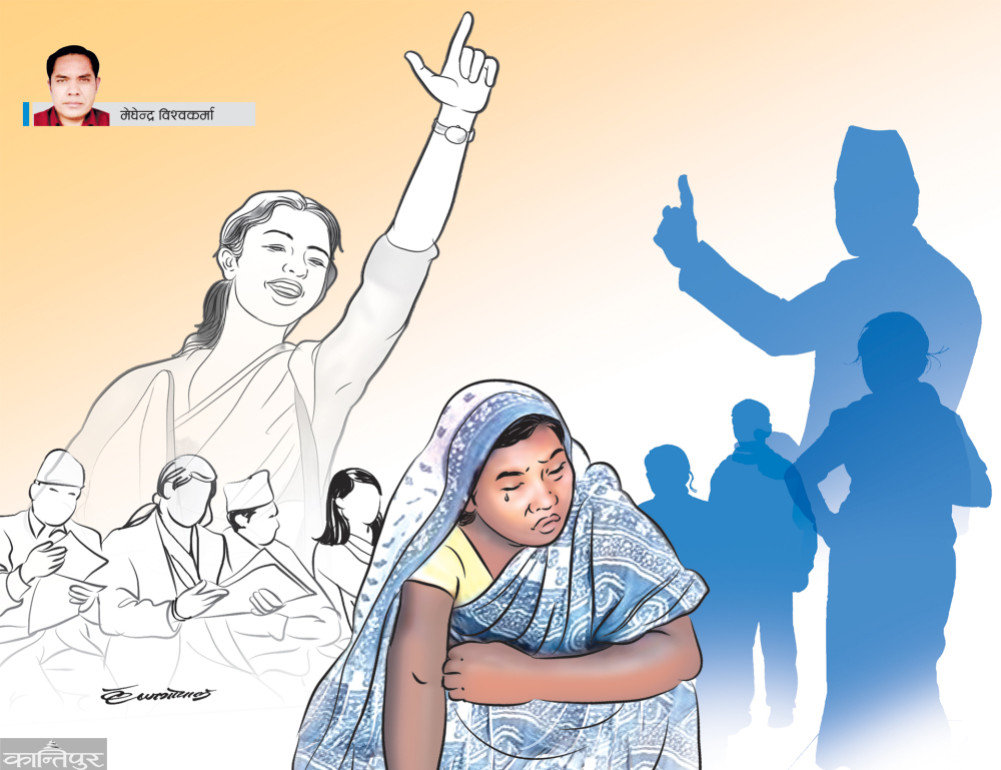
The Dalit community of Nepal is forced to suffer unbearable multifaceted discrimination, exploitation and oppression due to the Hindu high caste rulers and the caste socio-cultural structure. Various government/non-government statistics confirm that they are at the back of the society in all dimensions of development. The Dalit community, subjected to all-round economic exploitation, social exclusion and caste discrimination for ages, has been conducting many social struggles of different forms in different eras demanding the abolition of the unscientific untouchability system, social empowerment and political mainstreaming. However, the Dalit struggle, which was initially strong and effective, began to weaken from the Panchayat period. The Dalit struggle that tried to rise in the fifties was completely threatened by the seventies. During the making of the constitution, the issue that the influence of the Dalit movement was getting weaker compared to the tribal, Madhesi and regional movements was seriously raised in the political-social circles. So much so that there was strong criticism and commentary that there was no theoretical difference between running a Dalit movement in name only and not. Undoubtedly, such harsh criticism in the academic, social and political fields has raised serious questions about the existence of Dalit social movements.
Why did the power of the Dalit social movement, which made the issue of Dalit priority including the end of untouchability, Dalit inclusion and compensation the main agenda, decrease over time? What are the fundamental challenges of this movement, which prevented the Dalit social movement from progressing in a strong, effective and integrated manner? Along with that, where is the future direction and destination point of the Dalit movement? After the weakening of the Dalit social struggle, which aspects, factors and forces played a role? Where is the weakness in the ideological concept of the Dalit movement built within a narrow circle? There is a need for a serious review of the Dalit social movement in Nepal based on several questions raised about its character and tendencies. In this article, an attempt has been made to briefly analyze the basic weaknesses, challenges and future tasks of the Dalit social movement in Nepal.
Weakness
Dalit social struggle with a history of more than seventy-five years of organized movement was strong and powerful in the early years. The Dalit movement came close to extinction due to the opportunistic tendencies that grew with the desire of Dalit leaders to gain power in the Panchayat system. The Dalit movement, which had been inactive for a long time, gradually took over the armed Maoist rebellion, not wanting to rise up on its own with the establishment of democracy. With the passage of time, the dream of Dalit emancipation has come to a halt due to the imprisonment of the movement within the ideological circle of various political parties. Although the need for a unified movement has been realized till now, the leaders who are following the parties for power interests and political gains are falling into the delusion that the greater liberation of the Dalit community will be achieved through the efforts of the parties themselves. It is strange that the Dalit leadership enjoys the fantasy that the Dalit community will be freed from all-round discrimination and inequality under the watchful eye of the party and the leader, instead of conducting a strong and powerful Dalit social movement without dividing the entire Dalit community into political ideologies.
Dalit social movement has been making the agenda of ending untouchability and inclusion of Dalits the main topic since the beginning, but it has not been able to raise the issue of terrible poverty, economic inequality and landlessness in the Dalit community. The non-geographical federal state of the Dalit community, the determination of special areas for Dalit-dominated areas, proportional inclusive representation based on population and more facilities for compensation and the provision of legal arrangements for Dalit-Dalit competition in elections are in danger due to the incompetence of Dalit leadership, weak Dalit organization and the lack of a clear ideological vision. fell After all, with Dalit community leaders being divided into different parties, it is not unusual for the issue of Dalit liberation movement to be overshadowed as their political ideological approach, organizational responsibility and party strategy/tactics are different.
Instead of showing a sense of common responsibility towards the Dalit movement among Dalit leaders, the Dalit movement was damaged by party competitive spirit, clash of personalities and the tendency to indulge in the reformist work of Dalit NGOs. It is not correct to expect Dalit brotherhood/organizations bound by the control of political parties to advance the Dalit movement in an independent capacity. The Dalit movement does not pay attention to the activities of taking socio-cultural integration programs among the Dalit community, giving intellectual Dalit personalities a role in the mainstream of the movement and working hand in hand with progressive non-Dalit individuals, groups or organizations. In summary, the Dalit movement has clearly failed to develop a common organization, common ideological approach and collective leadership to make the movement decisive, dynamic and powerful. The main weakness of the Dalit social movement is the inability to develop a clear ideological approach, build a strong organization and prepare an honest leadership for the greater liberation of the Dalit community, which is suffering from multifaceted discrimination.
The challenge
Nepal's Dalit social movement faces challenges along with the possibility of liberation. It was certainly not a mistake for the party-affiliated Dalit brotherhoods/organizations to plead with the political parties for decades of caste discrimination and multifaceted emancipation. Taking away the entire possibility of a unified and powerful Dalit movement at the feet of the parties for the sake of temporary power and status enjoyed by some people was the biggest betrayal they gave to the Dalit movement. In this sense, the tendency of Dalit political associations/organizations to use the Dalit community as a ladder of power has become the biggest challenge for the massive and decisive Dalit movement.
The multi-billion dollar foreign aid program, opaquely mobilized by a handful of people in the name of Dalit civil society, does not make a fundamental difference in the lives of Dalit people who are suffering from poverty and caste discrimination. It does not seem to give any special results except to benefit a limited number of people. In that case, the Dalit non-governmental organizations that aspire to hold the reins of the Dalit movement, make Gasas a ladder for political and economic gains, and share the dream of Dalit liberation through small programs, have brought the Dalit social movement close to an accident. Likewise, the trend of chasing intelligent, honest and capable people of the Dalit community by self-proclaimed Dalit leaders and Dalit gas workers affiliated to political parties is equally alarming. The narrow mindedness of Dalits called Buzakkad, the slavish mentality shown towards the party leader and the opportunistic tendency to leave the movement in a desolate state for personal gain are seen as the main challenges of the current Dalit social movement.
The way forward
The Dalit social movement of Nepal seems to have to fulfill some tasks in terms of liberating the general Dalit community from the unscientific practice of untouchability and multifaceted discrimination. First, creating pressure through movement for the full implementation of the constitution is the main responsibility now. For that, the movement should be conducted by building an independent Dalit organization with the goal of building political power in the long term. If such a situation is not possible immediately, the main responsibility now is to force the state political parties to implement the constitution literally by forming a united front. Secondly, Dalit and other social movements at the international and national levels should be deeply reviewed and a clear ideological vision of Dalit social movements should be created. Caste, which is considered an integral part of feudalism, is a powerful social structure even in globalized capitalism, so the subject should be analyzed seriously.
Thirdly, both the Marxist and the democratic political forces have been treating the Dalit community as a knife in the mouth towards the agenda of ending untouchability and emancipation. Therefore, while building the ideological concept of Dalit liberation, instead of parties, the Dalit movement should develop itself as a strong national force and create a clear theoretical, ideological and organizational course of action. Fourth, Dalit emancipation through the path of democratic socialism carried by the Nepali Congress seems to be completely impossible and the Marxist ideology is distorted by the political forces called communists. In this case, the political ideology carried by them and envisioning the liberation of Dalits under their leadership is nothing more than indulging in fantasy. Therefore, it is necessary to develop an ideology with the goal of equality, social justice and egalitarian socialism through the organizational power built by Dalits themselves.
Fifth, the building of strong and independent Dalit organizations, the complete end of untouchability, economic equality and proportional inclusion with priority should be kept at the center of the ideological action plan. Since leaving political parties by abandoning political parties, there will be a stronger in a stronger periodile time to move forward in the middle period. Sixth, the process of moving Dalit Inter-Sadration should take place in the center of the movement as a campaign and the subject of poverty and landlessness. The Dalit movement should take the policy of cooperating with other marginalized communities and power on the basis of needs and justification. & Nbsp; In the
, it is necessary to restore the Dattical Social Social Masonry Social Mocilation of the Drived Social Movement in faced incidents. The liberation of invalid differences in force of forceful and interdingly freely Dalits are fully possible.