We use Google Cloud Translation Services. Google requires we provide the following disclaimer relating to use of this service:
This service may contain translations powered by Google. Google disclaims all warranties related to the translations, expressed or implied, including any warranties of accuracy, reliability, and any implied warranties of merchantability, fitness for a particular purpose, and noninfringement.
Butwal-Bhairawa region is known for the availability of necessary physical infrastructure with favorable environment for agriculture, tourism, industry and business operations. Due to plans and projects conducted at the national/international level and rapidly increasing urbanization and favorable geographical structure for import and export with India, Rupandehi has advanced as a financial hub in recent times.
Making Rupandehi the focal point, Kapilvastu, Nawalparasi and Palpa, which are connected, are also increasing financial transactions for agriculture, tourism and industry . Rupandehi is one of the country's model districts in commercial fishing, cattle breeding and ostrich breeding. With remittances coming in due to foreign employment, every village has turned into a city-oriented state. Due to the necessary physical infrastructure and favorable environment for the operation of the industry, the opening of industries in this area has increased significantly in the past few years. An exception is the current laxity in the industrial sector due to the economic recession. For the tourism industry, this area is attracting national and international investment .
Due to increasing industrialization, nearby Nawalparasi and Kapilvastu have also become preferred for domestic and foreign investors. Because of Lumbini, the physical infrastructure that has started to be built in this area, the calm and safe customs border, and the industrial friendly environment, this area has started to attract domestic and foreign investment for tourism and industrial business . On the one hand, it is located in the middle of India's major industrial city, Paik Parne, and on the other hand, at a distance of about 250 km from Bhairahawa-Butwal to connect to industrial and commercial cities like Kathmandu, Pokhara, Nepalgunj, Birganj, Ruppandehi and the surrounding area has developed as a financial hub. ;
Overall speaking, not only Rupandehi but also Lumbini province has progressed as a financial hub . However, there is a need for some policy reforms for agriculture, industry and tourism.
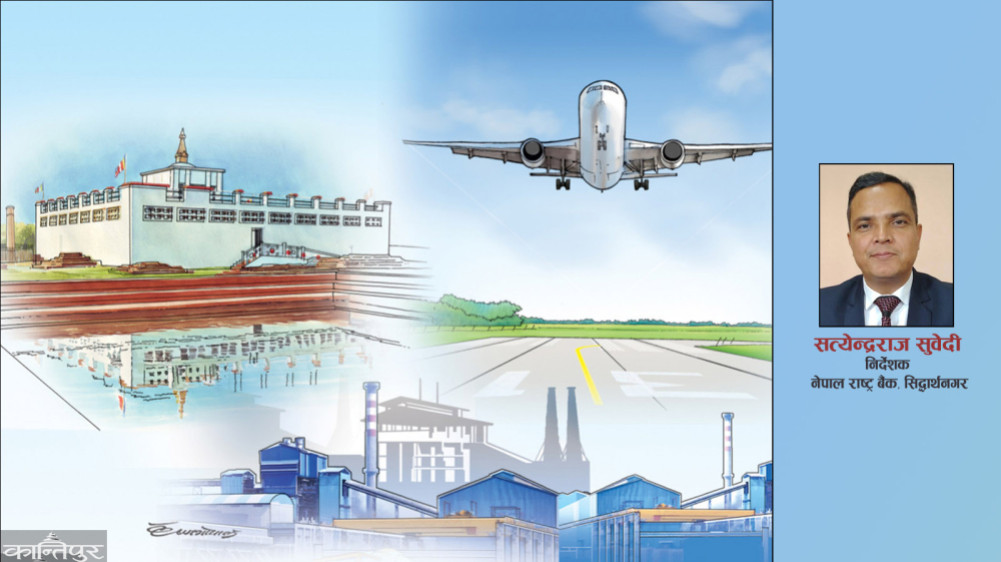
Lumbini, the birthplace of Lord Buddha, is in this province and geographically, this province is located in the middle of India's major industrial areas, which is the main basis of the industrial development of this region. Based on geographical structure, availability of natural resources, choice of tourists, level of awareness of locals and use of banking services, Lumbini province can be considered as a carrier of economic growth.
According to the National Statistics Office, the economic growth rate of this province is estimated to be 2.06 percent in the fiscal year 2079/80. With 14.2 percent contribution to the total domestic product of that year, Lumbini province is in the third place after Wagmati and Koshi provinces . It is estimated that the share of this province in the total agriculture, industry and service sector of the country is 17.5, 15.5, and 12.6 percent respectively. It is estimated that agriculture sector contributes 29.8%, industry and construction sector 14.7% and service sector 55.5% in the total domestic product of this province. Therefore, the sustainable development of Lumbini province is essential to raise the country from the status of an underdeveloped country by bringing improvements in social, educational and gender indicators along with sustainable, high and inclusive economic growth of the overall economy .
Challenges and prospects of agricultural industry
According to the data published by the Ministry of Agriculture and Livestock Development in 2022, out of the total geographical area of Nepal, the arable land is only 28 percent, 21 percent of the land is being cultivated and the remaining 7 percent is still barren. Amidst this limitation, in the overall agricultural production of the financial year 2079/80, Lumbini province occupies the third place after Koshi and Madhesh provinces. According to the National Agricultural Census, 2078, 67 percent of households in this province have done agricultural work on about 4,26,000 hectares and 56.7 percent of this land is irrigated.
Agricultural business is not adopted as a respectable profession by farmers with some exceptions who have done commercial agriculture . Farmers in the same geographical environment have almost the same problems. Most of the issues are of national importance . It seems that some problems can be solved at the local level. Even though there is a big river that flows from north to south for twelve months, our farmers have to depend on sky water for irrigation . The fact that the water of those rivers is being used unilaterally by the neighboring countries is a matter that the federal government has to address.
Irrigation schemes such as Sikta, Babai, which were started from state resources, have not been completed even after decades and the situation of declining capacity to provide additional budget has made the problem more complicated. Therefore, it is necessary to pay attention to the research to identify the agricultural products that get the highest return from minimum irrigation or to improve the existing crop breeds and reduce the impact on agricultural production and productivity due to lack of irrigation.
The main means of production here is land. During the last two decades, the price of all the land in Nepal has gone up, causing a great disruption in the century-old relationship between land and production. A person or company with new knowledge, skills, experience and technology will analyze the cost of benefits, the local price of agricultural products imported from neighboring and third countries, the possibility of foreign export, etc., to purchase or lease land needed for agricultural or any other business. The sound of reaching the point of inability has started to be heard . This is the second problem of national importance .
For this, it is necessary to take a policy of not increasing the price of land. It is necessary to adopt a policy that the same person or company who is the end consumer or the one who uses the land should buy the land, not to invest in the land as a speculation and not even to take loans from banks and financial institutions. For this, it is also necessary to increase public awareness .
Forests and the potential of tourism
Forests occupy 29 percent of the total land area of Nepal. But the contribution of forest to the total domestic product is almost insignificant. Forest products need to replace expensive imports of high quality and attractive furniture. For that, it is necessary to connect our forest production with the development of furniture industry with latest technology . There may be some legal and policy issues. However, the government mechanism of all three levels of the state, with the participation of experts and engineers in the relevant fields, has to prepare a private sector with corporate culture to act for the purpose of replacing the import of furniture and meeting the internal demand for wood without compromising on sustainable forest . The local bodies of this province should be able to take the initiative to study the feasibility of identification and commercial production of valuable wood and herbs for the international market, including blood sandalwood, which is in high demand in China.
Being the birthplace of Lord Gautama Buddha, the Lumbini area is a potential area that can be expanded into a major tourist area in the world . Making a circuit of places related to Lord Gautama Buddha including Lumbini, Tilaurakot, Ramgram, establishing meditation centers and conducting meditation camps for tourists, preparing documentaries on the life of Lord Buddha and presenting different series seven days a week can increase the quality of tourists' stay. There is plenty of potential. Apart from this, more tourists can be brought in if more publicity and structures can be built for visiting and visiting places of historical and religious importance such as Ranimahal in Palpa, Resunga Tapovan of Gulmi, historical palace of Arghakhanchi, Swargadwari of Pyuthan.
In addition to Indian tourists, the arrival of foreign tourists can be further facilitated by providing electronic payment services for the visa process of foreign tourists using Indian land from Belhia border, providing round-the-clock presence of customs and immigration office staff, and arranging lobby rooms in case of long queues. More benefits can be gained if the tourists visiting Lumbini can be taken to destinations like Pokhara, Muktinath, Annapurna Basecamp and other destinations according to their interest.
The potential of industry
Lumbini province is already an industrial province . Sugar, steel, iron and cane, rosin/turpentine, cement, paper, noodles and other industries have been existing in this province, but sugar industry, some cement industry and some paper industry are currently closed due to various reasons. Industrialists say that the rest of the industries are also not operating at full capacity. Industrial Business Act, Special Economic Zone Act, Foreign Investment and Technology Transfer Act at various stages with the aim of increasing the contribution of the industrial sector to the GDP, increasing exports, import substitution, increasing employment etc. But the expected benefit from the industrial sector as a whole including this province has not been achieved. Even if there is industrial laxity in the current situation, we have no choice but to find a quick solution for it . For this, it is better to analyze what solutions are available in a certain industry . For example, the problem of cement, rod, iron industry is that the product is not sold. For the time being, what kind of initiatives should be taken to increase the export of such goods to India, a solution can be found by discussing with experts.
State of financial access
Looking at the 2021 data of Global Findex, based on the number of bank accounts opened, the number of bank loans, women's participation in financial service consumption, etc., Nepal's financial access ranks third among South Asian countries after Sri Lanka and India . According to the source, in the questionnaire regarding the reasons for not opening an account in banks and financial institutions, the number of people who answered that they did not have faith in those institutions was 8 percent in India and 16 percent in Bangladesh, while in Nepal it was only 5 percent. Access to finance, financial services and use of financial instruments in Lumbini Province is satisfactory . There are branches of banks and financial institutions in all the 109 local bodies in the province. By the end of the financial year 2079/80, there are 748 banks of 'A' class, 257 of 'B' class, 46 of 'C' class and 1162 of 'D' class in this province. Financial institutions are operating . Out of this, maximum 553 branches are operating in Rupandehi district and least 17 branches are operating in Rukum East district. A branch of a bank and financial institution has provided banking services to an average of 2,315 people in this province. Which is slightly less than the national average of 2,517. According to the data of Nepal Rastra Bank, 34 lakh 71 thousand 309 mobile banking services and 240 thousand 92 internet banking services have been registered in this province by June 2080. Commercial banks have provided 222 branchless banking services. The share of Rupandehi district is about 33 percent. The lowest Rukum East district is 0.4 percent.
Credit and deposit situation and prospects
The province's deposit collection and credit expansion are gradually increasing. At the end of June 2080, the total deposits of this province increased by about 19 percent compared to the previous year and reached 507 billion . Which is 8.8 percent of total deposits . Due to the rising interest rate due to the lack of liquidity in the past, about 48 percent of the amount in this province is in the form of fixed deposits . Due to the fact that the term of those deposits will remain for the specified time, the base rate of banks and financial institutions has not decreased as expected even as the interest rate of deposits has improved significantly. Due to this, it is natural that the loan interest rate does not decrease as expected by the old borrowers. In the year 2080, loans in Lumbini province increased by 2.7 percent compared to the previous year and reached 553 billion. The share of this province in the total credit disbursement is about 11.4 percent. Due to the gradual expansion of loans and deposits, it can be understood that this province is economically viable.
With the increase in loan disbursement, the ratio of non-performing loans is also gradually increasing . If the principal or interest or installment amount due to the bank exceeds the payment by more than 3 months, the entire outstanding loan is considered as non-performing loan. It is estimated that the non-performing loan which was around 1.5 percent in June 2078 increased to 3 percent in June 2080 and reached 3.7 percent in December last year. Along with non-performing loans, the amount of outstanding interest has also increased. The outstanding interest of the total loan flowed to the private sector was 5 trillion 33 billion in December 2078, and in December 2079, it increased to about 8 trillion and reached 12 trillion 77 billion in 2080 . Even though Nepal's situation is good in terms of non-performing loans of South Asian countries, it seems necessary to take its size seriously.
The flexible policy taken by Nepal Rastra Bank to provide continuity to the business that was disrupted during the time of Covid-19 and at the same time to manage the increased liquidity in the banking system, the inability to analyze the borrower adequately when loans are being provided flexibly from the banks, even if the borrower does not want it, loans from the bank employees while increasing the business. Intending to take, providing loans in excess of needs, asking for loans in the name of employment and income generation and selling real estate at higher prices to pay off loans in that area may have increased the size of non-performing loans.
Sectoral credit condition and potential
Analyzing by sector, banks and financial institutions in Lumbini Province have given the highest amount of loans at the end of December 2080, about 24% under the title of wholesale and retail and then about 19% under the title of consumption . Similarly, it is estimated that 9 percent in agriculture sector, 9 percent in agricultural industry, 4.5 percent in tourism sector, 10 percent in industry sector and 2.5 percent in construction sector. It has been seen that the distribution of this type of sectoral credit is around the same as it was a year ago. Since about 45 percent of loans are seen to flow in the trade and consumption sector, it is necessary for this province to pay special attention to the new youth and private sector entrepreneurship enhancement program in order to gradually use financial resources from that sector in productive sectors such as agriculture, tourism, and industry. For this, it is necessary to give special emphasis on support and encouragement in the startup business recently introduced by the government by developing innovation knowledge and skills.
- Satyendraraj Subedi is the director of Nepal Rashtra Bank, Siddharthnagar.