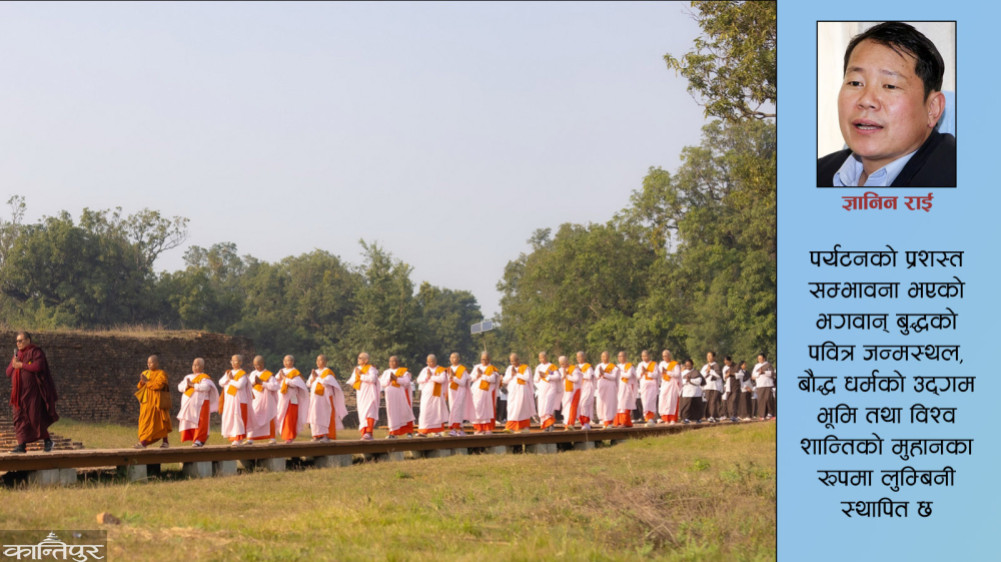
Lumbini is established as the sacred birthplace of Lord Buddha, the birthplace of Buddhism and the source of world peace, with abundant potential for tourism.
We use Google Cloud Translation Services. Google requires we provide the following disclaimer relating to use of this service:
This service may contain translations powered by Google. Google disclaims all warranties related to the translations, expressed or implied, including any warranties of accuracy, reliability, and any implied warranties of merchantability, fitness for a particular purpose, and noninfringement.
Gautama Buddha, the promoter of world peace, was born in B.C. It happened in Lumbini in 623. BC In 249 AD, Maurya Emperor Ashoka visited Lumbini with his Guru Upagupta. At the same time, Ashoka erected a pillar in Lumbini with an inscription proving the birth of Shakyamuni Buddha. After the death of thousands of people in the war of Kalinga, the deranged emperor adopted Buddhism.
The reign of Emperor Ashoka is considered the Golden Age of Buddhism. The government of Nepal has officially declared Lumbini as the 'holy birthplace of Lord Buddha, the birthplace of Buddhism and the source of world peace'.
General Khadgashamsher of Palpa and surveyor Dr. Anton Führer jointly rediscovered the Ashoka Pillar in 1896, proving the birthplace of the Buddha. Then the scholar's eyes seem to fall on Lumbini . In 1899, Babu Purnachandra Mukherjee excavated the southern part of the Mayadevi temple and discovered architectural remains made in the Saptaratha style and a stone sculpture depicting the scene of Mayadevi giving birth to the great man Buddha . Between 1933-39, Keshar Shamsher conducted unscientific excavations of Lumbini . In 1962 Devalamitra on behalf of the Archaeological Survey of India excavated the Ashoka pillar at Lumbini, the ancient Kapilvastu Tilaurakot palace area, between 1972-85 by the Department of Archaeology, between 1992-96 by the Lumbini Development Fund, the Department of Archeology and the Japan Buddhist Federation jointly at Lumbini. Excavations revealed a markerstone believed to be the actual birthplace of Lord Buddha.
A 2010-13 study by a team of experts from the Lumbini Development Fund, the Department of Archaeology, Durham University and the University of Stirling, led by Professor Robin Cunningham under the UNESCO Japanese Foundation Trust, discovered the first pre-Ashoka brick temple in South Asia, which itself predates Ashoka. It was built on the remains of a wooden temple. In addition, by finding the remains of an ancient village around 1300 BC, a few hundred meters south of the birthplace of Buddha, the proof of the existence of a settlement in the area was brought back a thousand years before the Ashoka period. Which in addition to providing important support for a better understanding of Buddha's birthplace, a press conference held at the UNESCO headquarters to inform about this achievement has led to widespread global publicity and promotion of Lumbini.
In recent days, using various scientific methods and techniques, the ancient culture, civilization and its spread of heritage sites including Tilaurakot Kapilvastu, Kudan, Sagrahawa, Gotihawa, Sisahnia, Karma, Niglihawa, Arorakot, Dohni, Chatradehi, Panditpur, Devdah and Ramgram in the greater Lumbini region. Although detection is ongoing, it is imperative that such activities be carried out on a larger scale with priority . In addition, it seems necessary to reach a conclusion from the discussion with local residents, businessmen, tourists, pilgrims and heritage experts on how to sustainably develop, promote and protect the Buddhist heritage in the greater Lumbini area and what kind of impact it will have on the local economy.
The development of Lumbini, the most sacred place of pilgrimage for Buddhists, at the Fourth International Buddhist Brotherhood Conference in 1956, after the then King Mahendra drew the attention of the world community, the international community began to pay attention to Lumbini . In 1967, the visit of the then Secretary General of the United Nations, Uthanta, proved to be a milestone in the development of Lumbini. After calling the international community to participate in the development of Lumbini, with his help, the Lumbini Development International Committee, consisting of 16 countries, was established in 1970 at the United Nations headquarters in New York at the proposal of the representatives of India and Thailand. . The same committee assigned Japanese architect Kenzo Tange to prepare the master plan of Lumbini in 1972 with the financial support of the United Nations Development Program and the Japan Expo Foundation.
In 1978, after the master plan was prepared and approved by the United Nations and the Government of Nepal, its implementation is being carried out by the Lumbini Development Fund on behalf of the Government of Nepal. It is necessary to present to the world the determination of the Nepal government to make the goals and ideals of developing Lumbini, the holy birthplace of Lord Buddha, more effective and accordingly to conduct the Lumbini development plan in a more coordinated and smooth manner. Exploration, Excavation, Conservation and Development of Tilaurakot (Ancient Kapilavastu), Gotihava, Niglihava, Sagarhava, Sisniakot, Kudan (Kapilvastu), Devdah (Rupandehi), Ramgram (Navalparasi-Bardghat Susta West) archaeological areas directly or indirectly associated with the life of Buddha. Ever since the Lumbini Development Fund was established by the Lumbini Development Fund Act, 2042, along with the sustainable development, protection and promotion of the heritage sites in the area, the nectarine teaching of Lord Buddha, which provides world peace and nirvana, has been intensively propagated . For the welfare of the whole world and to increase non-violence, brotherhood and harmony in the world, these works are going forward.
Lumbini is established as the sacred birthplace of Lord Buddha, the birthplace of Buddhism and the source of world peace, with abundant potential for tourism. With the belief that religious and secular people can work together to build a world free of hunger and conflict, UN Secretary Generals Dag Hammersold, Uthant, Kurtwaldheim, Javier Pérez de Coeur, Wan Ki Moon and recently Secretary General Antonio Guterres said, 'I would like to pay homage to Lord Buddha, his He has visited Lumbini with the belief that the light of universal peace, knowledge and compassion will inspire us to guide us in the search for peace in a sensitive manner.
Similarly, Narendra Modi, the Prime Minister of India, when he visited Nepal, expressed his gratitude to Nepal by saying 'I have come to the land of Lord Buddha' and also accepted the reality that the teachings of Lord Buddha can remove the darkness of the entire human mind . After the international conference held in Lumbini in 1998, 2001, 2004, 2014, 2016 and 2018 and the visit of the heads of state and government of different countries, the world community has been engaged in the sustainable protection, enhancement and promotion of this area. The ``Gautam Buddha International Peace Prize'' in the amount of 50,000 US dollars, which is given every 5-5 years by the Government of Nepal, was awarded jointly to the mayors of Hiroshima and Nagasaki in Japan for the first time in 2011, but it has not been distributed for the second time. is .
World Heritage and Tourism
The Nepal government declared Lumbini as a protected monument area on 24th December 2080, the third base of the world heritage designated by the World Heritage Convention, operational guidelines, and the records inscribed on the Ashoka Pillar have confirmed that Lumbini is the birthplace of Lord Buddha. The sacred land of Lumbini is considered one of the greatest and holiest places in the world. Lumbini was inscribed on the World Heritage List in 1997 based on the important evidence of a Buddhist pilgrimage site that has existed since ancient times, with archaeological remains of Buddhist temples and stupas (monumental shrines) dating from the 3rd century BC to the 15th century.
As a partner of the World Heritage Convention, the Government of Nepal is responsible for ensuring that the importance of its World Heritage properties is protected in the long term. In Article 108 of the operational guidelines proposed to implement the convention, there is a provision that "with each designated heritage, the above-mentioned management plan or other documented management system should be attached to the issue of how to protect the global importance of the heritage, and in this, participatory measures will be given priority".
The Tilaurakot Kapilvastu area, which has been on the potential list of World Heritage since 1996, was declared a protected monument area by the Government of Nepal on 8 Baisakh 2079. The World Heritage Nomination Document required to be listed in its list was submitted by the Lumbini Development Fund to the Ministry of Culture, Tourism and Civil Aviation, Department of Archaeology, Kapilvastu. It has been prepared and formally registered with the UNESCO World Heritage Center on behalf of the Government of Nepal in coordination with the municipality and UNESCO Kathmandu with the help of relevant experts. Its final decision will be made by the 47th General Assembly of the World Heritage Committee in 2025 after the evaluation report of ECOMUS, for which the state party needs to carry out the tasks in accordance with the commitment as much as possible and also take diplomatic initiatives with extensive publicity and promotional activities in the upcoming 46th General Assembly .
Tilaurakot Kapilvastu area is the main one among the designated bases for world heritage. The detailed urban plan of one of the oldest cities in South Asia, new and interesting information about ancient life, the urban plan mentioned in the historical work economics and the structure of the city of Tilaurakot, including the structure of the city of Tilaurakot, which is a place of unique global importance due to the local architecture, is based on the evidence obtained through the use of scientific and multi-methodology. Since 1996, it is necessary to carry out further scientific research in Ramgram area, which is a very sacred place for Buddhist pilgrims and has been listed as a potential world heritage site.
(Rai is the Senior Director of Lumbini Development Fund .)