We use Google Cloud Translation Services. Google requires we provide the following disclaimer relating to use of this service:
This service may contain translations powered by Google. Google disclaims all warranties related to the translations, expressed or implied, including any warranties of accuracy, reliability, and any implied warranties of merchantability, fitness for a particular purpose, and noninfringement.
We may not believe it when we hear that the flammable methane gas produced in Kathmandu Valley was used in government offices three decades ago. How can you believe it? If that is the case, why has the plan for gas production not been made in the valley for so long?
Even now we are hearing news of gas coming out and burning from places in the valley due to the inability to study and work in a planned manner for gas production. We are witnessing some incidents directly. A vivid example of this is the gas that was released during the construction of boring in Mahalakshmi Nagarpail-5 Shantoli of Lalitpur on 20th of February. Similarly, gas was released in Jorpati in July 2079 along with water.
8 years ago, there was a fire in Bhaktapur due to the release of gas during deep boring. Therefore, even though gas is released in the valley, this is not the first and new event in the valley, it has a long history.
In 1978, a team of the Japan International Cooperation Agency (JICA) and the Department of Mines and Geology studied the natural gas in Kathmandu Valley. In the year 2049, gas was tested by digging a well in Tikathali area where gas is now released. Almost half a century has passed since the study of gas in the valley, and it has been 32 years since testing.
In the year 2049, it was confirmed that gas could be produced and the private sector was searched for. It was at that time that the directive was felt to give the responsibility of gas production to the private sector. At that time, the government said that gas can be produced from 11 places.
Ramesh Kumar Aryal, the then Geologist of the Mining Department, said that the work was being done according to the policy of handing over the mines to the private sector. At that time, tests were conducted to extract gas at places like Tripureshwar, Teku, Pachli, Koteshwar, Tinkune, Shankhamul.
During the feasibility study of methane gas production, discussions were initiated to bring in the private sector . It was estimated that Tinkune has reserves of 170 million cubic meters.
The department had started gas extraction since the 40s by starting the 'Kathmandu Gas Project'. In the study of the department, it was estimated that there are 300 million cubic meters of gas within 26 km from Tripureshwar to Shankhamul. The gas produced from some places was being distributed free of cost to Teku Hospital, Home Department, former telecommunications station.
This gas cannot be filled in cylinders and distributed. If you invest heavily and use technology, you can take it to your house through a pipe . Three decades ago, it is in the records of the geological department that 100 to 150 cubic meters of gas was distributed daily. Currently, 14 places where methane gas can be produced have been protected. However, the government is not interested in the production and use of methane gas.
According to geologists, this gas can be harnessed if managed. Officials of the Geological Department say that a system can be made to take the gas to customs by piping it . According to a study, it was said that 50,000 families in Patialam have enough gas for 30 years.
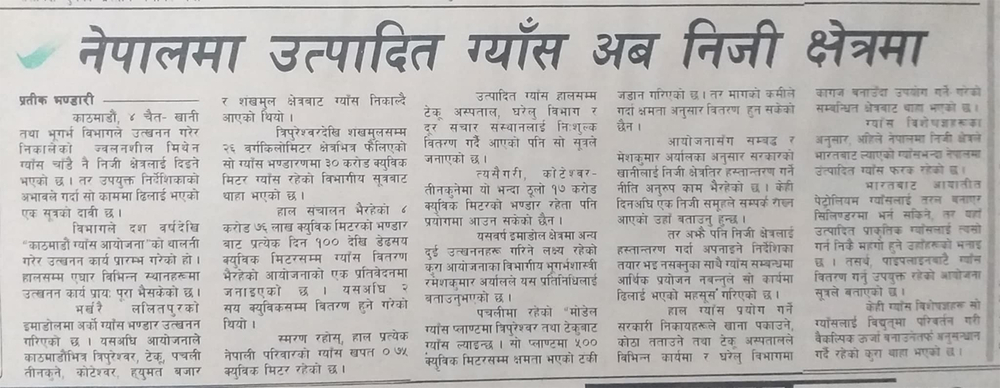
But now there is no further study except for securing the place of gas release. The matter was published in Kantipur Daily on 3rd Chait 2049 in the byline of journalist Prateek Bhandari under the title 'Gas produced in Nepal now in the private sector'.
presentation: Rishiram Paudyal