Legislation by ministers and ruling party MPs
We use Google Cloud Translation Services. Google requires we provide the following disclaimer relating to use of this service:
This service may contain translations powered by Google. Google disclaims all warranties related to the translations, expressed or implied, including any warranties of accuracy, reliability, and any implied warranties of merchantability, fitness for a particular purpose, and noninfringement.
Even now there is a debate about the choice of language and words used by MPs in Parliament. A similar debate was raised vigorously in the first parliament formed after 2046.
When the then Prime Minister Girija Prasad Koirala stood on the rostrum of the Parliament and answered the questions asked by the MPs about Bhutanese refugees and the National Planning Commission, it became a subject of controversy when the opposition MPs used the words 'treason' and 'immoral'.
At that time, the left-wing parties, including the main opposition UML, seemed very aggressive towards India. The slogan of Indian "expansionism" was heard on the streets as always. The Left seemed to be more aggressive towards Koirala because it was an issue related to India.
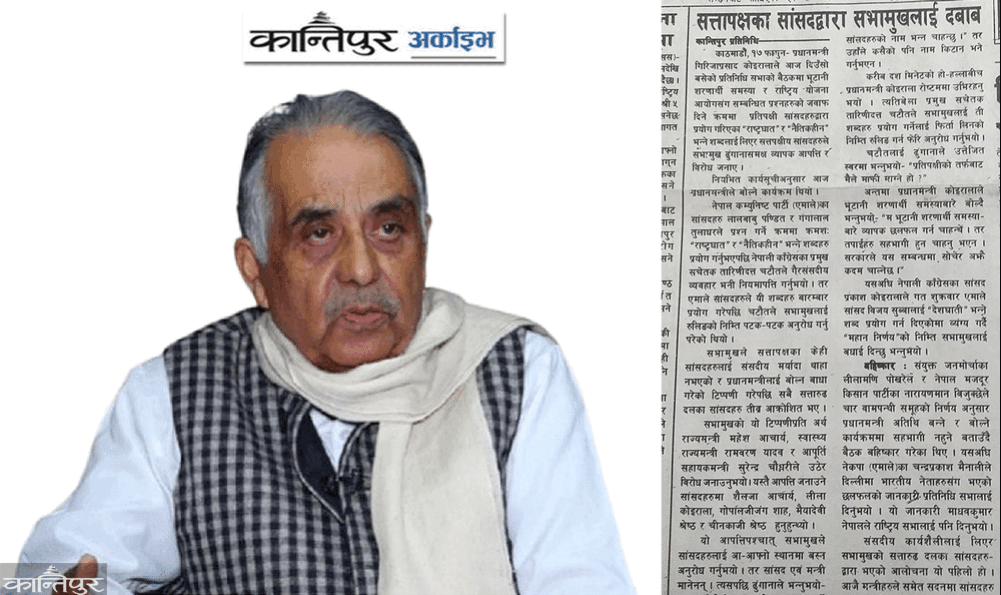
When UML MPs Lalbabu Pandit and Gangalal Tuladhar used the word while asking questions to Prime Minister Koirala, the ruling party MPs and ministers not only objected, but Speaker Damannath Dhungana himself got angry for allowing the use of unlimited language. The chief whip of the ruling party, Tarni Dutt Chatout, objected to the law saying it was unparliamentary language.
When the UML parliamentarians did not stop using the said language and the ruling party did not stop objecting, the situation became such that the Prime Minister who stood on the rostrum to answer the questions could not speak himself . Speaker Dhungana blamed the ruling party MPs for not knowing the parliamentary dignity and not allowing the Prime Minister to speak, saying that the ruling party MPs had created the ruckus.
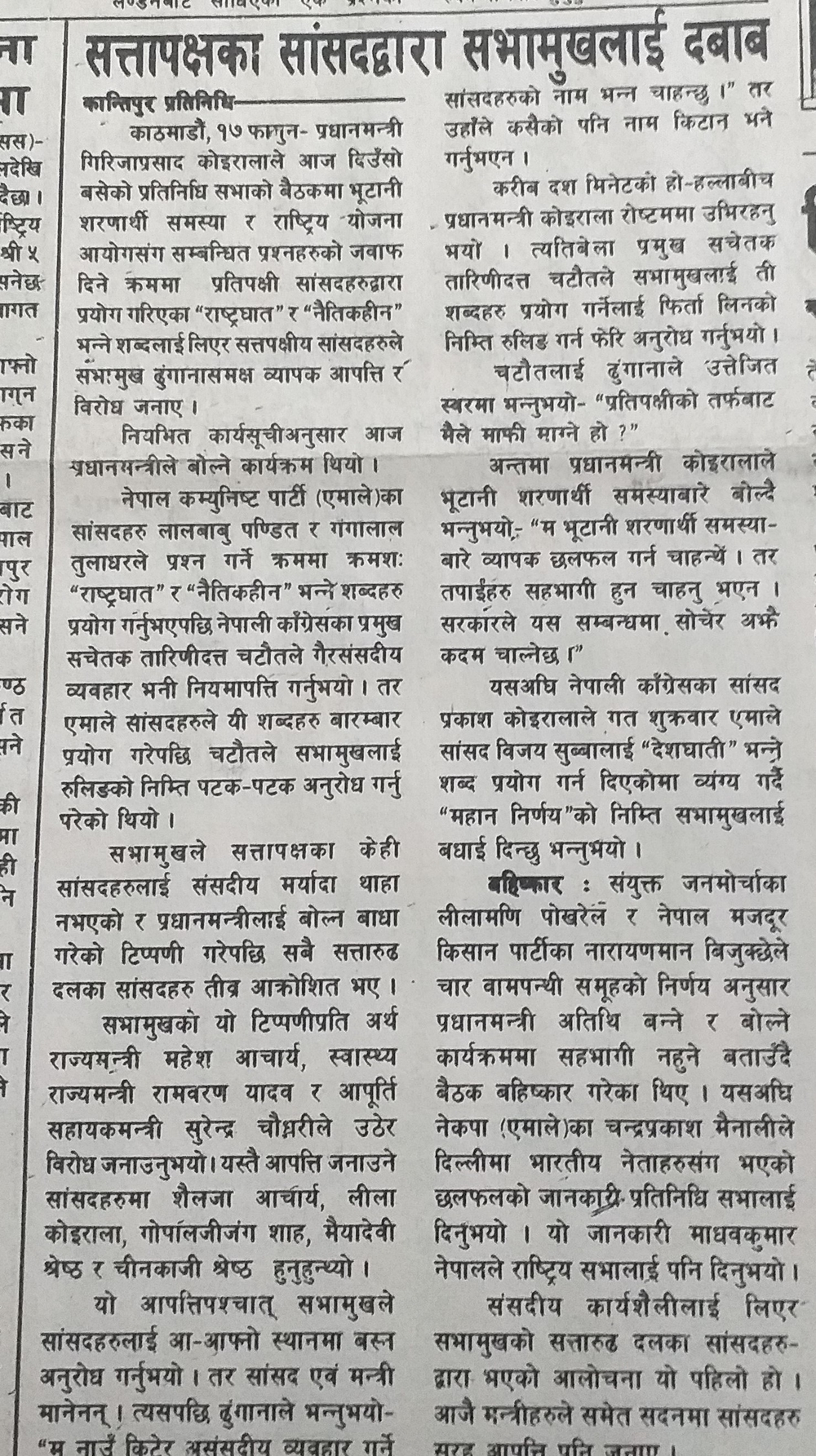
Minister of State for Finance Mahesh Acharya, Minister of State for Health Ramvaran Yadav, Assistant Minister for Supply Surendra Chaudhary, MPs Shailaja Acharya, Leela Koirrala, Gopaljijung Shah, Maiyadevi Shrestha, Chinkaji Shrestha and others protested against Speaker Dhungana's statement. At that time, it was considered new for ministers to pass laws in the parliament.
The ruling party MPs kept asking Speaker Dhungana to withdraw the words used by the UML MPs. In response to that, Dhungana angrily said, 'Am I going to apologize on behalf of the opposition?' Why did he say this because Speaker Dhungana had more faith in the belief that Parliament belongs to the opposition? That's why the parliamentarians of the ruling party were not happy with him.
Parliamentarian of the ruling party Prakash Koirala was not satisfied with the Speaker's behavior and said, "I congratulate the Speaker for his great decision." The Speaker was especially congratulated for allowing the UMA MPs Pandit and Tuladhar to use the word 'nationalist' targeting the Prime Minister. Leelamani Pokharel of United People's Front and Narayanman Bijukche of Nepal Labor Kisan Party boycotted the Parliament meeting itself. The four left parties boycotted the Parliament as they decided not to attend the Prime Minister's guest speech.
At that time, the opposition MPs were more aggressive towards the government regarding the Tanakpur agreement. On that day, UML MP Chandra Prasad Mainali (CP) informed the House of Representatives about the discussion about Tanakpur with Indian leaders in Delhi. Madhav Kumar Nepal, leader of the opposition party, also informed about the issue in the meeting of the National Assembly.
UML leaders returned from a 6-day visit to India to get information about Tanakpur, two days ago on 16 February. The same subject was informed in the House.
It was the first time that not only the MPs of the ruling party but also the ministers objected to the rules while the meeting was going on and the Prime Minister was standing on the rostrum. On the subject, Kantipur published a news article on 18 February 2049 under the title "Pressure on the Speaker by the MPs from the ruling party".