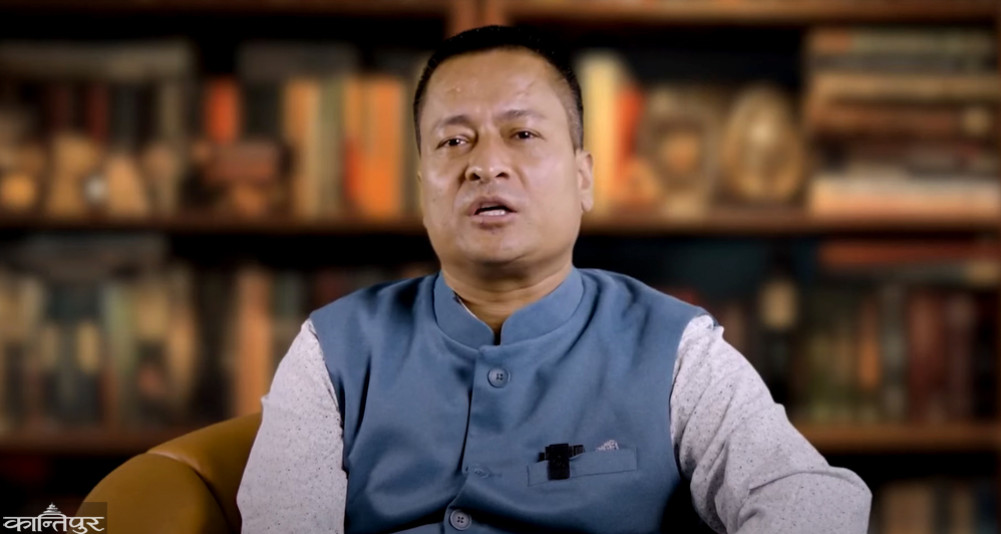
Author and pediatrician Dr. Navraj KC says: 'A patient in a hospital not only carries a disease, but also a debt. So if a doctor wants to open his mind, he can become a writer.
We use Google Cloud Translation Services. Google requires we provide the following disclaimer relating to use of this service:
This service may contain translations powered by Google. Google disclaims all warranties related to the translations, expressed or implied, including any warranties of accuracy, reliability, and any implied warranties of merchantability, fitness for a particular purpose, and noninfringement.
Pediatrician Dr. Navraj KC is equally active in the field of medicine as well as in writing. His first book 'The Price of Zero' (2079) was also popular. The book focuses on the story of the society of Karnali and how human development here is linked to the emotional and mental health of mothers.
KC's new book 'Swasparsh' has also been released. Here's an edited excerpt of five health- and generation-focused questions he has.
How is the health of Karnali now as shown by the value of zero?
Karnali has been developing in the new environment of the country for some time now. Although the standard progress that is being made globally may not be as much, positive and pleasant aspects of improvement are being seen. Earlier, the children had to be carried by their mothers in their arms in the Orali-Virali there. Now there are some roads. Ambulances are rolling. District hospitals have also started to become tight in some ways. Therefore, the human portrayal of Karnali is improving somewhat.
How do you explain the relationship between poverty and health?
Health and poverty are interconnected. In a society where there is poverty, there cannot be a good investment in health. When a person is poor, his food and living conditions are poor. He gets sicker. Therefore, poverty is a land that does not allow progress in the cycle by colliding with each other. It is very important for the state to think that its citizens are only sick when they are sick, and that they should not become poor while paying for treatment.
What is the relationship between a writer and a doctor?
Hospital is the last step of society. People go to the hospital when they are sick, when they are sad, when their relatives are sick. Hospital patients carry not only disease, but also debts. So if a doctor wants to open his mind, he can become a writer.
Once I met a brother who was collecting empty hospital bags outside my hospital. His name was Mandire Bayalkoti. I saw him and called him to my room. In his introduction, he said - 'I cook, sell, and eat rice in these empty pots.'
I also replied in his style - 'I also distribute the eggs inside the same empty basket, understand the salary and eat the rice. My life is also going on.'
He laughed so hard after listening to me. I saw that one of his hands was amputated while working in India. While speaking, he said - 'After this hand was amputated, I kept looking for the amputated hand for a long time, living in pain. One day it seemed like a knowledge dawned on me - Oh! I have a right hand and a leg. The current could have hit the head and the head itself could have been cut off. Since that day I laugh twice as much, I am twice as happy as I should be.'
I thought I might be of some assistance to him. But he helped me instead. My second book 'Swasparsha' also has his story. The story of the man carrying a heavy load outside the hospital can make people feel stressed and suicidal all over the world.
What's in your new book?
I have read many books in my life. After reading and writing, another fortune was added to my fortune - happiness was added. I got a job in my own village. While traveling in the remote areas of Nepal, I had the opportunity to read the society like reading a book. Now I want to write a socially useful book in my future life. In my second book 'Swasparsha', there is a story told to the young generation who have come under stress and are separated from life. Stories that teach those who spend their lives at war with themselves how to pick themselves up, how to embrace their mistakes. Stories of those who have succeeded using this method.
What books do you recommend reading to the new generation?
There are now four generations on earth. The first generation to raise more children after World War II. What is the brain of those who raise many children? Very disciplined, idealistic. They read and wrote similar books.
The second generation we, also called 'Millennials'. We spent some time with them and some time with the new generation. The current new generation, which we call 'Generation-Z' (Gen Z), has seen rapid progress on earth since they were born. They saw digital progress, so did their brains. They don't want to spend their lives in one job.
They don't need or like formal education like they used to. They don't want to be bound by any country or border. Therefore, Nepali literature should also do justice to the future generations. I recommend the new generation to read books with psychological and Buddhist knowledge.