We use Google Cloud Translation Services. Google requires we provide the following disclaimer relating to use of this service:
This service may contain translations powered by Google. Google disclaims all warranties related to the translations, expressed or implied, including any warranties of accuracy, reliability, and any implied warranties of merchantability, fitness for a particular purpose, and noninfringement.
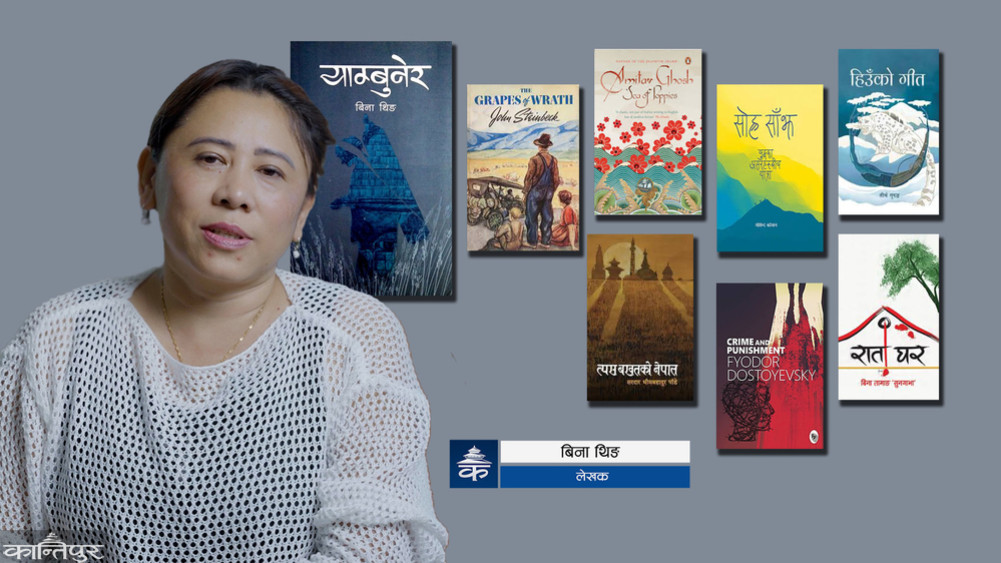
Writer Bina Thing is a teacher by profession. His story collection 'Yambuner' published in 077 is popular among readers. Earlier Thing's 'Chukki' story collection in 060 and 'Rato Ghar' poetry collection in 072 were published. Now she is preparing for a new story.
Author Bina has an edited excerpt of a conversation with e-Kantipur's regular column Five Questions :
What book did you read last time?
Lately I read the novel 'Snow Song' by Tirtha Gurung . It has been beneficial for me . 700 years before the Gurung community, there was a dense settlement with their own culture in a place called Kholasothar. The story of its dissolution is in the novel. During the colonial period, the dominant nations propagated Christianity through the narrative that their culture and art were good.
After the post-colonial period began, different communities started saying that we also have their own story. This tradition has come to Nepal as well. Tirtha Gurung also gave a continuation of that. That's why I found this book good and readable. Recently read Amitabh Ghosh's Ibis Trilogy .
It is a story of the time of the Opium War. I read its first volume 'Sea of Poppies' . Before that I had read a book called Opium War . Even after reading that, I could relate and understand myself in this novel . When India was under British colonial rule.
At that time, when they traded with China, they used to exchange only with silver coins and export their goods only. East India had a practice of not buying any goods . After the British made the Chinese addicted to opium, opium cultivation became widespread in the north of India. I read the story of how opium was brought to China by forcing people to torture and pressure them. Now there are two volumes left to grow .
Your favorite fiction? There are many
s. Due to their age, interest, and ideology, some stories have been liked by Tatkal. And then it becomes normal . Some stories continue to influence us for a long time. Fyodor Dostoevsky's 'Crime and Punishment' has influenced me in that way. The book depicts the Russian society of that time.
At that time when people are going through despair, Dostoevsky weaves both dark and light sides in one person . In some of the stories we read, the character is glorified as great and made a hero. Some have also been presented as villains. But one of Dostoevsky's abilities is to show that people are people, never gods or monsters. Due to circumstances and his problems, man can sometimes become a monster . Sometimes God can be . But Fyodor Dostoevsky said that he is actually a man.
The same person is killing someone and saving someone at the same time . I was convinced of his ability to show the dark and light side of people in a neutral way. Another is 'The Grapes of Wrath'. John Steinbeck tells the story of the 1930s in it . At that time there was a great economic depression in America. At that time, two things were on the surface in America. The
was naturally also a recession . Like the Empire of Dust . At the same time, there was no agriculture, the bankers gave interest to people, and the people there became homeless due to the tradition of imposing interest on interest. There is a story of a man's journey to California after becoming homeless. While reading the story, the detailing in it and the mood of the characters still make me like that story. I found that book when I went to an old book store. I also read that novel for learning its details and methods when I could not write.
Your favorite non-fiction? There are also many
nonfiction. The three volumes of Sardar Bhim Bahadur Pandey's "Tyas Bakhatko Nepal" are very popular. Another favorite of mine is 'Sixteen Evenings' by Govinda Prashant. After the cease-fire during the Maoist conflict, he went on a journey to West Nepal. He has written a non-narrative in a sweet style while remaining neutral on the economic, political and social effects of that war and conflict by recording the dialogues with ordinary people he met there during the journey. That is one of the non-fixations that is still influencing.
Book that came out recently but you haven't read it?
I'm a mess when it comes to reading . The books that I bring to read sometimes are kept on the rack for months. Sometimes I am reading a book while walking around the shops. Every book is accessible. It doesn't mean that he didn't get to study like that .
Book recommendation for the new generation ? Before recommending
, there are a few things to consider. What does that generation want? I want to study biology. He wants to read history. If you want to read fiction. If you just want to be entertained. I find it difficult to recommend this book as a new generation.
A person should at least read to know himself, to understand his family, society, country and international relations. Consciousness and knowledge must be taken. You can read books according to your interest . I have to read all the books of Parijat, BP and Dhach Gotame to name.