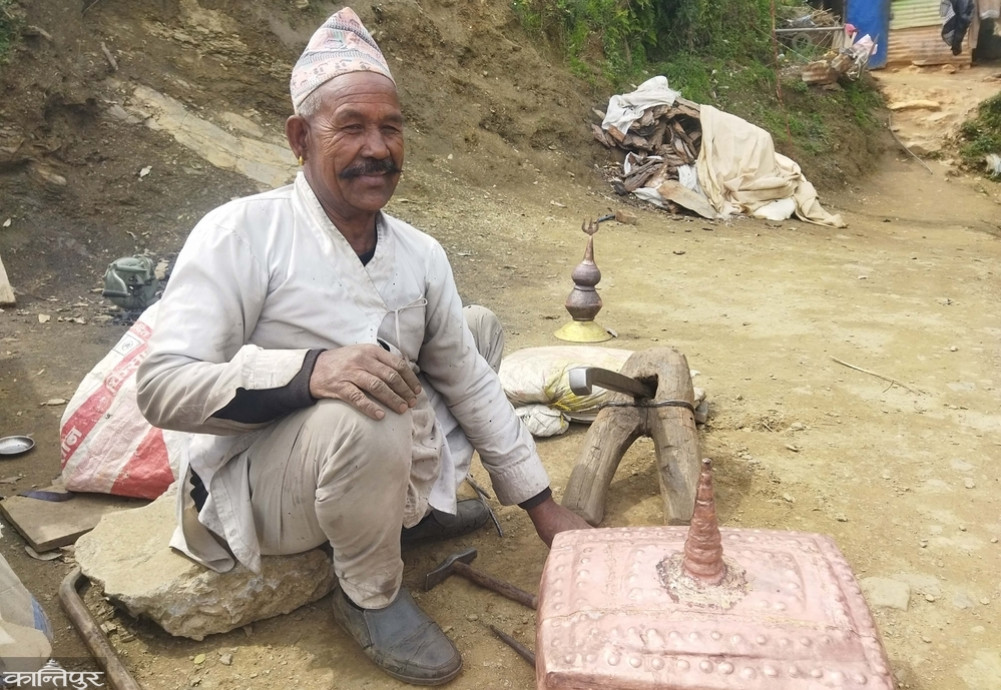
When I was in the village, the work of making copper utensils was going well. Especially, orders came in for making temple materials, lamps, urns, and worship utensils. Copper was important at that time. People associated it with culture and religion. When the materials we made reached the temple and were used in worship, there was a special sense of pride.
We use Google Cloud Translation Services. Google requires we provide the following disclaimer relating to use of this service:
This service may contain translations powered by Google. Google disclaims all warranties related to the translations, expressed or implied, including any warranties of accuracy, reliability, and any implied warranties of merchantability, fitness for a particular purpose, and noninfringement.
Now age has also started to affect me. I can hear less. As I get older, my body also doesn't support me as much as it used to. That's why I can't do as much work as before. But I haven't been able to give it up completely. Because this skill has become part of my life.
I am now 67 years old. We are living in Ranidhara, Amargadhi Municipality-5, the district headquarters. We moved here from Chhachoda, Amargadhi Municipality-6, about 15 years ago. I have four sons. Two of them are professionally engaged in this profession. They have run a shop in the district headquarters. The shop sells ready-made and handmade copper utensils. They have continued my skill. I am happy to see this.
The old house is still there, but most of my life and stories of struggle are connected to the headquarters here. My life is intertwined with copper. I learned the skill of making copper utensils from my grandfather. It was not just my choice, it was my identity, my ancestral heritage. I started this work when I was 15 years old, holding my father's hand. At first, it seemed like a game, but gradually I understood that this is a skill, this is a business, which has now become the basis of my life.
I started this work when I was 15 years old, holding my father's hand. At first, it seemed like a game, but gradually I understood - this is a skill, this is a business, which has now become the basis of my life. When I was in the village, the work of making copper utensils was going well. Especially orders came for making temple materials, lamps, urns, and worship utensils. At that time, copper was important. People used to associate it with culture and religion. When the materials we made reached the temple and were used in worship, there was a special sense of pride. But over time, that work that came with pride decreased. New materials came into the market, people's interests changed. There was no demand for copper utensils like before. Now the situation is like this - neither orders, nor income.
Even now, such orders come sometimes. Like now, an order has come from Baitadi to make materials for the temple. I am busy with it now. I can prepare it in a few days. At such times, it seems like the old rhythm has returned, the rhythm of the hammer, the sound of the copper, the skill of the hands. But that continuity is no longer there, it has become just a memory that comes from time to time.
One son is in the Terai, the other is at home. Everyone has gone their separate ways. Anyway, the family is moving forward normally today. The sons are earning money by running a shop, so the family situation is a little easier than before. But there are problems in business too. Customers tend to borrow goods from shops. It is difficult to collect money. If it does not raise money, there will be losses. This has become a big challenge in today's business.
I am not chasing a lot of income now. Sometimes the money from the goods I make covers my normal tea and expenses. For me, the most important thing now is that the family is running, that there is enough food. There is enough bread, rice, and vegetables to eat - that is what makes me happy. I have to live in the market. I have to bring them from the market and eat. I have to buy lentils, rice, and vegetables and bring them. In any case, I have been able to live with my family in happiness and sorrow. Sometimes I think, if I had continued this work professionally, I would have earned even better. But now I am not that age, I do not have that passion.
Now my sons have taken on that responsibility. The greatest satisfaction for me is that the skills I learned were not in vain. That skill has enriched my life, raised my family, and now it has become a business in the hands of my sons. Even though the old skills do not find much market today, their value is not zero. This is our culture, our identity.
Nowadays, when I sit in my free time, I sometimes sit with a piece of copper. I beat it, shape it. At that time, it feels like time has gone back. I remember my father's face, I remember his teachings. I feel that that skill is still alive in my hands. Times have changed, circumstances have changed, demands have changed, but my old skill still survives.
Presented by: Tarkaraj Bhatt
Published in the Household Expenses column Read other content also