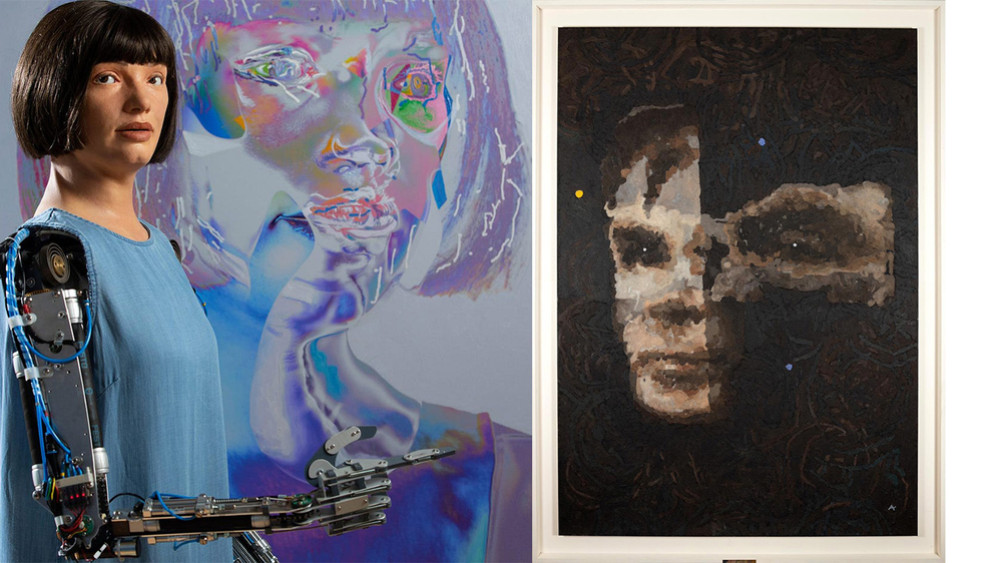
A portrait of British computer scientist and mathematician Alan Turing created by a robot named AE-D was auctioned off at a recent digital art fair in the US.
We use Google Cloud Translation Services. Google requires we provide the following disclaimer relating to use of this service:
This service may contain translations powered by Google. Google disclaims all warranties related to the translations, expressed or implied, including any warranties of accuracy, reliability, and any implied warranties of merchantability, fitness for a particular purpose, and noninfringement.
A painting made by an 'AI robot' has now made a big wave after it was sold for 1 million 80 thousand dollars (about 148 million rupees). A drawing by a robot named AE-D was auctioned off at a recent digital art fair in the US.
Dressed in jeans with a short bob cut hair, Ae-Da, who was present at the occasion, expressed her happiness that her painting was included in the auction promotion.
British computer scientist and mathematician Allen Turing's portrait (face) made by AE-D has been sold at an attractive price. It is being touted as the highest priced painting ever made by a robot. The painting was estimated at $120,000 to $180,000 before the auction went up, but it sold for about $1.1 million. A digital art sale at Sodeby's, New York's famous auction house, drew 27 bidders for Ae-Dr.'s painting. The identity of the buyer has not been disclosed according to his wishes.
British gallerist Aidan Mailer created the painting created by AI-D Robot and is named 'AI God: Portrait of Alan Turing'. This robot has a camera attached to its eye, while this robot with a robotic arm can communicate using the Large Language Model (LLM). Alan Turing's portrait created by AE-D was exhibited for the first time last May at the national federal program 'AI for Good Global Summit' held in Geneva.
According to gallerist Mailer, Ae-Dr herself chose Turing as her subject for the portrait. "We asked her what she would like to draw in the AI language model," Mailer said, "while discussing what to draw for the United Nations' AI for Good program, AE said she wanted to draw a portrait of Alan Turing." After that, they discussed with AE-D about the style, texture, expression, color combination and other features of the painting and showed a photo of Turing for study. told
'AI looked at pictures of Turing using a camera in her eye and created a sketch with her AI drawing and painting algorithm,' says Mailer Sold, it will change the approach to AI-painting in the future. Mailer says that there is a fear that AI-painting can destroy the art field itself, and the same doubt was also seen with the development of the camera. He has responded that the issue of whether to consider the picture made by AE-D as a 'picture' or not is left to the painting connoisseur.
AE-D was launched in 2019 in collaboration with a robotics company based in Cornwall, UK. It is said to be the world's first ultra-realistic AI-based robotic artist. Mailer says the Humanode robot was developed to reveal the combination of art, technology and AI. Ae-da had previously painted self-portraits. AE-Daka's self-portrait has been analyzed to give a symbolic meaning of identity and representation in how a machine takes itself and what kind of image it creates.
The concept of metaverse and digital reality is tried in the painting titled 'Leaping into the Metaverse' made by Ae-Da. It is said that digital interaction, virtual word and human-AI relationship are tried to be described through this very colorful and abstract painting. Similarly, in the series 'The Eyes of AI', AE-Daro created paintings showing the difference between human and machine perspectives, according to AE-Darobot.com. This website contains the paintings he made. After the development of platforms like
Midjourney, Dal-e, Gemini, Stable Diffusion, AI-generated art has emerged as a popular genre. It has also created criticism and controversy for creating an environment of misinformation, errors in historical accounts, copyright infringement, and job losses. According to international media, the first AI-generated art was created in the 1970s, but in the last decade, people's interest in AI artists has increased.
-