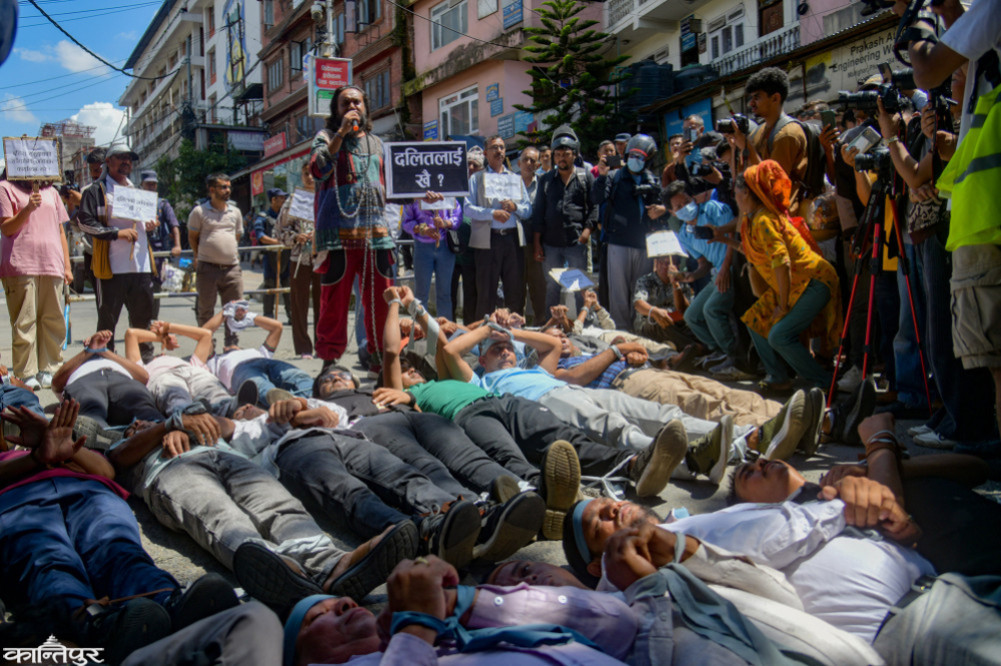
The constitution made the parliament inclusive, but the executive level is not inclusive, the main work has to be implemented by the executive level, not much attention has been paid to the representation of Dalits in the government.
We use Google Cloud Translation Services. Google requires we provide the following disclaimer relating to use of this service:
This service may contain translations powered by Google. Google disclaims all warranties related to the translations, expressed or implied, including any warranties of accuracy, reliability, and any implied warranties of merchantability, fitness for a particular purpose, and noninfringement.
I became an MP while doing student politics. At a young age, I was enthusiastic to enter the parliament. At the same time, it was like being pressed by the responsibility. But he had a dream in his heart. I had reached there by representing the village where I grew up, walked and especially the economically weak, socially marginalized community.
I was very enthusiastic in the early days with the view that I could wipe away the sorrows and tears of the community. There was also a rush to do something.
Today, two years and two months have passed since I entered the Parliament with a ray of hope and dreams in my heart. Meanwhile, a lot of water has flowed in Bagmati. However, I feel that I have not been able to achieve the expected results when I entered the parliament with the purpose and goal. The effort continues. However, everything is not completed just by entering the parliament. Basically, the main responsibility of Parliament and MPs is to make laws. However, reaching there is not only a place to make laws, but also a place to fight for justice for socially, economically and culturally backward classes and communities.
I have not shied away from the basic obligation to raise my voice for that. not tired How much the state listens and how much it doesn't listen has become different. However, if the voices of backward classes and communities are not raised in the parliament, building a society without discrimination and injustice will not be easy.
It is our basic responsibility to build a society free from all forms of injustice. How much role do I have in the parliament for that? How much can be done? I am committed to that. I have worked to prevent the state from being overthrown, to warn to stop all kinds of injustice and tyranny, and to shake the state.
Constitution itself is good. Fundamental rights guarantee the economic, professional and employment rights of all classes and communities. The necessary laws to implement the fundamental rights provided in the constitution have not yet been enacted. There is still work to be done to create laws and regulations to implement the laws.
I have repeatedly pressured and warned about that within the Parliament and the Congress party that I represent. The implementation of the existing law is also critical. Under the federal system, I have been playing a role in including cultural preservation and economic reform programs in the government's policies and plans for the development of Dalits, women, tribes, Madheshis, backward classes and communities in the budget.
What the experience of this period has shown is that it cannot be done with the same feeling that I came to Parliament as I did from the outside. There is no such thing as an agenda or a case. But the effort continues. Even in that the view of us is very different. Functionally, even within the parliament, the sense of collectivity is very low. The constitution made the parliament inclusive. However, it is not inclusive at the executive level. The main work has to be implemented from the executive level. There is still a weakness in implementing Dalits themselves.
Dalit representation in the executive i.e. government is not given much attention. Bhai Ha also represents the name only. So the executive has to be pressured again and again. However, the issues raised by one community in the parliament are not taken into consideration by the other community, Dalit issues are raised only by Dalits, tribal tribes, Madheshi, Tharu and minority issues are raised only by that community. Honorable members of other communities do not give priority, that is, they do not show solidarity. Even within the party there is uniformity in views and views. There is a lack of unity and integrity in the issue. It needs to be ripped. The
inclusion is a good feature in itself. Due to inclusion, the face of the multi-caste, multilingual, multi-religious community is seen inside the Parliament today. This is the beautiful aspect. It has helped in the capacity development of people from the lower communities. However, government access and access to state structures are still to be increased. When everyone is represented in the Parliament, the adoption of the laws made by the Parliament is done. On the other hand, the issue of whether the state has done justice or not is closely related. However, inclusion, which should be the priority of the target and class community, has sometimes not been achieved. Its main goal is to bring up the backward people even within the
community, but even within that, the marginalized have more opportunities. If it is not managed properly, it can lead to conflict and conflict. Therefore, for the empowerment of the lower classes and communities, inclusion is needed to establish their economic, social and cultural rights. However, only the representative face in the parliament cannot do all the work.
The government is above the parliament. Dalits are still only represented in the government. Sometimes it is zero. This has not worked as expected in the direction of the state giving priority to the voices, issues and concerns of Dalits and advancing the necessary policies, plans and programs. Representation is necessary in the executive and other important bodies of the state along with the parliament.
Political rights have been achieved and many laws are still to be made to exercise the rights. In particular, the necessary laws in the direction of the implementation of fundamental rights have not come. For that, it is necessary to put strong pressure on the government.
It has been ages since all kinds of discrimination have been regulated in the constitution and laws as social crimes, but even today, discrimination against Dalits continues. Recently, the pressure to annul Neha and Satyantra's inter-caste marriage and their safety has become a national issue. Parliament and the streets have to fight to ensure that no one else in this society suffers the fate of Navraj Vishwakarma of Jajarkot, who was killed in the Rukum Paschim incident. The recent incident of Neha and Satyantra has revealed that there should be a special investigation unit in the police to investigate the discriminatory behavior and incidents in the name of Dalits due to various incidents that have happened in the society.
Society has great expectations on an MP. Especially from the backward Dalit community, there is an expectation that the problem of economic security and livelihood would be solved. They don't have a good idea about the limitations of what MPs can do. How to protect financially and legally? How to do social and cultural justice? Income, how to join the business? How to manage its resources? The main challenge now is.
It is difficult to get even the right to live with self-respect without raising the economic standard of living. So the main challenge I have experienced is the financial security of the most backward communities. Government policies and programs should be focused in this direction. All a parliamentarian can do to make policies and programs and budget is to shake and pressure the state. It is not that there is no government policy. However, such a program is not reaching the actual and target community. One problem is that the union shows the province, the province shows the local and there is no program anywhere in the local.
The basic responsibility of the state is to protect the traditional Raithane skills for the upliftment of Dalits and to carry out programs for their moral development. There is a situation where the target community is not getting the budget that goes in the name of protecting Raithane profession and business. It seems that monitoring should be increased to see if such programs have reached the target community, if they have not, they should be delivered, and if they have gone elsewhere, they should be corrected.
Three generations are now represented in Parliament. Representation from grandfather to grandson generation is in the parliament. However, even though the youth like us have some representation in the parliament, they do not have a decisive role. Representation in the executive is low.
The leaders of the old generation who are running the entire state, it would be better if they understood the feelings of the youth and moved on. However, it seems that our thinking and spread is on one side and the feeling of the old generation leaders to run the government is on the other side. Understand the feeling. Understand the issue. However, it seems that there is a mistake somewhere in the implementation. Even among MPs, there is more competition than unity on specific issues. So Parliament is now a learning and understanding thing for me.