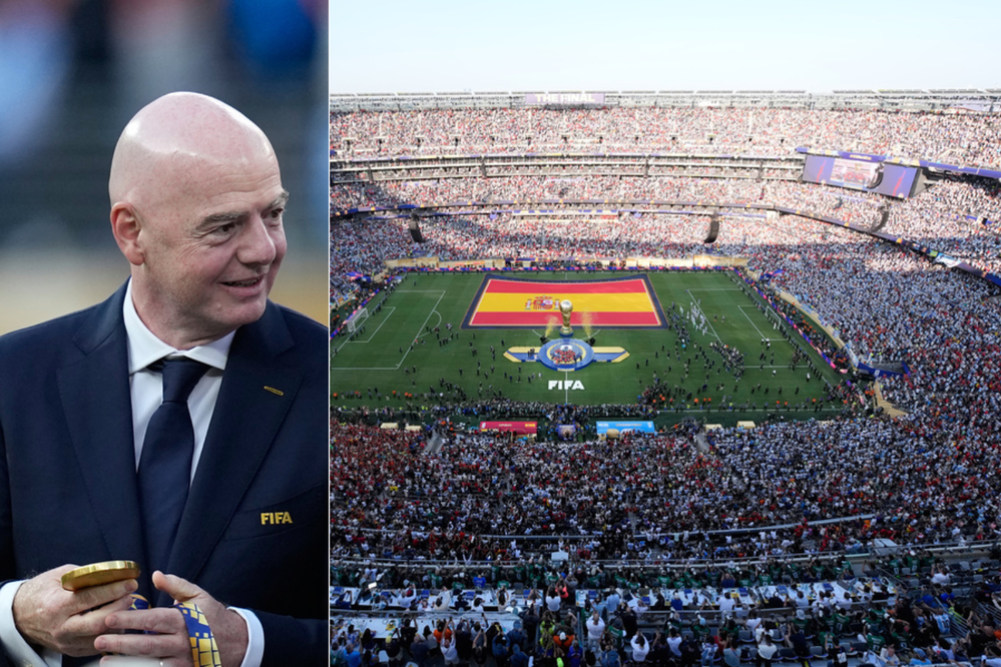
FIFA President Gianni Infantino says the suggestion to include 64 teams in the World Cup can be reviewed.
We use Google Cloud Translation Services. Google requires we provide the following disclaimer relating to use of this service:
This service may contain translations powered by Google. Google disclaims all warranties related to the translations, expressed or implied, including any warranties of accuracy, reliability, and any implied warranties of merchantability, fitness for a particular purpose, and noninfringement.
It has only been a few days since the first World Cup football tournament with 48 teams concluded. FIFA President Gianni Infantino has already started the debate on an even bigger tournament.
Infantino has not ruled out such a possibility. If such a decision is indeed made, it will fundamentally change the football economy. At the end of the World Cup, President Infantino had a lengthy conversation with Swiss television.
During that conversation, among the various ideas worthy of reviewing the tournament, he mentioned a 64-team World Cup. He believes the next World Cup could be even bigger. If this really happens, speculation has already begun about how massive the economic impact of football will be.
The bigger the tournament, the greater the management challenges. More stadiums, more hotels, more transportation. It will also take much more time. The biggest impact, however, will be economic. The meaning of the World Cup for many countries will not be the same as before when it comes to the selection process. This will reduce the commercial value of the qualifiers, but FIFA’s
own main tournament will become more important. The decrease in the commercial value of the qualifiers means that the football confederations of the six continents will become more dependent on FIFA’s financial support.
This will naturally not only increase FIFA’s financial status, but its power will also expand accordingly. Last year, UEFA President Aleksander Čeferin said, “A World Cup with too many teams is not good for the main tournament nor for the qualifying stage. That’s why I do not support this idea.”
There has been no change in Europe’s stance so far. Asian Football Confederation (AFC) President Sheikh Salman has also opposed it. His question was, where will this increase in teams stop? FIFA has not yet answered such questions. Infantino himself says, “When the World Cup is organized, it should be for the whole world, not just for European and South American countries.”
He argues, “As long as small countries are not given the opportunity to participate in the World Cup, their chances for the development of the game remain limited.”
This time, the World Cup jointly hosted by the United States, Canada, and Mexico was the biggest tournament since 1998, increasing from 32 to 48 teams, and lasting more than five weeks. 104 matches. If the tournament is organized in groups of four teams, there will be a round of 32. In a 64-team World Cup, there will be 128 matches. That is 24 more games than the current World Cup, and even double the number of games compared to a 32-team World Cup. If FIFA does not shorten the match schedule or hold many games at the same time, the tournament will last more than five weeks. An additional week will be needed.
So far, most of the matches of the 2030 World Cup will be held in Spain, Portugal, and Morocco. Uruguay, Argentina, and Paraguay will each host one match in the first round. Hosting 64 teams will be no small challenge for the six host countries. Later, organizing a World Cup with so many teams in a single country will be almost impossible.
The 2034 World Cup will be hosted solely by Saudi Arabia. Questions have already been raised about how Saudi Arabia will organize such a tournament. That year, Ramadan is expected to begin around mid-November. Therefore, the World Cup will have to return to the November–December period. The same timing was used for the World Cup in Qatar.
This will once again affect the world football calendar. It will have to be restructured in an unprecedented way. More teams mean even more training centers, hotel and transportation capacity, volunteers, etc. will be needed. This will also put pressure on the host country’s tourism industry to build its infrastructure. Saudi Arabia has proposed 15 venues for the 48-team World Cup.
Of these, 8 are in Riyadh, 4 in Jeddah, and other stadiums are in Khobar, Neom, and Abha. Saudi Arabia has said it will complete the construction and reconstruction before the 2027 Asian Cup. Work is underway accordingly. The expanded World Cup will add even more strain to an already busy international calendar. Domestic leagues will come under pressure.
Most of these domestic leagues traditionally start in August in Europe. Japan’s J-League now also starts around August, and Major League Soccer (MLS) in America also aligns itself with that schedule. Therefore, it is certain that any future winter World Cup will particularly affect Europe’s major leagues.
In such a situation, the World Cup will prove extremely expensive for any country’s association—even for a wealthy association like France. The French Football Federation estimated that it would cost $28 million for this World Cup. Its president, Philippe Diallo, said that for France not to incur a loss, its team would have to reach at least the semifinals.
That is why, at the FIFA Congress held in Vancouver in April, he said that FIFA should provide even more financial support to the host countries. If the 48-team World Cup is already putting financial strain on participating teams, it is hard to imagine what impact a 64-team World Cup would have.
A bigger World Cup will also increase the pressure on players. They will have to exert even more physical effort.
This could affect the health of the players. An even bigger World Cup will also mean higher expenses for fans. The matter does not end there; in the largest World Cup, it will lose its unique identity, and its appeal will diminish. Nevertheless, much will depend on how the current 48-team World Cup is evaluated.