Survey results indicate that most voters will not vote based on political beliefs in this election.
We use Google Cloud Translation Services. Google requires we provide the following disclaimer relating to use of this service:
This service may contain translations powered by Google. Google disclaims all warranties related to the translations, expressed or implied, including any warranties of accuracy, reliability, and any implied warranties of merchantability, fitness for a particular purpose, and noninfringement.
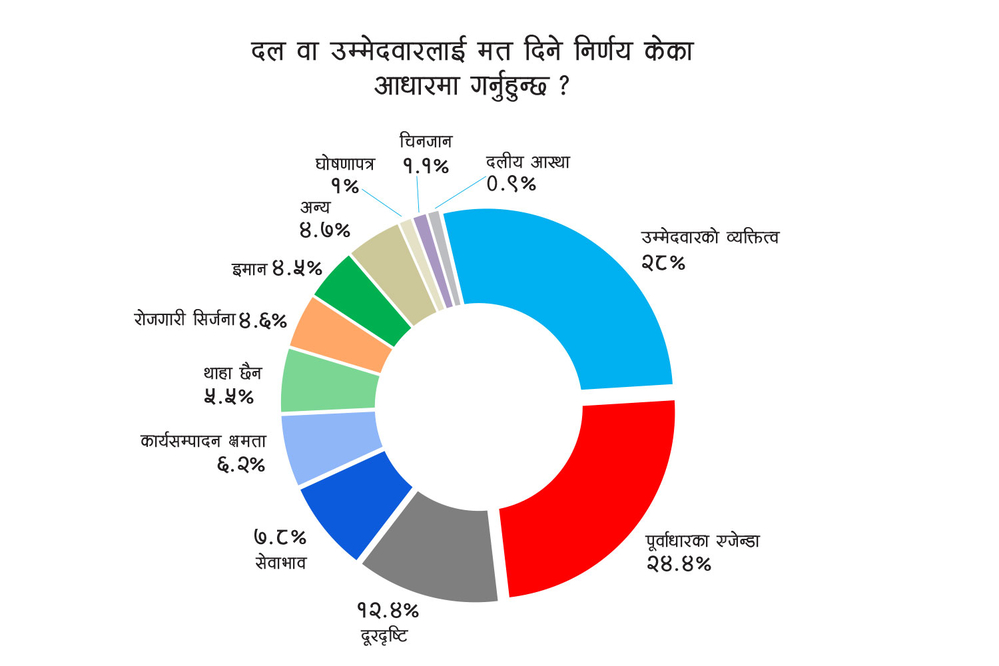
Voters are seen favoring the personality/qualifications and capabilities of a candidate as the main basis for casting their votes in the upcoming House of Representatives elections. In a nationwide survey conducted in collaboration with Kantipur Media Group and Sharecast Initiative Nepal, the highest number of respondents, 28 percent, said they would look at the personality/qualifications and capabilities of a candidate.
During the survey, 2,905 people were asked, "What basis do you prioritize when deciding whether to support a political party or vote for a candidate?" They were not given possible answer options. The respondents answered in their own way.
The survey results indicate that most voters will not vote based on political beliefs in this election. Only one in a hundred said they would vote based on political beliefs. The number of respondents who said they would vote based on the parties' manifestos and commitments is also very low. Only about 1 percent mentioned manifestos and commitments as the basis for voting.
Almost all the parties participating in the upcoming election had made their manifestos public last week. There is not much coordination between such manifestos, which are made public by giving names such as pledges, promises, manifestos, resolutions and other names to the plans to be implemented in the next 5 to 10 years, and the actual priorities of the citizens.
Respondents say that they give priority to the candidate's personality, qualifications, development and infrastructure development plans and conduct rather than the party's name and flag, ideology or philosophy. Among those who give priority to the candidate's personality/qualifications and capabilities, there are 4 percent more men than women.
Respondents who give priority to personality/qualifications and capabilities are more than those in the 50 to 59 age group compared to other age groups, and when viewed by province, the highest number of respondents are from Koshi Province.


Respondents focus directly on the candidate's qualifications and capabilities, so it seems that voters are trying to choose a candidate before the 'party'. One in four respondents in the study said that they would give priority to a candidate who can work in development and infrastructure. The number of such respondents is the second largest. The respondents' statement that they are looking for a candidate who can build development and infrastructure shows the hunger for development among the people in the country. This is also confirmed by the fact that the respondents mentioned the construction of roads and other infrastructure as the main problem in their lives. It seems that the respondents have made the 'visible work' such as roads, bridges, drinking water, sewage/drainage, construction and other improvements related to daily life as the primary basis.
There are more respondents in the Far West who should make development/infrastructure the 'main basis'. Among the respondents who prioritize those who can do development and infrastructure work, the highest number is in the Far West, 17 percent, which is about 5 percent more than the national average of 12 percent.



