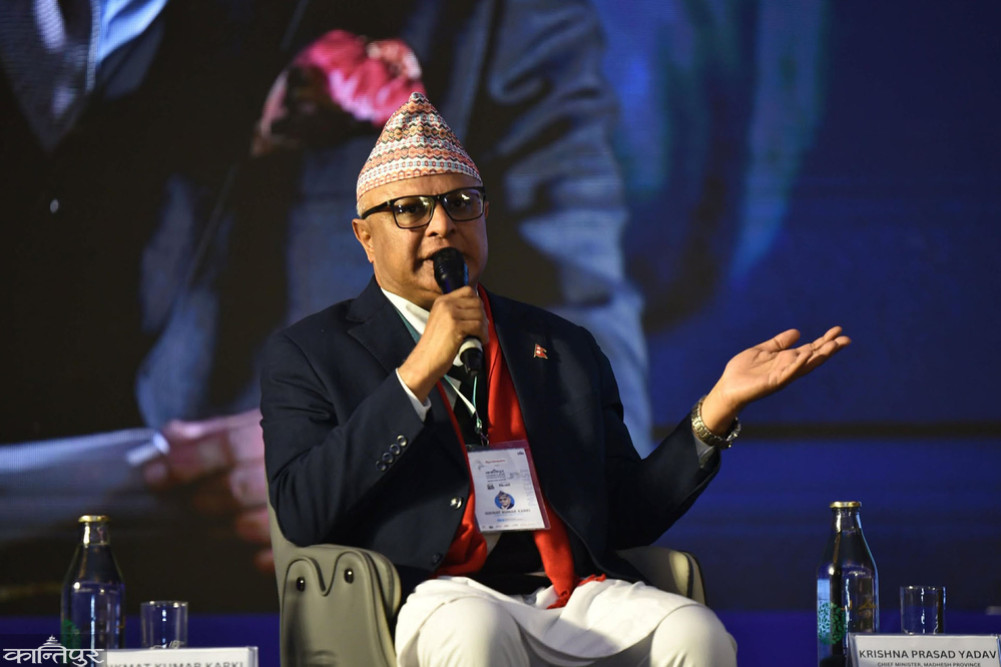
'Nepal's federalism was guaranteed by the 2072 BS constitution. It was divided into a three-tier structure and the tail of everything has been brought and brought into the central law.'
We use Google Cloud Translation Services. Google requires we provide the following disclaimer relating to use of this service:
This service may contain translations powered by Google. Google disclaims all warranties related to the translations, expressed or implied, including any warranties of accuracy, reliability, and any implied warranties of merchantability, fitness for a particular purpose, and noninfringement.
Koshi Province Chief Minister Hikmat Karki has said that federalism in Nepal has been brought for the decentralization of powers.
On Tuesday, the second day of the fifth edition of the Kantipur Conclave, Karki also said that the provinces have done a good job in the session 'Federalism: Only a Structure or a Carrier?'. Chief Minister Karki also said that the central government has not given authority to the federal structures and that there is a problem because they are linked to the central government in almost all matters. Karki said that although federalism is necessary, a discussion is needed regarding its impact on society. 'Federalism is the highest form of decentralization of power,' he said. Chief Minister Karki also said that a debate should be held on why questions are being raised about federalism and the provincial structure in society. He said that a discussion is needed if the provincial structure was brought without the people's request. 'Leaders at the top and political parties need to review this again.' He said that a situation has arisen where this question will always be raised and the leaders of political parties will always be the victims.
Chief Minister Karki said that since there has been a long debate about federalism in Nepal, there should be a discussion on the issue of delegation of powers. 'The federalism of Nepal was guaranteed by the 2072 BS constitution. It was divided into a three-tier structure and the tail of everything has been brought and brought to the central law. Because of this, no matter how much the local level and the province try to do, it is said that the elephant has entered the elephant and the tail has got stuck and the work is not performed,' he said.
Similarly, Chief Minister Karki also said that the work done by the provincial government is superficially interpreted and analyzed in the media and society. Karki said that in the past 8 years, the provinces have done more than their rights in policy development, economic development, production of prosperity and increasing productivity, providing employment and poverty alleviation.