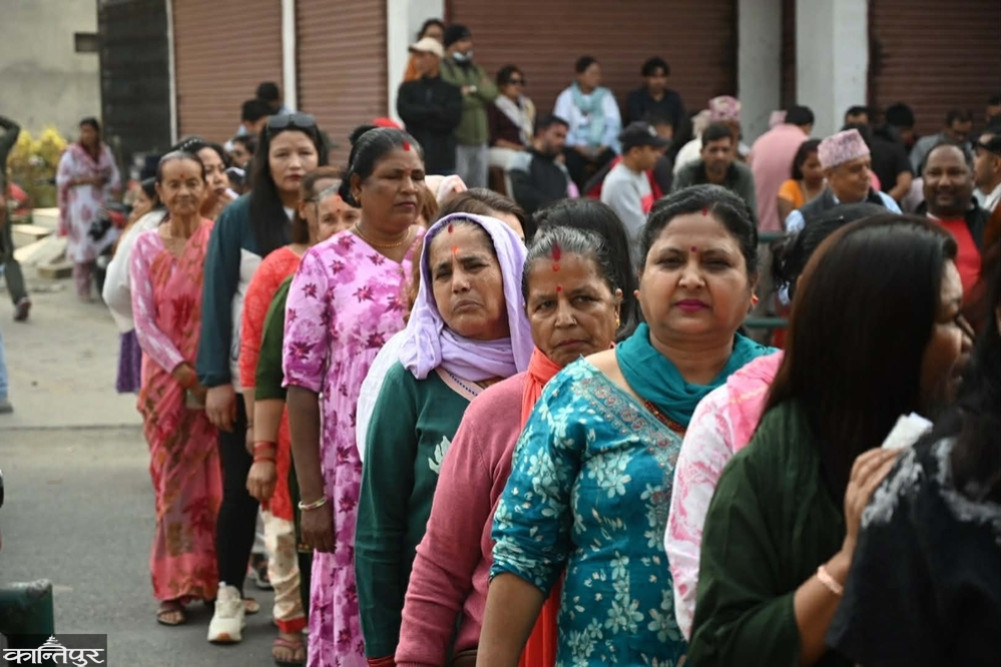
Many citizens are beginning to feel that political parties are more focused on gaining and maintaining power than on the real needs and problems of the people.
We use Google Cloud Translation Services. Google requires we provide the following disclaimer relating to use of this service:
This service may contain translations powered by Google. Google disclaims all warranties related to the translations, expressed or implied, including any warranties of accuracy, reliability, and any implied warranties of merchantability, fitness for a particular purpose, and noninfringement.
In recent years, new forces have emerged in Nepali politics. The desire for change, trust in new leadership, and the search for alternative political cultures seem to be attracting people to new parties. The increasing use of social media, the expansion of civic participation, and the activism of youth have also given further strength to this process. In this context, an important question arises—is the emergence of new forces truly a sign of people's hope and change? Or is it just a momentary attraction or an illusion?
Frequent changes of government, political instability, internal factionalism, and personal interest-based politics have gradually weakened public trust. Many citizens are beginning to feel that political parties are more focused on gaining and protecting power than on the real needs and problems of the people. In addition, issues such as allegations of corruption, delays in implementing public policies, unemployment problems, and the emigration of the young generation have also increased dissatisfaction among the people. In such a situation, educated youth have started searching for alternative political forces after not seeing the expected change from the traditional political leadership.
This disappointment and dissatisfaction seem to have prepared the environment for the emergence of new political parties and leadership. There are various social, political and psychological reasons behind the emergence of new political forces. Mainly, the growing dissatisfaction and desire for change among the people seems to have inspired the emergence of new forces. After the same political style and leadership failed to produce the expected results for a long time, the people have started to show an increasing attraction towards new thinking and new leadership. The youth have expected a political culture that prioritizes transparency, accountability and good governance.
With the emergence of new political forces, various kinds of hopes and expectations have been born among the people. Many citizens, especially the younger generation, believe that the new leadership will bring positive changes in the country. They expect honest, transparent and responsible leadership, which will work by prioritizing the interests of the people. The biggest expectation is for honest and accountable governance. The people expect the new forces to take the initiative to control corruption, utilize state resources properly and make the governance system transparent. If such a governance system can be established, then the people's trust in the government can be re-established.
Similarly, economic development and job creation are also among the major expectations of the people. In a situation where the unemployment problem in Nepal is becoming serious, it is expected that the new power will create employment opportunities within the country and create an environment for the youth to seek a future at home. There is also an expectation among the people that the new power will be implemented effectively and expand economic opportunities.
The people have high hopes for the new political power, but they are also likely to face various challenges. The biggest challenge may be the lack of political experience. Although the new leadership may have enthusiasm and innovative thinking, they may lack practical experience in governing, which may create difficulties in the policy formulation and implementation process. Another challenge is maintaining political stability. There is a tendency for governments in Nepal to not last long. In such a situation, the question may arise whether the new powers will be able to formulate long-term policies and provide stable leadership.
In addition, the gap between promises and implementation may also become a significant challenge. If the commitments made during the election cannot be implemented in practice, public trust may weaken again. Therefore, the new power will be able to maintain public trust only if it can act according to its promises. Many have seen the emergence of the new power as a sign of change. As public discontent with the long-standing traditional political style grows, many citizens feel that the new forces have shown a ray of hope.
These forces, which have been promising new leadership, new thinking, and a different political culture, have inspired the public to expect positive change. However, being new alone does not guarantee success. If the new forces also adopt the old political style or fail to act according to their promises, public trust may weaken again. Therefore, it is necessary to make a true assessment of the new forces based on their behavior, policies, and performance. In this sense, rather than calling the emergence of new forces a complete hope or a complete illusion, it can be seen as both an opportunity and a challenge. If the new forces can establish transparency, accountability, and result-oriented governance, it can become a ray of hope for Nepal's politics. But if they fail to bring about the changes expected, it may be limited to only a momentary attraction.