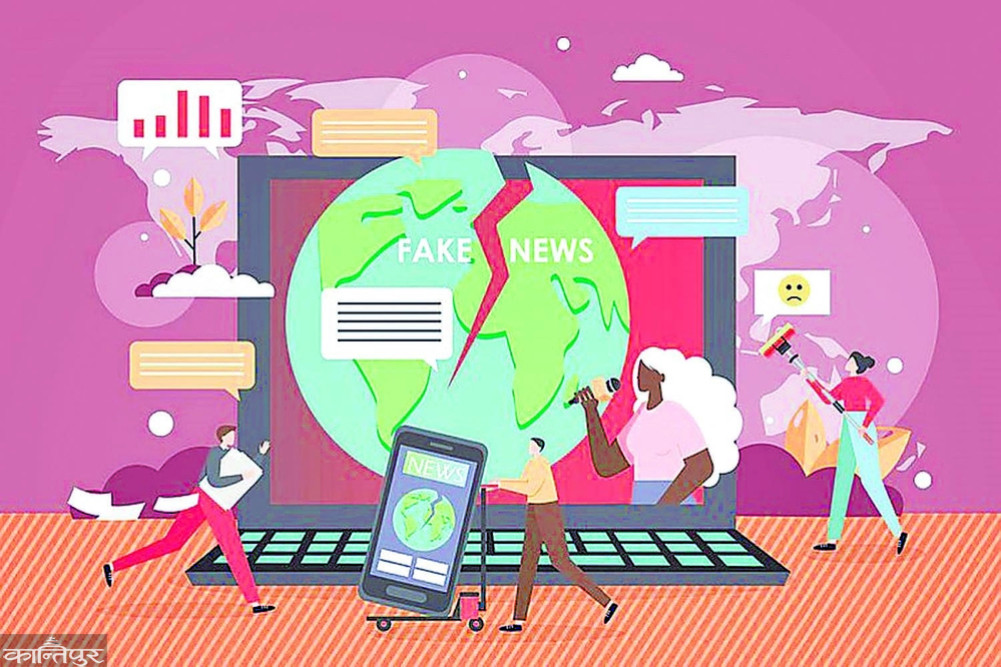
Preventing the spread of false content is not possible solely through the power of fact-checking; the entire information and communication system, the world of journalism, the country's social structure, culture, and the intellectual level of citizens all play an equally important role.
We use Google Cloud Translation Services. Google requires we provide the following disclaimer relating to use of this service:
This service may contain translations powered by Google. Google disclaims all warranties related to the translations, expressed or implied, including any warranties of accuracy, reliability, and any implied warranties of merchantability, fitness for a particular purpose, and noninfringement.
Last week, some journalists working and living in Morang district shared a photo with me. The photo, which appears to have been taken at dusk, shows about six animals on the side of a paved road.
The dim light of a distant lamp illuminates the road that looks like a rural Terai. However, the animal appears to be illuminated by some other source (camera flash?) rather than a lamp.
When I received this photo, news about it had already been published online. According to those news reports, locals were panicking after hearing that a hyena (an endangered carnivorous wild animal called hyena in English) had been spotted in a village in Rangeli Municipality-6 of Morang district. The District Forest Office was also informed about this, but the news report mentioned that the animal was not found when a rescue team was sent. The news reported that the animal may have come from India and that hyenas are only seen in western Nepal.
However, those news reports did not mention who took the photo. Later, after reading the news that it was an ‘AI-generated photo’, I uploaded it to a website called ‘Hive Moderation’, which checks whether it was generated by AI or not. The website responded by saying that it was ‘Not Likely to Contain AI-Generated Content’.
I have included this context here for a reason. In the current era of communication, it is becoming increasingly difficult to distinguish between what is right and what is wrong. Especially after major events such as protests, natural disasters or air crashes, the task of finding out the truth has become complicated and difficult due to the spread of false and misleading information. Technology-based social networks, which prioritize viral content that arouses anger over truth and facts, have now become the primary source of information. That is why this has happened. Experts have called this ‘information distortion’.
In the last decade, the terms ‘wrong information’ and ‘misinformation’ (misinformation and disinformation) have come into vogue. Generally, ‘misinformation’ refers to false information spread without knowledge. Some people share information or content based on rumors or hearsay, incomplete details or assumptions. Their intentions may not be bad, but their impact can be serious.
‘Disinformation’, on the other hand, has the intention to spread lies. The purpose of such content, which is prepared to deceive, insult, or incite or humiliate a community, is to spread confusion. Content such as edited videos, tampered photos, fake ‘screenshots’ fall under ‘disinformation’.
The photos and videos that circulated during the Gen-G protests on Bhadra 23 and 24 in Nepal heated up this rumor market. Misleading information was spread about the human losses and injuries in the protests on Bhadra 23. The arson and vandalism that occurred nationwide on the second day also became an opportunity to spread confusion. Details of how the events of that day happened and who caused them are coming and will continue to come. However, instead of revealing the truth, the photos and videos taken on that day confused people even more. There were various reasons behind it. The
video only shows one side of the incident. Another is that it does not make clear the role of the person (whether he went there to burn or to save or just as a spectator). Moreover, short videos called ‘shallow fakes’ are posted to confirm their claims rather than revealing the truth. After the Gen-G uprising, a ‘disinformation war’ began between its leaders and the old political parties (it is still ongoing and will probably continue until the elections). After the physical form of the current movement, the challenge of the commentary war about it in digital form is before us.
‘deep fakes’ and AI
Why do such materials spread so quickly on social media? The answer is more related to human nature than technology. We believe simple, straightforward and emotional stories more quickly. It takes a lot of effort to create content about complex topics. However, direct accusations like ‘such and such a leader is corrupt’, ‘such and such a community did this’, ‘the state ordered the shooting’ arouse anger.
For most people, the main source of news is still the mainstream media, although ‘content creators’ on YouTube and TikTok have also become popular in recent times. Various studies have shown that the proportion of false or misleading content is small. However, even this small amount has a wide impact during sensitive times such as protests, major accidents or elections. People naturally get agitated at such times.
Since social media also prioritizes inflammatory content, an environment is created where lies spread at once can confuse a large number of people.
There is another problem. Nowadays, anything can be dismissed as ‘fake’. Labeling a real video as ‘deep fake’ paves the way for claiming that the real video is also false or misleading. ‘Deep fake’ has been widely misused to lie.
Similarly, a trend of escaping controversy by saying that it was ‘made by AI’ has also started to be seen in Nepal. A video of Nepali rupee notes found at former Prime Minister Sher Bahadur Deuba’s house went viral. A month later, when he appeared at a public event, he claimed that the video was ‘fake’ when he explained it. He said that his home and foreign videos were cut and pasted. When he was not asked to say AI, he looked at the audience and asked, ‘What do you call that?’ When he was told that it was AI, he repeated it – ‘AI.’
Not only Deuba, but also the current interim government’s Education Minister Mahavir Pun has claimed that the photo that went viral claiming that he was receiving tika from the hand of former King Birendra was made by AI, while fact-checkers have found that the photo is of singer Purna Nepali. It has become very easy to raise doubts in the minds of the public by saying that the real photo or video was made by AI or ‘deep fake’. In this way, the problem is not only about the wrong photo or audio. There is no consensus on what is right.
Why does misinformation spread so easily?
The epidemic of misinformation is not just a technical problem, it is a matter of human nature. As conflict and division, polarization and distrust increase in any society, the impact of lies becomes stronger. According to psychologists, people do not always react based on facts. Most of the decisions we make are emotional. We also have an identity and we are connected to different groups or communities. This is why simple and straightforward claims spread faster than complex and elaborate explanations. Claims like ‘there was a conspiracy’, ‘this is a game of foreign powers’ seem to give people immediate meaning even if they do not have supporting evidence.
Why are people so easily influenced? The ‘illusory truth effect’ is the phenomenon of the same thing being repeated over and over again, making it seem like the truth. Its impact is more visible on social media. The same post is shared repeatedly through dozens of groups and pages. Even those who doubt it for the first time will wonder ‘is it true?’ after seeing it several times. The ‘algorithm’ of social media has also strengthened this.
Another important thing is that lies often come in the form of half-truths. There is a small part of the content that is true, but content that is slightly distorted and contextualized is dangerous. Images, audio, and videos created using AI make lies so natural that it is becoming difficult to distinguish between ‘what the eyes saw’ and ‘what AI created’.
Content created by replacing one person with another person or giving a new caption to an old video is now seen on the network. Videos with changed faces, altered audio, or ‘fake screenshots’ with official logos are spread. On the one hand, lies spread easily, and on the other hand, inconvenient truths are slow to arrive, leaving us in a dilemma. In such times, the suspicion that ‘everything is fake’ can also arise, which weakens even reliable sources.
The limits of fact-checking
For a few decades, fact-checking has been adopted as a way to break the web of misleading and disinformation. Fact checking is the process of collecting reliable evidence for a viral information or claim and labeling it as true, false or misleading or reaching a conclusion. However, it should not be considered an infallible tool to remove information distortion. Because it is reactive. Misinformation spreads rapidly, its reach and impact are widespread. It comes only after fact checking. A photo or video on social media goes viral in a few moments.
However, fact-checking takes time to verify it. A fact check is done by reaching out to the source, searching for it, opening the context, and presenting evidence. In some cases, evidence and events need to be analyzed. Usually, it takes 4 to 5 hours to produce and publish a fact check. However, sometimes it can take several days to conduct a complex fact check. By the time the fact check is published, people may have already reached conclusions about it.
Another challenge is that it is difficult to determine whether all topics are true/false or misleading. Some information is ‘half-truth’. For example, context has been removed, old events have been made to look new, or facts have been distorted. It is difficult to call such content false. Political and social developments are evolving rapidly. Fact-checkers also do not have a magic wand. They also have to search and research online and offline based on available reliable sources and decide on claims. The truth of some incidents only comes out much later. As the investigation progresses, new facts emerge, and decisions are overturned.
So why not do fact-checking at all? The need for fact-checking has increased. It is good that citizens' trust in fact-checking is increasing. However, the crisis of trust in our institutions is deepening. Like journalists, fact-checkers are also accused of taking the side of 'a certain party'. Some people wrongly portray fact-checking as a 'campaign to spread false theories'. As a result, the problem that fact-checking has to solve becomes even more complex.
Also, in the face of content created using AI, traditional fact-checking is starting to seem inadequate in many cases. Has a person's voice been edited in an audio? Has a face been changed in a video? What is the source of a viral photo? To answer these questions, technology-based measures such as ‘Google Reverse Image Search’ as well as in-depth research are required. There is no need to rely on technology alone because on the one hand, other complex problems arise when ‘detection tools’ are developed, and on the other hand, those companies have addressed the unnaturalness that can be detected by the naked eye. Some AI ‘detectors’ show fake content as true, while others show that the correct content was created by AI.
It is not possible to stop the spread of false content by the power of fact-checking alone. The entire information and communication system, the world of journalism, the country’s social structure, culture, and the intellectual level of citizens play an equal role.
The path to a solution
Today, we all have a deep problem with how we receive information, how we evaluate it, and what and whom we trust. AI has the ability to create voices, faces, and scenes at once, due to which the line between truth and falsehood is becoming blurred. However, technology alone cannot be blamed for this. The problem has become worse due to superstition, political polarization, conflict, and weak information systems in our society. Ironically, many people today have mobile phones, but most of them are not digitally literate. This is the biggest challenge to the spread of misinformation.
Ultimately, the solution does not lie solely in the hands of the government, the media, or technology companies. Users must demand transparency from the ‘platforms’ they use. Why does a ‘platform’ ‘recommend’ a post? Why is a content ‘boosted’? The media should also disclose its sources and processes. The government’s official information system must be agile and systematic. Only by taking all these steps together can the distortion of information be stopped. Otherwise, by the time one lie is fact-checked, many new rumors can be spread. As the saying goes, by the time the truth starts tying its shoelaces, the lie has already traveled halfway around the world.
The solution is not just to stop videos that spread instantly on Facebook, TikTok, or YouTube. समाधान तब हुन्छ, जब नागरिकले ‘यो सूचनाको स्रोत के हो र यो मेरो टाइमलाइनमा किन देखिँदै छ ?’ भनेर सोध्न थाल्छन्, मिडियाले ‘हामीले यसलाई यसरी पुष्टि गर्यौं’ भनेर बताउँछन् र सरकारले आफ्नो आधिकारिक सूचना घटनापछि होइन, घटना भइरहँदा नै स्पष्ट रूपमा सार्वजनिक गर्छ । कुनै घटनाबारे साझा धारणा त्यतिबेला बन्छ, जब सत्य पत्ता लगाउने काममा नागरिक, मिडिया र संघसंस्थाले आ–आफ्नो भूमिका गम्भीरताका साथ वहन गर्छन् ।
नागरिकस्तरमा पनि स–साना अभ्यासहरूले ठूलो परिणाम दिन सक्छन् । अस्पष्ट र भ्रामक जस्तो लागेका पोस्ट सेयर गर्नुअघि केही रोकिने, पढ्ने अनि पहिलो स्रोत खोजेर हेर्ने गर्नुपर्छ । सन्दर्भ बुझ्ने र उतिबेलै सेयर नगर्ने जस्ता आधारभूत बानीहरू अपनाउनु जरुरी छ । गलत सूचना फैलाउन एक क्लिक चाहिन्छ, रोक्न एक सचेत कदम ।
गलत वा भ्रामक सूचना बाहिरबाट मात्रै आउने संकट होइन । यो हामीभित्रै रहेको अविश्वास, आक्रोश र ध्रुवीकरणका कारण जन्मिने समस्या हो । त्यसैले यसको समाधान पनि तथ्य जाँच वा प्रविधि–जाँचले मात्र हुँदैन । समाधानका लागि नागरिकले आपसमा संवाद गर्ने, सार्वजनिक संस्थालाई विश्वसनीय बनाउने, मिडियामा पुष्टि र प्रमाणीकरणलाई प्राथमिकतामा राख्ने र सामाजिक सञ्जाल कम्पनीहरू जिम्मेवार हुनुपर्छ । – तथ्य–जाँचकी संस्था साउथ एसिया चेकका सम्पादक रहिसकेका अधिकारी स्वतन्त्र पत्रकार हुन् ।