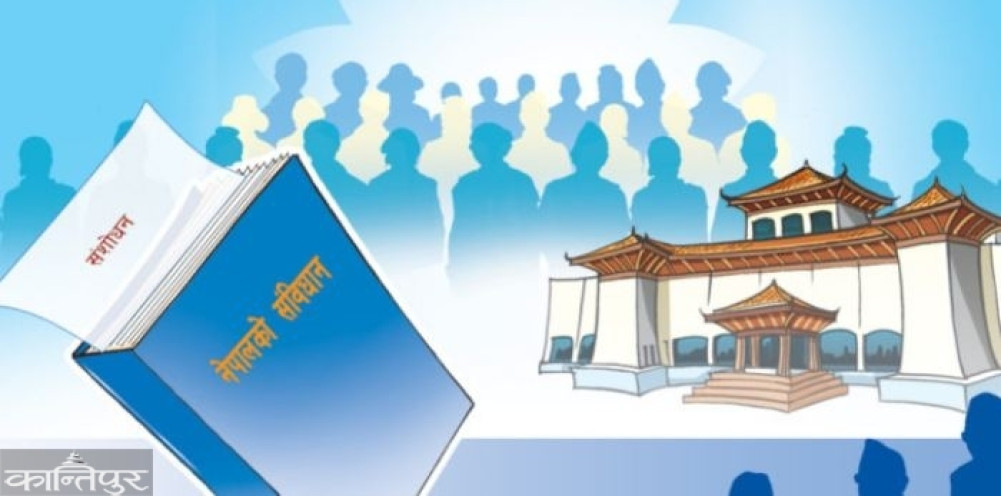
Democracy is strong only if parliament, executive, federal structure, constitutional bodies or judiciary all discharge their rights and responsibilities honestly. Therefore, the main question today is not the provisions of the constitution, but the loyalty of the political leadership to the constitution.
We use Google Cloud Translation Services. Google requires we provide the following disclaimer relating to use of this service:
This service may contain translations powered by Google. Google disclaims all warranties related to the translations, expressed or implied, including any warranties of accuracy, reliability, and any implied warranties of merchantability, fitness for a particular purpose, and noninfringement.
– Rajendra Paudel/ The country has once again fallen into a serious political quagmire due to the Gen-Ji movement that took place on August 23 and 24. Vandalism, arson and attacks on public property seen during the movement have not only affected the structure of the state, but also the economy.
Although the initial demands of the movement were focused on corruption control, transparency and simplification in the government's working style, new demands have been put forward after the incident.
During that time, the debate on the complex issues related to Nepal's federal government structure and political system has been heated again. Issues such as federalism, form of executive leadership, parliament-executive relationship, transparency of constitutional appointments and independence of the judiciary have now come to the forefront of the national agenda.
Although the formal mandate of the movement was not this constitutional debate, civil society, political parties and analysts have started to interpret it as five major demands that should be addressed through constitutional amendment.
According to the current constitution, the Prime Minister is elected by the Parliament. There is a provision to elect the leader of the party's parliamentary party or the MP who is able to get a majority as the Prime Minister . Such a system has ensured the system of forming the government on the basis of the parliament, but due to political instability, the people have been suffering the consequences for a long time .
After the constitution was promulgated in the year 2072, the prime minister changed several times from Sushil Koirala's government till today. KP Sharma Oli became the prime minister four times, Pushpa Kamal Dahal once and Sher Bahadur Deuba once. But the number of cabinet reshuffles remained high. It has made the government like a game of 'musical chairs', the impact of which is not seen in the stability of policies and civil services.
Political stability is considered more important for the country than political stability. But as the Prime Minister changes time and time again, the priorities of the government are changing. This has created a situation where plans cannot be continued, policy priorities are different and the crisis of confidence among the citizens is increasing. For this reason, the opinion that the prime minister elected by the parliament cannot govern effectively in the interests of the citizens is getting stronger.
But the concept of a directly elected executive prime minister also raises serious questions. It is not a 'panacea'. For example; At the local level, there is a system of direct election of chiefs or presidents, but there is also criticism that their performance is not satisfactory. There is a danger of personal dominance in the guise of 'populism'.
The example of world politics also shows that this system can be challenging for Nepal. Once a directly elected executive is in power, it is difficult to remove him. If such an executive favors a particular country or power, Nepal's geo-political sensitivity may be more at risk. But in that case, Parliament has limited tools of effective control to rein in the Prime Minister.
However, the problem is not only in the system, but in the thinking, competence, honesty and ethics of the leadership. In neighboring India, Prime Minister Narendra Modi, although not directly elected, is running a stable government within a parliament-based system. Therefore, rather than directly elected prime minister or not, the ability, accountability and political honesty of the people's representatives has become the main question. Before giving priority to this issue in the amendment of the constitution, it is essential to have an in-depth study and deliberation on these issues as well.
Debate 2: Non-MPs to be Ministers
Nepal's constitution has established a close relationship between the legislature and the executive. The provision that it is necessary to be a member of Parliament to become a minister has placed the executive under the direct influence of the House. It seems to emphasize 'checks and balances' more than 'separation of powers'. But in this way, the closeness of the Parliament and the Council of Ministers has also led to unhealthy political competition.
MPs often aspire to become ministers. The prime minister is also making a means of 'distributing' ministerial posts to balance the equation within the ruling party and to keep the position safe. It prioritizes the political equation over capacity and vision, resulting in an unstable and weak Council of Ministers.
This is the reason why there is a debate about the arrangement of non-MPs to be made ministers. If MPs are barred from becoming ministers, then the prime minister has an opportunity to go beyond intra-party pressures and appoint competent, honest and subject-oriented people as ministers. This can help the cabinet to increase its professional efficiency and effectiveness.
In such a system, Parliament retains the right to monitor the government's policy actions, but ministers are freed from direct pressure from Parliament. The Prime Minister has the freedom to choose his ministers and if the Minister does not meet the expectations of the citizens, the Prime Minister remains free to change the Minister and if the Prime Minister cannot maintain the effectiveness of the government as a whole, the Parliament can remove the Prime Minister through a motion of no confidence. Thus the accountability of the Council of Ministers is centralized to the Prime Minister, which can make the decision-making process clearer and faster.
But this system also has its own challenges. Ministers who do not have direct contact with Parliament may face difficulties in policy implementation. When the distance between the parliament and the executive increases, political legitimacy may be questioned. Therefore, the provision of non-parliamentary minister should be adopted thoughtfully. The option of non-parliamentary ministers can be considered as a "pilot project" to get out of the unhealthy political competition and instability that Nepal is currently witnessing. This will not only reduce the 'ministerial ambition' of MPs, but also bring professional expertise to the cabinet.
Debate 3: Abolition of provinces
Nepal adopted a federal structure through the 2072 constitution. There has been an attempt to decentralize the power of the state after the formation of the government at the three levels - union, state and local level. But in recent times, the voice of 'province should be abolished' has become intense.
One of the reasons for this debate is the portrayal of the state government as an 'unnecessarily costly structure'. The political tussle seen in various state governments, the game of making and breaking the government, the unnatural expansion of the ministries and the misuse of resources have increased the discontent among the people. In the eyes of some, the state governments are mere imitations of the Centre—all ministries, departments and commissions seem like parallel structures of the Union. It has not only increased the expenditure, but also disappointed the public expectations.
The provincial government may not have given anything to those who debated the abolition of federalism while sitting in the star hotel of Kathmandu, but the demand for abolition of the province based on the service and development administration that has been brought to this situation by the recently shifting state structure cannot be considered as a concrete answer. The main reason for adopting federalism was to end the Sinha Durbar-centered rule and to provide closer service to the people. In the past, people's representatives from Karnali or Far West were forced to go to Kathmandu to demand the general budget. Now, due to the provincial government, the possibility of prioritizing regional needs has increased. The idea of scrapping an entire structure based on a few bad practices can be like 'cutting off the hand when the finger is sore'.
However, improvement is inevitable. Basically, the provincial government is a very temporary government that has been irritated by the people, the bid to become a minister, the ministers and their allies are the main ones. It is inevitable to amend some provisions at the constitutional level to control the current distortions. For example: making a clear provision that the size of the Provincial Council of Ministers should be a maximum of 7 members, keeping the ministries of the provinces only according to the characteristics and needs of that province and making strict arrangements to control the expenditure. Also, more discussion is needed on the option of selecting the Chief Minister from Parliament or directly electing him.
Thus, the problem is more than the existence of the provincial government, it focuses on the weaknesses in its practice and operation. Instead of abolishing federalism, adopting a reforming path seems to be a practical option for Nepal's diversity and geography.
Debate 4: Transparency in constitutional appointments
The constitution has made clear provisions for the purpose of making the constitutional bodies independent, fair and competent in Nepal. But in practice, constitutional appointments are always in dispute. Allegations that appointments are made based on party divisions, balance of power and political proximity have become public perception.
For example, a big controversy arose when the then Oli government appointed 52 constitutional officials through an ordinance. It was alleged that the faces close to the party were given priority while the qualified and capable people were screened. Some of the deserving faces of these appointees also fell under unnecessary suspicion.
Appointment disputes in constitutional bodies not only weaken individual credibility, but also undermine the credibility of the entire institution. Such bodies are the backbone of the democratic system - when trust in institutions like Election Commission, Commission for Investigation of Abuse of Authority, Human Rights Commission decreases, democratic governance is directly weakened.
Therefore, there seems to be an urgent need for reforms to ensure transparency and accountability in constitutional appointments. Priority should be given to clear criteria, public hearing and proven basis of merit in the appointment process. 'Why was the appointed person deemed qualified ?' The government or the recommending body should be obliged to answer the question.
Such reforms offer two benefits—(1) ensuring that qualified, competent and honest people are brought into leadership, and (2) an opportunity to restore citizens' confidence in the constitutional body. Therefore, the main key is the honest political will to improve the appointment process rather than thinking that the weakness of the government character is a weakness of the constitution itself.
Debate 5: Independent Judiciary
The Constitution recognizes an independent judiciary as the backbone of a democratic governance system. But in recent years, the judiciary has become the most criticized organ. Controversial decisions, delayed justice and the working style of judges appointed under political influence have strengthened the public opinion that 'judiciary itself does not get justice'.
Since the Interim Constitution of Nepal, 2063, questions have been raised about the structure and functioning of the Justice Council. The current constitution has continued the same structure. Especially since the role of political parties in the appointment of judges has increased, the independence of the judiciary has been weakened.
The preference for partisan balance and personal proximity in the appointment process of judges has become a factor directly affecting the quality of justice. It seems difficult to get the impartiality and efficiency expected from a judge appointed under political pressure. This has criticized not only the judiciary, but the credibility of the entire constitutional regime.
The first step to reform is to reconsider the structure and functioning of the Judicial Council. According to the current structure, political interference in the appointment of judges is easily possible. This can be avoided by studying relatively successful practices like the 'collegium system' of India.
Two things are imperative to restore public confidence in the judiciary—(1) completely remove political pressure from the appointment process, and (2) ensure timeliness and quality in judicial decisions. If the judiciary itself becomes unreliable, the basis on which citizens can trust other organs of the state also weakens. Therefore, without sincere reform of the judiciary, other efforts to amend the constitution are less likely to yield long-term results.
Conclusion
The Gen-G movement exposed not only surface discontent but also deeper questions connected with the practice of the Constitution. Directly elected executive prime minister, the possibility of non-parliamentary ministers, abolition or reform of provinces, transparency in constitutional appointments and ensuring an independent judiciary—these five issues seem to determine Nepal's future concretely, but the way to solve them is not limited to amending the constitution. The real challenge lies in political honesty, accountability and quality of practice. A culture of instability, marginalization and partisanship undermines any system. Therefore, along with the amendment of the constitution, the reform of the political culture seems to be mandatory.
The way to bring stability in multi-diversity Nepal is not only to abolish or replace the structure, but to strengthen the institutional practice . Democracy is strong only if parliament, executive, federal structures, constitutional bodies or judiciary all discharge their rights and responsibilities honestly. Therefore, the main question today is not the provisions of the constitution, but the loyalty of the political leadership to the constitution. There is no doubt that Nepal's future journey depends on bold decisions to improve both constitutional stability and political culture.
- Poudel is the deputy secretary of the Supreme Court.