There is no need to talk about Nepal's potential in tourism. If the state builds the necessary infrastructure for tourism and promotes it in the international market, tourism income will spread everywhere through tourism.
We use Google Cloud Translation Services. Google requires we provide the following disclaimer relating to use of this service:
This service may contain translations powered by Google. Google disclaims all warranties related to the translations, expressed or implied, including any warranties of accuracy, reliability, and any implied warranties of merchantability, fitness for a particular purpose, and noninfringement.
Due to the covid-19 epidemic, wars, mutual misunderstandings between powerful nations, climate change, human life is facing a difficult situation. This is a situation where the world human community is going through an extreme economic and political crisis. After the Second World War, all the structures built by the human community, the knowledge produced and the values established have come under great doubt.
The level of economic and political crisis we are facing in South Asia from this wider world is not normal. Just as the post-war world order is in doubt today, so all our efforts for the past long time are also in doubt. When all these things are refined, today's world, driven by the continuous development of human consciousness, is now looking for something new and different. We can hope for a better world. But it is not going to happen automatically and naturally. For that, we all need to make a collective effort. Accepting this truth, the Rashtriya Swatantra Party (RASWPA) is ready to work together with everyone for that collective work and is in politics today.
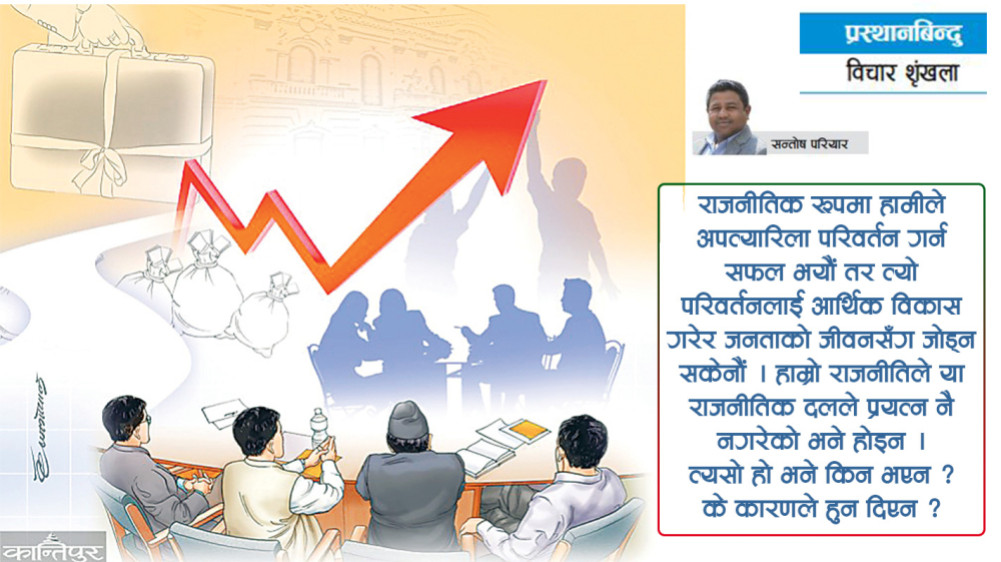
Today's Nepali economy is probably at the most complicated point in history. Some of the reasons for this are global. However, many think it is because of ourselves. Nepal has more than what is usually available in a nation-state. However, Nepali life has not been completed financially. Few countries are so rich in natural resources. The environment is even more wonderful. Despite this, we were not as financially prosperous as we should have been. Politically, we have succeeded in making inevitable changes, but we have not been able to connect that political change with economic development and people's lives. It is not that our politics or political parties have not tried. No matter how hard you try. If so, why not? Why not let it happen? We have to find answers to such questions.
Raswapa held a historic meeting of the party at Jaleshwar in Mahottari on 11th, 12th and 13th of last year. The political, organizational and economic policy of the party was made public. Which we call as 'Jaleshwar Prelude' of Rashtriya Swatantra Party. It is brief, but it speaks to the basic concept of RSVP. We said in the first letter of our preamble that we believe in a liberal economy with social justice committed to equitable progress.
This means, we believe in a liberal economy and equitable development is our priority. We develop the market, but we don't believe in economics where the market controls everything. The main thing is the state. Another thing, based on the structure of Nepali society, we cannot withdraw social justice from our economy and politics. Or let's say, the state implements several social justices and only equitable progress can take place. RSVP's understanding of social justice is a bit broader. It is the economy that implements political change. That is, the economic program. Therefore, RSP now believes that any economic policy we make should make all the provisions of the constitution a reality.
We talked about ensuring a welfare state in our introduction. We have talked about an independent economy by expanding national income and building national capital by sustainably mobilizing public, private and community resources in building a welfare state. For this, we have made a commitment to develop economic access for everyone by creating a clean and strong regulatory structure for the development of an enterprise-friendly, investment-friendly, competitive social market economy. We have talked about the social market economy.
is more important in the ground reality of Nepali society. In general, the state intervenes legally for social security and economic equality in a social market economy. However, to do this, we must enhance the capacity of the state through dynamic mobilization of private, public and community resources. So even when states are poor, they protect the weak and should. For economic equality, the state should basically bring the economy to multifaceted dynamics.
National Independent Party will work in various fields for the development of Nepali economy and the economic prosperity of Nepal.
Agriculture : Self-sufficient agriculture is also a very big thing for us today. which reduces imports to a large extent. Also, if our products can be exported to South Asia and the Middle East, our economy will be greatly expanded.
Tourism : There is no need to talk about Nepal's potential in tourism. If the state builds the necessary infrastructure for tourism and promotes it in the international market, tourism income will spread everywhere through tourism. Once the income from tourism reaches the common people, it becomes easier for the government to carry out other development works. Government can do meaningful work in education, health and security.
Natural resource utilization : Nepal is one of the richest countries in the world in terms of natural resources. How much we use it is one thing. We can say that Nepal has immense natural resources based on what we know about what is available within our borders.
The development of science and technology : With the development of science and technology, people today have been able to work at home. A large number of young people in Nepal are also working in many international companies related to technology. On the one hand, we can make our traditional working style more effective by combining it with science and technology, on the other hand, we can make it work by building a skilled workforce.
Collaboration with international companies : For the past few years, Nepal's hydropower capacity has been continuously increasing. We can allow the best manufacturing companies of the world to open their companies in Nepal by providing the necessary production electrical power, ensuring labor safety. It consumes our electricity on one hand, creates employment and on the other hand the state also receives taxes.
Actually, the development of Nepalese economy is not as complicated as other countries. However, why has the Nepali economy not been able to reach its potential level with continuous efforts over a long period of time? That is the main question today. There can be many reasons why things that are likely do not turn out to be true. They will be briefly discussed here.
structural problem : There is a problem in the structures of our state. The structures are old. They are traditionalists. They do not accept the latest changes in the state and society. Structures are supposed to make things easier, they make things more complex. As a result, economic activities shrink.
Institutional problem : After any political change, the special process of our state-building did not start. We were again forced to rely on the same old institutions. Naturally, the old institutions cannot meet the new needs. Due to institutional problems, we cannot have economic prosperity as we think or want to do.
Cultural problem : The culture of that society is very important in the development and prosperity of human society. Just as culture plays an important role for a biological human being to be social, the culture of that society also plays an important role for a society to develop and prosper.
Social problems : When human society was living, not everything was good. Politics should have removed those wrong things from the society and transformed the society, it didn't do that. I don't mean to say that it didn't happen at all, it didn't happen as much as it should have. Instead of respecting labor, a social order was created. Inclusion was established as a political issue, but it did not gain much importance in other important sectors of the state, including the economy. People were largely excluded.
The annual session of the federal parliament ie the budget session has started recently. The government makes a budget every year, but does the purpose of that budget get fulfilled or not? Income and expenditure accounts match or not? Will the budget be successful in implementing the constitution? These are the main things to look out for.
There are some suggestions before the finance minister regarding budgeting :
1. Estimates of income and expenditure should be realistic, reliable and a budget that can convey the message of improvement.
2. There should be a radical reform in the trends and structure of public finance.
3. There should be a distinct system of new thinking, departures, disruptions and transformative plans, not just gradual reforms.
4. Review the past years and prepare for potential risks.
5. The development philosophy of the budget should be institutionalized, responsible and balanced.
- An edited part of the views given by National Independent Party chief whip Pariyar in the session 'Basic needs of the economy: collective commitment of political leadership' under the 'Kantipur Economic Summit-2024' organized by Kantipur Media Group in Kathmandu on Sunday.