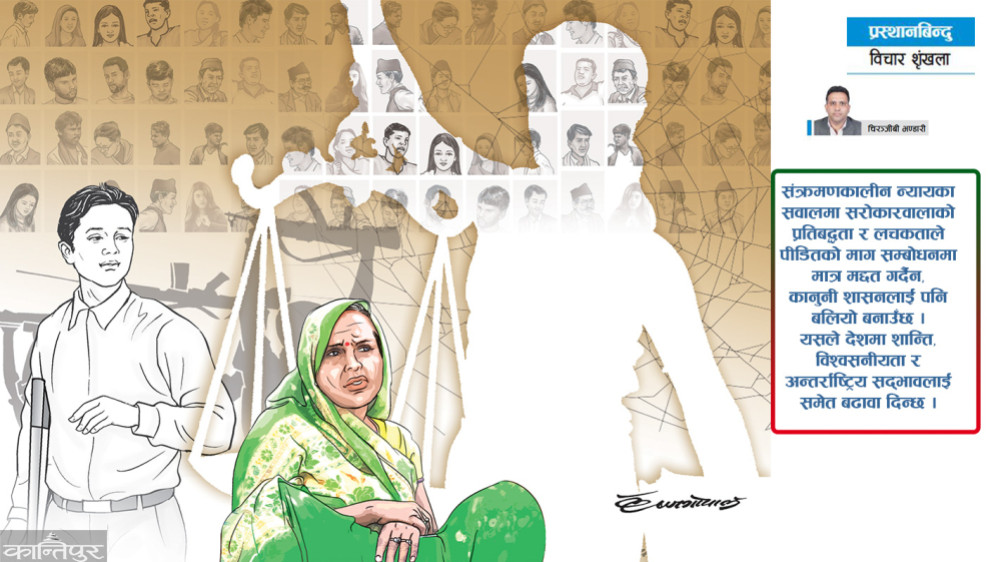
In a collaborative manner, the government, political parties, and conflict victims show flexibility from all sides to transform their existing positions into long-term interests, desires, and needs, and finalize transitional justice is Nepal's commitment to originality and peace. If resolved in this way, Nepal can become a successful and exemplary example for other countries that have gone through conflict.
We use Google Cloud Translation Services. Google requires we provide the following disclaimer relating to use of this service:
This service may contain translations powered by Google. Google disclaims all warranties related to the translations, expressed or implied, including any warranties of accuracy, reliability, and any implied warranties of merchantability, fitness for a particular purpose, and noninfringement.
Nepal's peace process is often discussed as an original and exemplary example at the national and international levels. However, even though it has been 18 years since the signing of the peace agreement, the victims of the conflict are still fighting for justice, reparation and self-respect. Looking back at the past, there was nothing wrong with the peace process.
Through the Constituent Assembly, considerable progress has been made in writing the constitution, adjustment and rehabilitation of Maoist army fighters, reconstruction of destroyed physical structures, collection of materials of conflict-affected and victims, and interim relief.
Ironically, transitional justice has been beset by various obstacles and confusions since its inception. In particular, this process involves the government issuing ordinances and laws, creating commissions, political parties never getting tired of policy commitments and not being active in implementation, courts, civil society, human rights organizations, the international community and victims expressing interest in the process of bills, laws, formation of commissions and appointment of officials. Have gone through a cycle of rejection. So, what are the main reasons why the transitional justice process has been a victim of confusion for so many years? What is the current perception of conflict victims? This article focuses on the question of what stakeholders should do to bring this process to a logical conclusion.
Development of transitional justice process
The first document of transitional justice is the Comprehensive Peace Agreement 2063. 5.2.3, 5.2.4 and 5.2.5 of this Agreement make commitments regarding transitional justice. According to Article 33 of the Interim Constitution 2063, on the basis of the report of the commission of inquiry established regarding the persons who disappeared during the armed conflict, to provide relief to the families of the victims and to investigate the truth about the persons who committed serious violations of human rights during the armed conflict and those who were complicit in crimes against humanity, and to create an atmosphere of reconciliation and reconciliation. It was mentioned that the commission would be formed.
In accordance with the purpose of implementing the detailed peace agreement and the commitment of the interim constitution, an ordinance was issued as the first legal order regarding transitional justice on 1st Chait 2069. The Ordinance provided for a single commission for investigation and truth-telling and reconciliation of disappeared persons. A writ was filed in the Supreme Court regarding various provisions of the Ordinance. Hearing the said writ, on 19th Chait 2069, the Supreme Court issued an interim order and stayed the implementation of some clauses of the Ordinance, and later the Bill became invalid and void.
About 8 years after the peace agreement, the Investigation, Truth and Reconciliation Act of Disappeared Persons was issued 2071. In accordance with the Act, the Truth and Reconciliation Commission and the Commission of Inquiry on Disappeared Persons were formed. The commission formed on January 28, 2071 worked for about four years and the commission formed for the second time according to the decision of January 6, 2076 worked for about two years and six months. The commissions that were formed twice remained active for about 7 years after being extended several times and since the term of the officers formed for the second time expired in the end of June 2079, both commissions are without officers.
A bill to amend the Investigation, Truth and Reconciliation Commission Act, 2071, in accordance with the Supreme Court's repeated directives, the concerns and suggestions of national and international organizations, addressing the demands of the victims and expanding the scope of the law, was registered in the House of Representatives on February 25, 2079. was done A sub-committee was formed under the Human Rights Committee of the Federal Parliament. The sub-committee discussed the Transitional Justice Bill in detail and submitted a report to the committee. The members of the sub-committee could not agree on four main issues in the report.
First, the issue of whether arbitrarily brutal killings or killings other than double confrontation are included in serious human rights violations. Second, the issue of how to address those involved and affected during armed conflict. Third, the issue of what to do if the victim does not have free consent for reconciliation in cases of human rights violations.
Fourth, regarding the reduction of the sentence, it is suggested that the committee should discuss more about the matter of setting a provision that the sentence can be reduced by disclosing the underlying reason or setting a percentage. In addition to that, in the latest developments, the Supreme Court issued the full text of the verdict on the petition filed by conflict victim Gyanendraraj Aran on January 15 and ordered the government to start the process of appointing officers to the Truth and Reconciliation Commission and the Commission of Inquiry into Disappeared Persons within a month. However, the process of transitional justice is becoming more uncertain as the power equation changes frequently and the commissions are left without office bearers.
Complaints registered with the Commission
According to the annual report of the Truth and Reconciliation Commission in 2080, there were 10,858 murders, 4,316 kidnappings and body hostages, 5,150 mutilations, 19,874 physical and mental tortures, rape and A total of 63,718 complaints have been registered, including sexual violence 314, property-related 16 thousand 65, displacement 5 thousand 985, disappearance 180, undisclosed 49 and other 1134. Out of which 3 thousand 787 complaints have been investigated and investigated. Similarly, out of the complaints registered in the commission, 2 thousand 268 of the incidents outside of the period of armed conflict and incidents unrelated to the conflict were decided to be kept under review by the commission and the concerned complainants were informed. It has been mentioned that some progress has been made in the detailed investigation, victim ID card recommendation and compensation recommendation as well.
According to the data of the Inquiry Commission of Disappeared Persons, out of 3,288 complaints registered, 277 complaints were sent to the Truth and Reconciliation Commission, 136 charges were deducted due to double registration and 292 complaints are pending. There are 48 cases where people have been found and charges have been deducted and 2,515 complaints that have been decided by the Commission for detailed investigation are on public notice on the Commission's website. In addition, 3 thousand 995 members of 1 thousand 321 families of the disappeared have received victims' identity cards. Due to
interruptions
Even though it has been almost 18 years since the end of a decade-long armed conflict and the beginning of the peace process, the process itself is becoming a complex, complicated and sensitive issue. The main reason why this process did not take the expected speed is the lack of common understanding between the then seven parties about the purpose of transitional justice and the necessary process for its implementation, even though it was mentioned in the detailed peace agreement and the interim constitution.
Based on the interactions and discussions with conflict victims and stakeholders in various districts over the past 15 years, the question of transitional justice is becoming more complex and complicated due to legal inadequacy and confusion, lack of willpower among political parties, appointment of commission officials based on political partisanship, and the inability of victims to be adopted in the transitional justice process. has gone The lack of necessary laws, manpower and resources for the commission, the division of officials and conflict victims on the basis of political beliefs and the presence of middlemen who see more possibilities as the process is prolonged have also added to the problem. Since the release of the Act, it has been established that the Act is not victim-centered, not in accordance with the decision of the Supreme Court, does not address international human rights and humanitarian law, and is not in accordance with the recommendations of the international community.
In other important issues related to the peace process, the party that has shown practical commitment regarding the writing of the constitution, the adjustment and rehabilitation of the Maoist army fighters, has expressed a political commitment to the issue of transitional justice, but it is an irony for the nation as a whole that it is ironic that most of the conflict victims and stakeholders have repeatedly raised the idea that have done The parties changed their views on the issue of transitional justice while in government and in the opposition, and there is a tendency to invisibly link such a serious issue of human sensitivity with the bargaining of power transfer. Because of this, it has become more complicated to investigate serious violations of human rights and crimes against humanity and bring out the real facts. The victims of the conflict are dissatisfied with the failure to create an atmosphere of lasting peace by enhancing the sense of mutual harmony and tolerance through reconciliation, by providing compensation and compensation to the victims, and by bringing complicity in serious crimes into the scope of legal action to prevent such incidents from happening again in the future.
When officials are appointed based on invisible political consensus and share rather than on the basis of qualifications, expertise, national and international experience, the credibility of the commission is also questioned. The whole process is confused because the commissions cannot work according to the principles of independence and autonomy. Although it sounds good to hear the question of resolving the disputed issue through consensus method, the parties used the name of consensus to cover up the lack of willpower and used it in bargaining for power transactions, according to the conflict victim.
Regarding the issue and process of transitional justice, a sense of invisible panic has been seen in the party leaders who were in the leadership of the government and the top leadership of the Maoists who led the movement. The fear that serious human rights incidents during armed conflicts will be investigated or punished for past incidents has not developed a feeling that this issue should be resolved immediately.
The perception of conflict victims
All conflict victims' struggles, experiences and pain are not the same. They are not victims of similar incidents. Their demands are also different depending on the nature of pain, social, economic and gender conditions. During the confused, uncertain and inconclusive struggle, some victims are exhausted and some have lost their desire for justice. They are determined to know the truth, but the feeling of revenge and revenge is not very visible.
victims are willing to take a future-oriented approach to conflict resolution and transitional justice. Most of the victims of the conflict at the ground level in Kathmandu and the remote districts are expecting truth-seeking, reconciliation, bringing those involved in serious human rights cases to justice and a guarantee that such incidents will not be repeated in the future. They also expect a public apology from the government and the top leadership of the then seven parties for the mistakes and shortcomings of the decade-long armed conflict.
The victims have demanded a victim-friendly justice process, identification of real conflict victims, respectable identity cards, scholarships for children's higher education, health insurance and easy drug treatment, adequate living allowance for injured and disabled. They also demand vocational training, grants for businesses, psychosocial counseling, humanitarian aid, skill-based employment arrangements, martyrs' memorials, and the inclusion of the history of Nepal's conflicts and victims' struggles in the educational curriculum of schools and universities. Women who have been subjected to sexual violence during the conflict are not able to register their complaints openly. Due to the lack of adequate laws, family and society's view of sexual violence against women is not entirely positive, they keep the pain within themselves. Most of the victims of sexual violence have filed complaints with the commission as victims of torture.
Lately, religious and cultural problems have also been seen among missing family members. Some people are plagued by anxiety upon anxiety. Baichan is living in the absence of truth. Instead of saying that the disappeared people will come back, they want to get the truth and do the deeds according to the social, cultural and religious traditions. Some families, unable to wait for a long time, have even done work for the missing family members. Religious rituals and traditions are issues related to the psychosocial aspects of the victims. However, the confusion of the judicial process has neglected the sensitive and important issues related to religious beliefs. This has also affected the social-cultural concept of the missing family member's inner peace or 'liberation' after life.
Another question relates to the structure and authority of the transitional justice process. Victims complain that there was no adequate consultation on any matter, be it the promulgation of the Act on Transitional Justice or the formation of the Commission. They have also raised questions about the qualifications of the commission officials, the capacity and working style of the Commission. Between political turmorant officials have expressed the view that the appointment of victims were hesisted rather than address the victims. & Nbsp;
positive change & nbsp;
is a good side to be established as a strong force in times of distress. They are integrating the sound of overall conflict victims. The question of political parties and government is creating pressure, various international communities and union are capable of drawing attention to various international community and the United Nations. The victims are struggling to acquire their rights demanding their right and answering with civil society, human rights activists, keeping their existing problems bittering. & Nbsp;
is currently activated the protection of the rights and capacity of the rehabilitation of conflict-victims of the nationality of the country, reconciliation and conflict-victims. The main reason for the victims are strong as a strong force, about two decades are continuous news of justice and a strategic advocacy, agitation, agitations, agitation and civil society. & Nbsp;
transitional justice is the subject of concerns of all Nepalis and national obligation. This is not just a matter of conflict-criticized and concerns of the government. The seven parties and the then Maoist leaders have repeatedly committed to complete the work that remaining judgment as much as possible in various national and international forums. Even in the international level, even national reputation is ensnared due to lack of permission during time. Nepal has overshadowed contributions to the construction of peace in the country through the United Nations. Most of the victims have increased, the hope of justice is changing in despair.
& NBSP; Therefore, the commitment of all stakeholders in the transitional justice and add more flexibility in the transition period is strengthened by the victim and more flexibility and helps to promote peace, reliability, and international goodies in the country. Therefore, the Bill on the parliament is necessary to issue the Supreme Court order, the feelings of the Supreme Court, the spirit of the peace process, the effects of the peace process, the effects of the peace process, and the victims as soon as possible. Commission has been more than a more and a half, and the latter court has directed the last order for completing proportion to office bearers.
is not an option to assimilate the direction of the Commission official. When appointing their qualifications, skills, skills, skills, efficiency, victims, families, or focused person, may pollinate the process. The government, political parties and conflict victims of all parties change flexibility from all parties to convert flexibility to convert the flexibility from all parties to convert the flexibility from all sides and concludes the originality and peace of Nepal. Resolving this way, Nepal can become a successful and exemplary example for other countries that Nepal rush out of the conflict.
-evaded Tribhuvan University of Department of Constitution, Peace and Development Department.