By studying the areas that make Nepal competitive, Nepal can compete with India or Bangladesh by increasing investment. As if the IT sector can be encouraged by the state, exports of 5-6 billion dollars cannot be increased.
We use Google Cloud Translation Services. Google requires we provide the following disclaimer relating to use of this service:
This service may contain translations powered by Google. Google disclaims all warranties related to the translations, expressed or implied, including any warranties of accuracy, reliability, and any implied warranties of merchantability, fitness for a particular purpose, and noninfringement.
The then Prime Minister of Japan, Hayato Ikeda, announced in 1960 - 'Income Doubling Plan'. Because of this plan, Japan's economy grew from a target of 7.2 percent to over 10 percent and doubled in size in 7 years. The goal was to double the size of the economy within ten years by prioritizing exports and industrial development. Prime Minister Ikeda pushed ahead with plans to expand investment in targeted areas, tax breaks for industry and social security.
Currently, there is a 'chip war' (semiconductor war) going on in the world, how to beat the competition in the production, export, import and use of semiconductors, which are used everywhere from mobile phones to missiles, from cars to passports, from TVs and refrigerators to computers. If there was no war between the US and China, then the Chinese company Huawei would have ruled the world through the '5G' network. Japan's Prime Minister Ikeda, who understood the importance of semiconductors, was known as 'The Transistor Salesman' in the 1960s.
In 1962, Prime Minister Ikeda presented President Gaul with a small Sony transistor radio while attending a grand ceremony at the Elysee Palace hosted by French President Charles de Gaulle. President Gol, a connoisseur of formal and grand ceremonies and a bit of a military buff, is said to have remarked to his aides that 'the Japanese prime minister appeared like a radio salesman, not a statesman'. However, within a few years, Japan became the world's largest power in electronic goods and semiconductors, and within 5 years, it surpassed France and became the third largest economic power after the United States and the Eastern Soviet Union.
If we look at the experience of the Prime Minister of India, Narendra Modi, those who lead the government must play the role of 'salesman' effectively in order to create an environment that brings in sufficient investment for the country's economic growth, development and construction. However, what we are selling for investment also becomes important. The third investment conference is going on in Nepal. Now it is natural to have a discussion about its relevance, purpose, goal and measure of success. Considering the political and economic situation of the world and Nepal, it has been argued that there is no suitable environment for the investment conference. It is a positive thing to conduct a national debate for the reform of the economy, to try to bring investors together, to set priorities for investment areas, and to try to make policy and legal reforms. However, it does not send a good message when the amendment of the law is brought through an ordinance without discussion with the stakeholders of the private sector.
Importantly, in order to say 'invest in our economy', it is important to be clear about what Nepal is selling now. At the same time, some questions naturally arise - what is the hope-confidence raised by the country's leadership towards a developed, prosperous and happy future? Do we have high-speed economic growth like Bangladesh or India or cheaper and quality labor force than them? What is the political and political stability of the country? How strong are our revenue and tax systems? Are new trade agreements with China and India and international markets guaranteed? Is there a situation where the cost of production has been reduced by Nepal's significant changes in human resources or the upgrading of roads, railways and highways and abundant electricity? How is the upheaval in the mortgage market like in India? Looking at economic and financial liberalization or tax rates, how can Nepal become an attractive destination for investment? What are the expected structural changes in the economy?
According to Nepal Rastra Bank, only 5-6 billion (15 percent of the total commitment) of foreign investment of 38 billion approved in Nepal in 2022/23 has been received. According to the Board of Investment, in the last 12 years, foreign investment equal to 12 trillion 50 billion rupees has been approved in Nepal, 1 trillion 37 billion rupees (11 percent) of investment has come to Nepal for various projects. Foreign investment of only 1 billion every year is certainly not so encouraging. Looking at the statistics, it is said that out of the 14 billion foreign investment promised in the 2017 investment conference, only 2 billion has been received, while in the 2019 investment conference, more than 12 billion was promised, but only 90 billion investment has been received.
s seem to be organized to bring in investments by giving the message that the country has now moved towards stability after a relatively successful investment conference or major political changes. Investment conferences are also held to gather the necessary resources and tools for rescue and reconstruction after major natural disasters such as earthquakes and floods. On the other hand, India's Gujarat Investment Conference seems to have been successful. The 'Vibrant Gujarat Summit', held every two years, was started in 2003 when the current Prime Minister of India, Narendra Modi, was the Chief Minister. This model is now being followed in states like Uttar Pradesh, Assam, Madhya Pradesh, Tamil Nadu, Bengal etc. In the 2024 conference alone, Gujarat has managed to sign Memorandums of Understanding (MoUs) worth Rs 2.6 lakh crore (2,600 trillion) for 41,299 projects. The previous conference succeeded in bringing in foreign investment up to 70 percent of the commitment, while this time the target is 90 percent.
The cost of means of production including labor, internal and external market size, trade openness, political and policy stability, legal rule and good governance, the state of corruption, regulatory bodies, the capacity and quality of major institutions of the state, the basic structure of development, human capital and the quality of the health sector. Foreign investors often look at it. However, looking at the experience of Rwanda and India, a clear national vision for the development and prosperity of a country or state, strong political leadership and policy stability to achieve these goals are important.
The geopolitical battle between China and the US and rising labor costs in China are in place. However, the attraction of investors towards Gujarat or the whole of India or Bangladesh is due to the goals set by them and the economic progress shown in recent years. India's Gujarat is not only targeting a $1 trillion economy by 2030, but is also achieving high economic growth. Gujarat's economy is estimated to grow by 19.3 percent in 2021-22, 15.7 percent in 2022-23, and 10.5 percent in 2023-24.
With a population of 140 million and an economy of more than 4 trillion (4 behind 12 sunna) dollars, India is now one of the fastest growing economies in the world. According to the International Monetary Fund, India's economy is estimated to grow at around 7 percent in 2024-25. India's per capita income has increased by 55 percent in the last 9 years, rising from the ninth to the fifth largest economy in the world. In the next two to three years, India will surpass Japan and Germany and become the world's third largest economy after America and China.
Like Japanese Prime Minister Ikeda, India has set a target of doubling its economy by 2030. If India's economy grows at 6 to 6.5 percent, the economy will double in the next 7 years. Many say that democracy is eroding in India, but when it comes to political stability, if Modi's party wins this election, he will rule for 15 years. The budget focuses on comprehensive reforms in 70 sectors, from skill development of labor force to increase exports, from upgrading of highways to expansion of production in factories.
From the world's longest highway tunnel (Atal Tunnel) to the world's highest rail road bridge (Chenav Rail Bridge), India is taking a big leap in infrastructure construction. In the last 10 years, the network of highways in India has increased by 60 percent and the construction of 34,800 km of highways is at a fast pace. India's exports, including defense sector products, are targeted to increase from $700 billion to $1.58 trillion by 2030. At the same time, India's manufacturing and manufacturing sector is growing at a rate of 8 percent. At $4 trillion, India's mortgage market is now the sixth largest in the world. India, which is leaping in the fields of digital economy, financial inclusion, green energy, etc., has given incentives of 26 billion dollars in 14 sectors including electronic products, cars and buses, pharmaceuticals, and medical equipment to attract the world's biggest investors for production.
Bangladesh with a population of more than 170 million is a more attractive destination for investment than Nepal in terms of labor market. However, Bangladesh has prioritized qualitative infrastructure development (including technology infrastructure development) and 11 ministries are working in coordination for further development of the production and export sectors. The development of manufacturing and industrial sector has always been at the center of Bangladesh's development plan. Bangladesh has received 8 billion dollars in aid to combat climate change.
Although the Prime Minister of our country seems to be stable, the investment conference continues in Nepal amid political instability. There is no policy stability when three Finance Ministers change in 15 months. Also, Nepal is a country with unstable tax rates. Nepal, which achieved a low economic growth rate of 1.9 percent in 2023, is estimated to achieve about 4 percent in 2024, while Nepal's foreign investment is 0.1 percent of GDP. The share of the industrial sector in the total domestic product has dropped to 4-5 percent and even the special industrial sector has not been able to do much. It is said that there is load shedding of up to 14 hours a day in the industries of Nepal and the capacity of the industries is limited to 40 percent.
It will be difficult to attract foreign investment if the country's economic growth does not keep pace and there is no progress in trade and production. Due to the revenue not rising as expected, it is difficult to increase the government investment in infrastructure construction, while the capital accumulated in the bank is not being properly mobilized. Similarly for capital expenditure
The situation where the allocated budget is low (17-18 percent of the total budget) and the capital expenditure is even lower is a challenge in itself to increase investment. The progress of the Rashtriya Gaurav Yojana and other priority schemes over the years towards building infrastructure has been disappointing. Obstacles such as land acquisition, forest and court entanglement, security etc. are still there, due to the poor quality of highways and the high price of land, Nepal is a country where the means of production are expensive.
In this background, Nepal's investment conferences should be freed from becoming ritualistic. The 16th Five Year Plan aims to increase the economy to 81 trillion by maintaining an average economic growth rate of 8.5 percent in the next five years, which is not a realistic target. If it happened before the Corona period, it would not be possible to achieve the average goal of 8.5 percent, but the average economic growth rate of the world in 2024 is estimated to be only 2.6 percent.
The World Monetary Fund predicts that only seven economies (China's Macau, Guyana, Palau, Niger, Senegal, Libya and Rwanda) will achieve economic growth above 7 percent in 2024. If these economies have their own characteristics, Nepal has such a competitive sector, which will achieve an average growth of 8.5 percent in the next five years. For Nepal, which has achieved an average economic growth of 4 percent in 60 years, to meet the target of 8.5 percent, a radical change in the structure of the economy is necessary on the one hand, and on the other hand, an investment of about 9-10 billion dollars is required. The target of 9-10 trillion dollars is like the fruit of the sky for Nepal, which received only 250 million dollars in foreign investment in 2023.
Nepal's National Planning Commission, like India's Policy Aayog, should lead a detailed study and investigation into why the investment did not flow in as promised. Nepal should go to the Sri Lankan government's concept of reforming the justice system by forming six special committees to increase investment, legal, policy and structural reforms, mediation in industry-business and trade disputes and taking cases on a 'fast track'. Nepal cannot become an attractive destination for investment by showing improvement in only one sector.
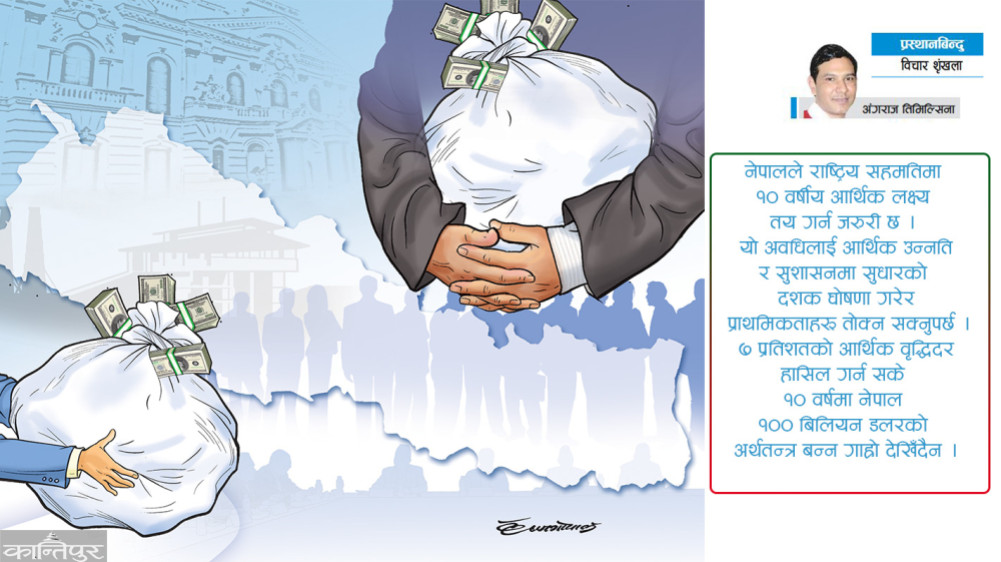
It is necessary for Nepal to set a ten-year economic goal with a national consensus. In other words, making Nepal's economy worth 100 billion dollars by 2034 and according to this goal, priorities should be set by declaring the next decade as the decade of economic progress and reforms in good governance. If an economic growth rate of 7 percent can be achieved, it does not seem difficult for Nepal to become a 100 billion dollar economy in 10 years. Declare this decade as the decade of qualitative change in Nepal's infrastructure and try to bring radical changes in the fields of roads, highways, railways, tunnels, electricity, education, and health.
Nepal can compete with India or Bangladesh by studying the areas that make Nepal more competitive and increasing investment. As if the IT sector can be encouraged by the state, exports of 5-6 billion dollars cannot be increased. There is great potential in many areas from green hydrogen, hydropower sector, tourism, organic farming, making Nepal a regional financial center to trade network connecting India and China. As Gujarat did, Nepal should continue to hold investment conferences every two years. For this, it is necessary to create a permanent structure under the National Planning Commission and entrust it to the Planning Commission itself.