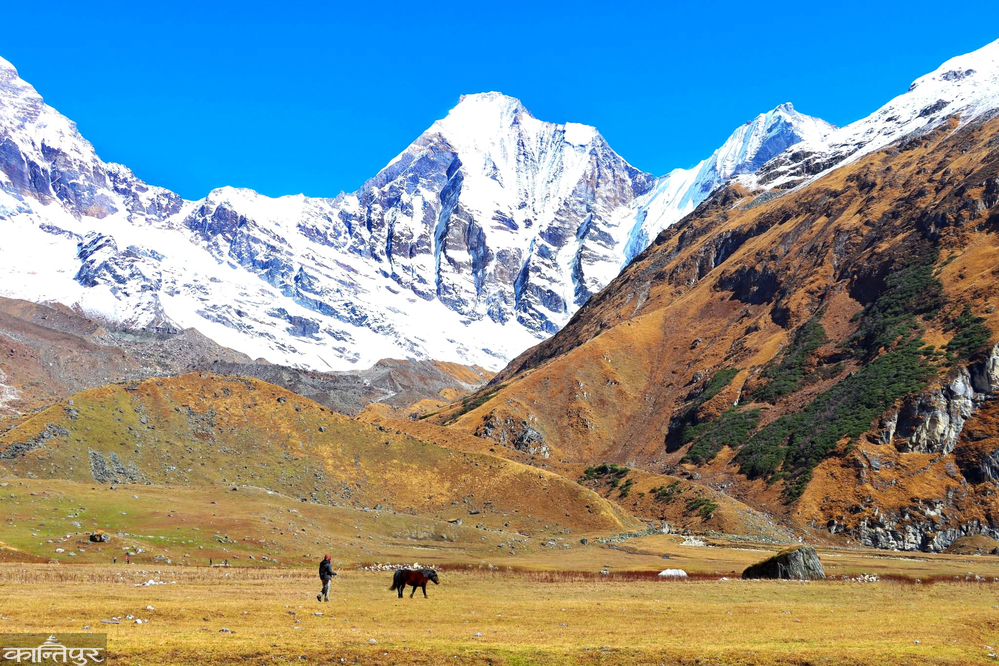
Badimalika, Ramaroshan, Khaptad, Saipal, Api Himal, and other renowned destinations of Sudurpaschim have seen an increase in tourist attraction, but infrastructure remains the main challenge.
We use Google Cloud Translation Services. Google requires we provide the following disclaimer relating to use of this service:
This service may contain translations powered by Google. Google disclaims all warranties related to the translations, expressed or implied, including any warranties of accuracy, reliability, and any implied warranties of merchantability, fitness for a particular purpose, and noninfringement.
One morning in Asar, a jeep was climbing up the rough road to Jadlek in Saipal Rural Municipality, raising clouds of dust. The jeep carried domestic tourists from Bajhang, Dhangadhi, and Dadeldhura. Their destination was the southern base camp of Saipal Himal, Aulagadh, the western base camp Raidhugi, and the valley of Maja surrounded by mountains.
They were filled with excitement to see in person the enchanting scenes they had seen on social media. The trek that started from Dhaloun reached the southern and western base camps via Kakarkot without difficulty. But after heading towards Maja Valley, about four hours from the western base camp, their journey came to a halt. Although they followed the narrow trail from Raidhugi towards Gadul Himal for a while, the path soon disappeared.
The trail was so narrow that only one foot could be placed at a time, with cliffs on both sides and bushes in the middle. Ultimately, the group decided not to risk it and turned back. “There was only a path wide enough for one foot. We moved forward holding onto the grass, but then there was nowhere left to step,” said team member Bir Bahadur Dhami. “Looking down, there was only a cliff. Some friends felt dizzy. We thought it was better to turn back than risk our lives.”
Dhami shared that even a simple trail marker would have helped, but due to the lack of a path, their journey was left incomplete. Such scenes are now common not only in Maja but at many destinations in the west. The number of tourists coming here after seeing the beautiful and attractive natural landscapes on social media is increasing every year. However, due to the lack of necessary infrastructure for tourists, not only at new destinations but even at established ones like Saipal, Api, and Khaptad, visitors are forced to return with some complaints despite the natural beauty. As a result, despite the growing attraction and world-class potential of these destinations, the expected tourism activity has not materialized due to weak infrastructure.
Until a few years ago, Khaptad, Saipal, and Api were preferred only by a limited number of trekkers and researchers, but now, thanks to social media platforms like YouTube, Facebook, Instagram, and TikTok, they are widely discussed. After Prime Minister Balendra Shah posted a short video of himself playing cricket at the base camp of Api Himal on his Facebook, the area suddenly gained attention. Similarly, after Prime Minister Balendra referred to Badimalika as the “father of Switzerland” during an election rally in the Far West, Badimalika also went viral on social media.
 Statistics from the Department of National Parks and Wildlife Conservation under the Ministry of Forests and Environment also show an increase in tourist numbers at these destinations in recent years. According to the department’s report, 29 foreign tourists visited the Api Nampa Conservation Area in fiscal year 2081/82. However, data from Api Himal Rural Municipality in Darchula shows that more than 5,000 tourists reach the Api Himal base camp alone each year.
“The number of tourists recorded by the National Park staff sitting at the district headquarters is very different from the actual number coming here,” said Api Himal Rural Municipality Chair Bhagat Singh Thekare Bohara. “According to the municipality’s data, more than 5,000 tourists, including about 150 foreigners annually over the past three years, have visited Api.”
Compared to other destinations in the Himalayan districts of the Far West, tourists have found the Api base camp trekking route to have better infrastructure. A safe trekking trail has been constructed up to the base camp. Along the trekking route, including the base camp, there are four guest houses and four tea shops in operation, and five villages along this route have homestays. However, Chair Bohara says that the current infrastructure is insufficient to handle the growing number of tourists.
The number of visitors to Khaptad, another popular destination in the Far West, is also increasing every year. According to the National Park Department’s report, between 2069/70 and 2074/75, only 19 to 46 tourists visited Khaptad National Park annually, but since 2075, around 3,000 tourists have visited each year.
There are many examples of tourists having to spend cold nights due to a lack of suitable accommodation when numbers are high. Some tourists have even gotten lost after missing the trail due to insufficient signage.
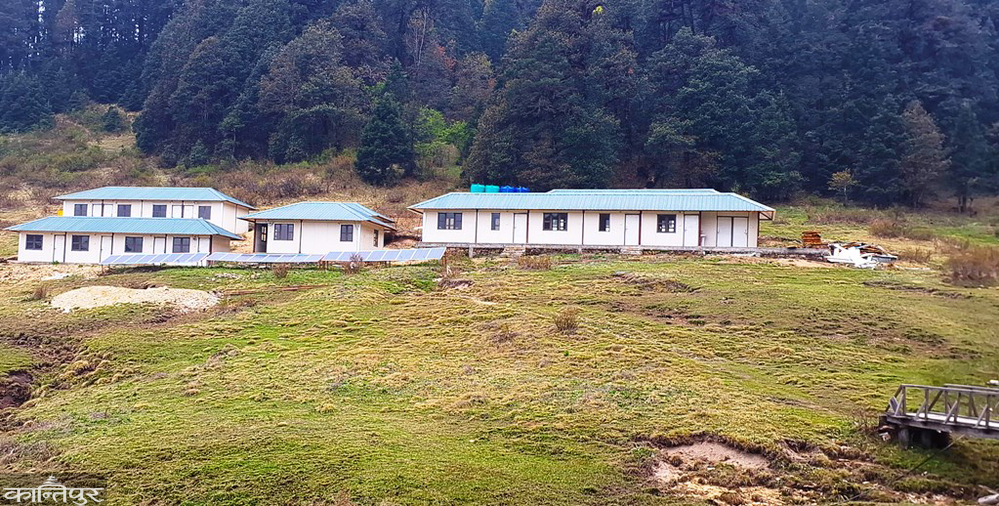
Meanwhile, structures built here with significant government investment have become dilapidated due to lack of use. The latest example is the so-called well-equipped building constructed for tourist accommodation in Khaptad. Eight buildings with a total capacity of 80 beds near the main barracks of the park and 20 beds at Bichpani for tourists coming via the Doti route have been left unused for seven years.
The contract process for constructing buildings to accommodate 150 tourists in a well-equipped manner began in 2076. Using the 50 million rupees allocated by the Nepal Tourism Board in fiscal year 2075/76, Khaptad National Park awarded the contract and built prefab technology-based buildings. These buildings, equipped with technology to keep rooms warm even in cold weather, are about to complete three years since construction. But tourists still have to spend the night in the cold and take photos in front of these buildings in the morning.
“We have repeatedly requested everyone from the chief conservation officer of the park to the department to bring these buildings into use quickly,” says Khem Joshi, executive director of the Khaptad Area Tourism Development and Management Committee. “They keep making excuses, saying the operating procedures are being prepared. The buildings have started leaking even before coming into operation.”
The number of visitors to Saipal, another major destination in the Far West Province, is also increasing annually. According to Saipal Rural Municipality, before the COVID-19 pandemic, about 100 to 150 tourists visited Saipal each year, but now 300 to 400 arrive each month. Visitors here also face problems due to lack of infrastructure.
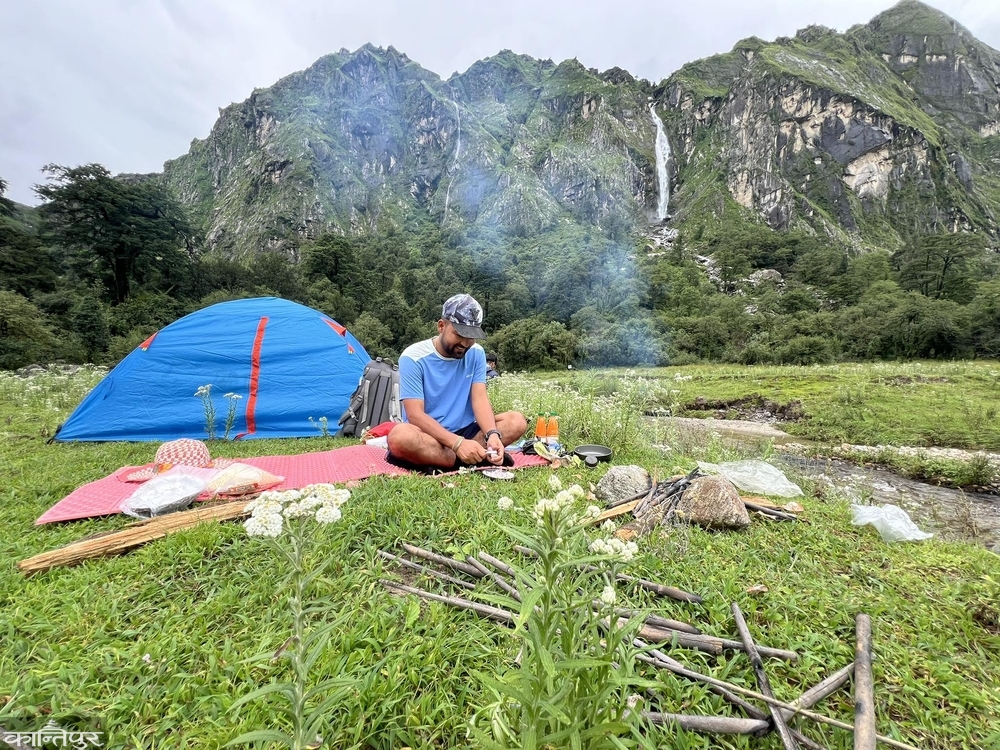
Some sections of the trail are risky because damaged paths from floods and landslides have not been repaired in time. In some places, due to the lack of safe bridges, tourists have to cross rivers precariously using narrow supports. While there is accommodation available up to Dotalle, which is about half a day below Saipal base camp, those wishing to stay at the base camp must bring their own tents. Saipal Rural Municipality Chair Manbir Bohara said that preparations are underway to build accommodation structures above Dotalle.
It takes two to three days to reach Khaptad from Kathmandu. It can be reached via Bajhang, Bajura, Doti, and Achham. To reach Saipal base camp, one must travel by jeep from Dhangadhi to the district headquarters of Bajhang and then to Dhaloun in Saipal Rural Municipality, from where a one-and-a-half-day trek begins. To go to Api Himal, after a road journey from Dhangadhi to Darchula, the trek starts from Makrigad. From there, it takes about three days of trekking to reach the base camp.
As the number of tourists increases, cycling enthusiast and tourism activist Bharat Bikram Shah says that well-managed trails, information boards, rest stops, rescue points, and tourist information centers are needed everywhere.
 In some places, trekking without a local guide is risky, so visitors have felt the need for trained guides, porters, trekking maps for foreign tourists, digital navigation, weather information, and emergency contact systems, according to Shah. Fifty-five-year-old Sushma Bhatt from Dhangadhi has been planning to visit Badimalika for many years. But after hearing that the roads and accommodation and food arrangements are poor, she has not dared to go.
Badimalika, filled with religious significance, unique natural beauty, and biodiversity, is one of the most attractive tourist destinations in the Far West. However, due to the lack of trails, accommodation, drinking water, toilets, communication, and other basic infrastructure, tourists still face hardships there.
In recent years, the popularity of Badimalika has increased significantly. The federal government’s budget for fiscal year 2083/84 includes plans to construct the Shuklaphanta–Khaptad–Badimalika tourism corridor and to develop the Khaptad–Badimalika–Ramaroshan–Budhinanda–Rara–Swargadwari high-altitude eco-tourism trail. The hundred-point governance reform agenda announced by the government led by Prime Minister Shah also mentions preparing an implementable plan for the Badimalika trekking route after conducting a study. However, there has been no clear progress on implementing these plans.
The Far West Province government also formed a task force for tourism infrastructure development in the Badimalika area. The report prepared two months ago concluded that about 1.79 billion rupees would be needed to build infrastructure such as easy access, safe trails, accommodation, and drinking water. However, the province’s budget for fiscal year 2083/84 does not allocate a separate budget for Badimalika.
Every year, a special puja is held at Badimalika Temple on the eve of Janai Purnima. Due to the belief that wishes are fulfilled after visiting, pilgrims come from Uttarakhand, Kumaon, and Garhwal in India, according to priest Netra Raj Padhyaya. Along with its religious significance, Badimalika is also considered a unique destination for its natural beauty. Tourism promoter Bharat Bikram Shah says that the lush meadows spread over about 14,000 feet, colorful flowers, rare plants, and wildlife attract everyone who visits.
Padam Bikram Singh, president of NATA Far West, said that the “Khetibeti” area of the Triveni region is itself a unique natural and cultural heritage. He said that due to religious beliefs, natural beauty, and snowfall, there is also potential for ice skating here. In recent years, conservation challenges have increased in this area, which is home to rare wildlife and valuable medicinal herbs.
Forest Officer Dan Bahadur Thapa of the Ministry of Industry, Tourism, Forests, and Environment said that free grazing, illegal collection of medicinal herbs, and poaching have put the region’s biodiversity at risk. “From Chaitra to Bhadra, large numbers of livestock are brought here to graze. The collection of medicinal herbs and poaching are also increasing,” he said. “If conservation is not done in time, it will affect the natural heritage itself.”
Despite so much potential, the biggest problem in Badimalika remains the lack of basic infrastructure. The trails are not safe. There are not enough lodges, toilets, drinking water, hotels, or rest stops for travelers. “If we are to talk about tourism development, the first thing we need to do is build basic infrastructure,” said Dammar Mahat, Ward Chair of Badimalika Municipality–2.
Province Tourism Unit Chief Double Bahadur Bohara said that small lodges and some trails with railings have been constructed near Budhimai’s shrine and Badimalika.
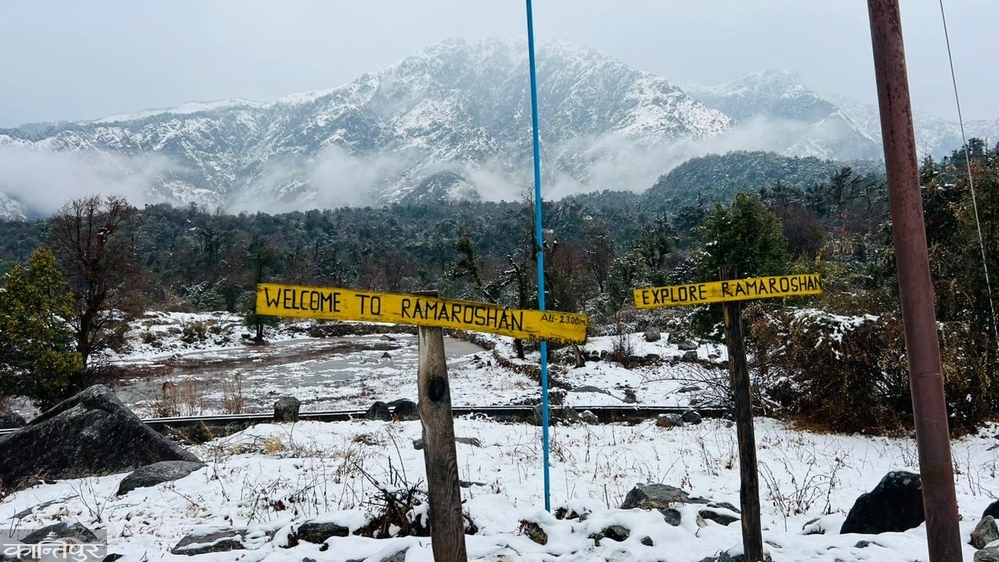
Due to its natural beauty, rare biodiversity, and vast grasslands, Ramaroshan in Achham has become increasingly attractive to tourists in recent years. However, the lack of reliable roads, communication, accommodation, and other basic infrastructure has made it challenging to reach here during the rainy season.
Spread over an altitude of 2,000 to nearly 4,000 meters above sea level, Ramaroshan is known as “12 Bund, 18 Khand.” There are 12 lakes and 18 vast meadows here. The Kinemine meadow, spread over 52 bighas, is considered the largest pasture in Achham, with the Kailash River meandering through its center. According to Purna Bahadur Bik, executive officer of the Ramaroshan Area Tourism Development and Management Committee, the lakes here have their own unique features. The three-kilometer-long Jingale Lake is shaped like the English letter “C,” and when standing on the shore of Lamadah Lake, one can feel the water moving up to 10 meters. “In spring, 12 species of rhododendron bloom here. The forest echoes with the call of the Himalayan monal. This is also a safe habitat for deer, musk deer, Himalayan tahr, and goral,” he said.
 Prime Minister Shah said that after Ramaroshan was mentioned as Nepal’s unique natural heritage during the last election in Dhangadhi, its popularity soared. Since then, the number of visitors from cities such as Kathmandu, Pokhara, Butwal, and Dhangadhi has increased, according to Gopi Khanal, chair of the Ramaroshan Area Tourism Development and Management Committee.
Local entrepreneur Shamsher Bahadur Bohara said that many tourists have had to turn back because of the road. “The road by the river gets washed away during the rainy season. It’s very difficult to go above Mujabagar,” he said. “Many tourists have started coming, but everyone has the same complaint—why is the road so bad?”
Locals complain that although a budget has been allocated for Ramaroshan’s development for the past fifteen years, no work has been done that makes a visible impact. “Previously, the budget came not according to need, but according to individual wishes,” said Bik. “Budgets would come in the name of Ramaroshan, but nothing would happen in the field, which has stalled development for a long time.” Bohara said that last fiscal year, some minor construction was done with the province government’s allocation of five million rupees.
Currently, the biggest obstacle to reaching Ramaroshan is the road. The rough and narrow road from Mujabagar to Ramaroshan is extremely dangerous during the rainy season. In some places, landslides and rivers wash away the road, cutting off access entirely. This affects not only tourism but also the sale of local products.
Millet, buckwheat, nettle, honey, and medicinal herbs have not been able to find a proper market. Locals claim that if the road were improved, this area could become an excellent “hill station” for tourists coming from Dhangadhi and Surkhet. Due to lack of infrastructure, only temporary hotels are currently operating in the Ramaroshan area.
The committee said that due to the lack of legal certainty for running hotels permanently, it has not been possible to build structures suitable for accommodating guests. Along with the lack of infrastructure, another major challenge here is the lack of conservation of natural lakes, illegal export of medicinal herbs, and continued poaching of wildlife, according to locals.