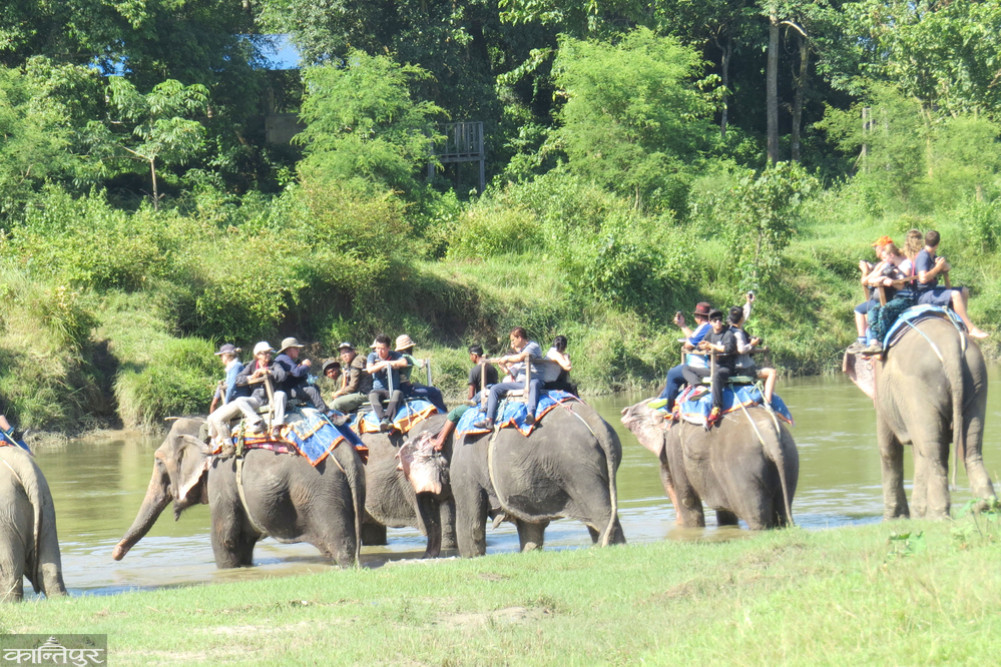
Tourism entrepreneurs in Sauraha are concerned about the impact on income and employment following the court order to prioritize elephant welfare, with some even demanding a clear policy and alternative tourism models from the government.
We use Google Cloud Translation Services. Google requires we provide the following disclaimer relating to use of this service:
This service may contain translations powered by Google. Google disclaims all warranties related to the translations, expressed or implied, including any warranties of accuracy, reliability, and any implied warranties of merchantability, fitness for a particular purpose, and noninfringement.
Samjhana Tiwari, a trained nature guide who takes tourists through the forest, posted a video on social media on Friday afternoon. The video was about the vehicles carrying tourists who had reached the Baghmara Intermediate Community Forest for elephant safaris and boat safaris. ‘There are so many vehicles, not even in the bus park,’ Tiwari said. The video itself says it all – even though it is not the tourist season, there is no shortage of tourists going on elephant and boat safaris in the Baghmara forest area. Tiwari was concerned about the management of the vehicles carrying tourists, both large and small, arriving directly at the elephant or boat riding areas. The news of the Supreme Court order, which came the previous day, on Thursday, has created a different debate in Sauraha.
On behalf of the Janhit Sankaran Manch, advocate Sanjay Adhikari and others had filed a writ petition on Bhadra 29, 2078 demanding that elephants be protected, not tortured, records of purchases and sales be kept, illegal trafficking not allowed, not chained, and arrangements for observation be made to stop elephant rides in the tourism sector. The court had also made the cooperative that conducts elephant safaris a defendant in the writ petition on Poush 2.
The full text of the order made by the joint bench of Supreme Court Justices Hari Prasad Phuyal and Tek Prasad Dhungana was uploaded on the court's website on Thursday. It mentions various orders related to elephant welfare and clearly directs to find alternatives to elephant safaris. With this, a debate has started in the tourism sector about the alternatives and their impact.
Supreme Court orders to find alternatives to elephant safaris
In point number 48 of the 46-page and 62-point court order, it has been said that the practice of carrying people on elephants during elephant safaris should also be reconsidered from the perspective of elephant welfare and alternative use measures should be adopted. The court has accepted that elephant safaris are an important economic activity in areas including Sauraha in terms of income generation, tourism promotion and employment.
‘Using elephants as mere tools for entertainment or tourism purposes is inconsistent with their value as living creatures and the responsibility for their welfare,’ it is stated at the end of point 48. .
The court has given an option in point number 51 to conduct activities like elephant-friendly trekking (elephant walk, elephant bush walk) instead of the practice of carrying tourists on safaris. ‘In line with welfare standards, it is imperative to make legal and policy arrangements to replace elephant safaris and cruel captivity systems in Nepal and transform them into ethical eco-friendly models,’ the order states. The court has asked to start bush walks, elephant-friendly walks and the practice of allowing tourists to observe elephants only from a safe distance, which are prevalent in various countries, in Nepal.
Businessmen worried, debate on alternatives
The Baghmara Intermediate Community Forest near Sauraha is spread over a total area of 215 hectares. There are seven to eight Baghmara-like forests in the Chitwan National Park area, where elephant safaris are the main source of income.
Baghmara used to earn an income of around Rs 30 million a year, says outgoing forest chairman Jitu Lama Tamang. In which the income was around 10 million rupees only from elephant safaris.
There has been no elephant safari inside Chitwan National Park for almost a decade and a half. Only the buffer community forest under the Chitwan National Park conducts elephant safaris, that too from private elephants raised at home. Government elephants are not used in safaris either.
‘Tourists from China are very interested in elephant safaris. Even after the start of Shrawan, a good number of tourists have come from China. They do not return without going on elephant safaris,’ said Forest Chairman Bhuvaneshwor Prasad (BP) Chaudhary. ‘There is hope from the Chinese in the decreasing income from safaris after Corona. There is also concern that the income of the forest will be affected by thinking about alternatives to safaris.’
Reduction in deaths due to wild animal attacks in Chitwan, the park should ‘Tracking’ started
On December 18, 2014, an organization called Pro Wildlife in Munich, Germany, issued a press release calling the use of elephants in tourism inappropriate "Keep it in the model," Lama said. He said that it is time to send a message that tourism activities are carried out in a way that does not negatively affect elephants.
Khatiwada said that elephant safaris have been declining recently due to various reasons. Before the arrival of Corona, at least 63 elephants from the cooperative alone were used in safaris. When tourism slowed down after Corona, the elephants that were rented were returned. Some elephants were sold and reached India. Now, he said, he is of the opinion that the remaining elephants should be properly managed.
"We are the ones who are in the safari business." We have been asked to find an alternative. But this cannot be done by our efforts alone. Where will the Elephant Walk go, how will it be done, and what policy arrangements will be made for it? The government should look into this,” said Chairman Khatiwada. “We will abide by the court order, but if we immediately go for the alternative, the tourism sector will be affected. We need time to promote the alternative.” He said the government should immediately take the initiative on integrated management of elephants. “It was seen that the court has taken many concerns for the elephants we have raised. But it would have been better if it had also included the issue of arranging grazing to solve the problem of elephants not being able to eat grass,” he said. Story break 272,000 people visit Chitwan National Park in a year, the number is high in Baisakh-Jeshtha too. Story break Haribhakta Ghimire, a veteran tourism entrepreneur from Sauraha, says that the government’s policy should also come out with the verdict. Ghimire said that the hotel in Sauraha in 2040 BS He opened it. Immediately, he kept the elephants for the safari. He still has two big ones and a two-year-old calf. He argues that since elephant safaris were associated with tourism even before the establishment of Chitwan National Park, it should not be considered wrong. He says that the excitement of Chitwan National Park's tourism is linked to safaris.
'People have been riding elephants in Nepal and India since ancient times. Elephant safaris started in Chitwan National Park with its establishment. Tiger Tops, which opened in 2022 BS eight years before the establishment of the park, used to conduct elephant safaris. This is an old tradition,' said Ghimire. He says that since tourism entrepreneurs are committed to raising elephants properly, it would be better if the court had given an order after considering everything.
Conservationist Basu Dhungana Bazar, who has opened a tourist resort in Kumroj near Sauraha, also considered the option of elephant safaris. Tourism entrepreneurs suggest that it would be appropriate to make a program accordingly. Dhungana, which started a resort three years ago, does not conduct elephant safaris. He urged the government, community forests, hotels and tourism entrepreneurs to work together to make elephant-friendly arrangements regarding the alternative.
Ved Kumar Dhakal, spokesperson for the Department of National Parks and Wildlife Conservation, says that they are serious about elephant management. He says that the order from the court and the concerns of elephant keepers will be implemented in coordination.
Wildlife observation is the first choice of tourists visiting Chitwan National Park. Around three lakh domestic and foreign tourists come here every year. Along with elephant safaris, jeep safaris, boat safaris on the rivers and streams flowing across the border and jungle walks are held in the park.
‘Dhurbe’ falls into the neck for the fourth time 'Caller'