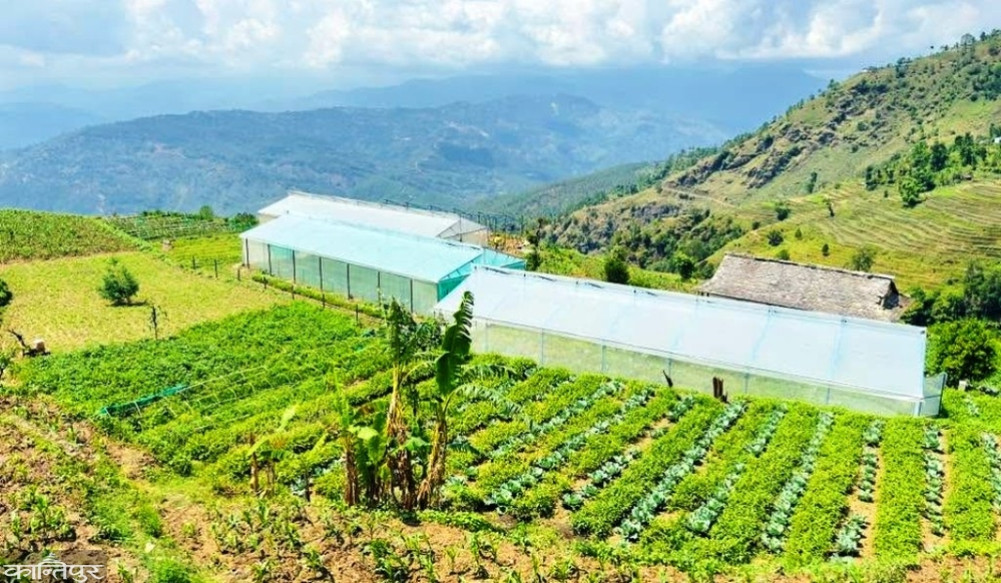
The campaign has stalled due to reasons such as the lack of alternatives to chemical fertilizers and pesticides, the impact of climate change and drought, lack of irrigation, and the migration of the workforce dependent on agriculture.
We use Google Cloud Translation Services. Google requires we provide the following disclaimer relating to use of this service:
This service may contain translations powered by Google. Google disclaims all warranties related to the translations, expressed or implied, including any warranties of accuracy, reliability, and any implied warranties of merchantability, fitness for a particular purpose, and noninfringement.
After the formation of the provincial government, the first cabinet meeting on Falgun 6, 2074 (February 18, 2018) declared Karnali an organic province. Nearly two years later, the second meeting of the Provincial Coordination Council on Poush 9, 2076 (December 25, 2019) decided to make Karnali an organic province.
Accordingly, an Organic Agriculture Conference was held in Karnali in 2076, and nearly 160 million rupees were spent on programs such as subsidies for the transportation of organic fertilizer, subsidies on the price of bio-pesticides, cooperation with cooperatives and the private sector for the production and processing of bio-pesticides, bio-fertilizers, and organic fertilizer industries. However, as most programs remained limited to fragmented plans, no significant achievements were seen. Similarly, from fiscal year 2075/76, a total of 328.6 million rupees was allocated over four consecutive years to establish high-tech nurseries. The main objective of setting up climate-controlled and automated nurseries was to produce all the saplings required for Karnali. However, 23 nurseries built at a cost of nearly 100 million rupees are now abandoned.
Under the organic campaign, in 2077, 20 million rupees were allocated to establish bio-fertilizer and bio-pesticide factories in Birendranagar Municipality of Surkhet and Bheri Municipality of Jajarkot. However, the work of establishing the industries could not move forward, and since then, no budget has been allocated for this purpose. In 2076/77, the Karnali government allocated 5 million rupees each to 13 local levels to run organic agriculture model programs. These programs are also now defunct. For the past two years, no budget has been allocated for these programs.
In fiscal year 2077/78, 15 million rupees were allocated for the construction of rapid pesticide detection laboratories in Harre of Surkhet and Kapurkot of Salyan, and infrastructure including buildings was constructed. About 7 million rupees were spent on each. Similarly, in fiscal year 2078/79, 2.9 million rupees were allocated for the purchase of necessary equipment. However, as six staff members could not be managed for each laboratory, the buildings and other structures are deteriorating. In the same year, a total of 1.97 billion rupees was spent by both the federal and provincial governments on organic programs. However, despite the large expenditure, no visible programs have been implemented. The operation of the laboratories has been included in the policy and programs for the coming year, and budget has also been arranged.
In the current fiscal year, 61.8 million rupees was allocated for organic agriculture, indigenous crops, and livestock promotion programs. “Since most plans are cadre-friendly, the budget is misused every year,” said organic agriculture activist Devikrishna Rokaya. “Real farmers still face problems with cultivation, fertilizer, seeds, and marketing. More than half of the subsidized agricultural enterprises have already closed, and cadre-oriented budgets have increased economic disorder in agriculture.”
Since its establishment, the Ministry of Land Management, Agriculture and Cooperatives of Karnali Province has allocated a total budget of 23.9759 billion rupees from fiscal year 2074/75 to the current fiscal year. Of this, 14.312664 billion rupees had been spent by the end of last Jestha (mid-June). About 30 percent (4.293799 billion rupees) of the budget has been spent on various plans under “Organic Karnali.” However, due to lack of preparation, shortage of staff, prioritization of fragmented plans, lack of investment-friendly environment, lack of alternatives to chemical fertilizers and pesticides, impacts of climate change and drought, lack of irrigation, and outmigration of the agricultural workforce, the campaign has faltered.
Under the “Organic Karnali Campaign,” in the past two years, the ministry has also introduced programs to assist with origin certification, branding, labeling, and quality logos for the marketing of indigenous products from Karnali with the “Valuable” logo. However, Nawaraj Nyaupane, a farmer from Jumla, said that apple farmers in Jumla have suffered for years due to lack of market and fair prices for apples, which are the most produced crop in Karnali. “Outside the district, Jumla apples are sold at 150 to 200 rupees per kilo, but we never get more than 45 rupees per kilo,” he said. “During apple season, the Karnali Highway is always closed, and due to lack of quality cartons, a third of the apples rot on the way. Every year, pest outbreaks spread, but due to lack of government support, production is declining annually.”
His statement is corroborated by statistics from the Ministry of Land Management, Agriculture and Cooperatives. According to the ministry, apples are cultivated on 9,377 hectares in Karnali. Of this, 3,419 hectares are considered productive areas. In productive areas, the average yield is 9.10 metric tons of apples per hectare. Last year, 31,102 metric tons of apples were produced. However, only 14,306 metric tons of apples were exported.
Agricultural economist Tej Kumar Sharma said that the organic province campaign faces additional challenges because large quantities of pesticide-laden Indian vegetables continue to enter the region unchecked due to insufficient local production. “Chemical fertilizers and pesticides were banned in the Himalayan districts under the organic province campaign, but pesticide-laden Indian vegetables are reaching as far as Jumla and Humla without restriction,” he said. “However, as production and pest control are not managed, farmers are forced to secretly use expensive chemical fertilizers for crops and vegetables.”
Ratna Budha, a farmer from Raskot Municipality-2 in Kalikot, said that urea, which is available at 25 rupees per kilo in other provinces, has to be used illegally at 50 to 60 rupees per kilo, and DAP fertilizer, which costs 50 rupees per kilo elsewhere, is used at 75 to 90 rupees per kilo. “Traders sell it secretly at high prices,” he said. “Manure from the cowshed is never enough, and there is no alternative to using chemical fertilizers to increase production.” He said that due to repeated pest outbreaks, they are compelled to use pesticides.
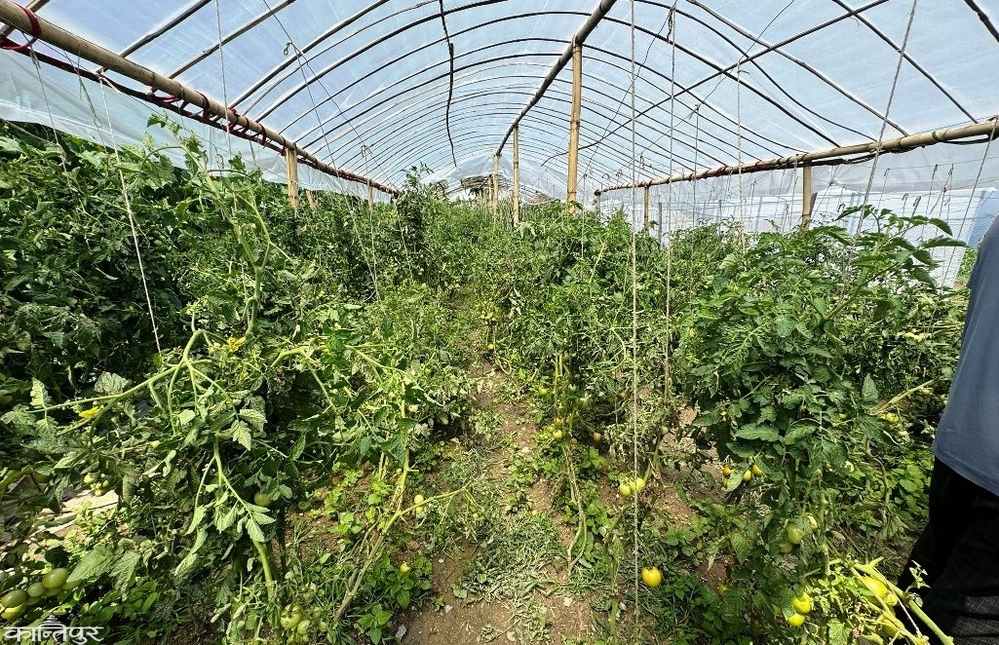
Currently, vegetables imported from India are only tested at the Jamunaha checkpoint. Dhan Singh Thami, a technician at the Rapid Pesticide Analysis Laboratory under the federal government in Birendranagar, said that since the laboratory in Harre, which began construction in 2077/78, is still incomplete, pesticide-laden Indian vegetables continue to flood the market.
According to him, nearly two quintals of vegetables were destroyed just last Saturday. He said that tests on the destroyed vegetables showed a pesticide residue rate exceeding 61 percent. “If the pesticide residue rate is less than 35 percent, we allow it for sale,” he said. “If it is between 35 and 45 percent, we keep it in quarantine for up to seven days and retest before allowing it to be sold. If it is higher than that, there is no option but to destroy it.” According to him, about 50 metric tons of fresh vegetables enter the Bulbule wholesale agricultural market in Birendranagar daily. In one year, nearly 289 metric tons of highly pesticide-laden vegetables have been destroyed.
According to the Ministry of Land Management, Agriculture and Cooperatives, Karnali produces 169,000 metric tons of vegetables, but there is a shortfall of 2,374 metric tons. Last year, 112,000 metric tons were imported into Karnali, of which about 80 percent came from India, according to ministry secretary Sanjiv Kumar Karn.
Pesticide dealers claim that pesticide use in Karnali has not decreased. Himal Oli, proprietor of Panchkoshi Agrovet and Trading Center in Surkhet, said he trades nearly 5 million rupees worth of various pesticides annually. He sends pesticides to almost all districts of Karnali based on farmers’ demand. “There is no alternative to using pesticides in commercial farming,” he said. “On a farm, some pesticide must be sprayed at least every 15 days, as there is always some pest outbreak, and there is no other way to control it.”
Currently, an integrated agricultural laboratory under the provincial government is operating in Birendranagar. However, due to lack of sufficient manpower and equipment, the laboratory’s work has not been effective, according to ministry secretary Karn.
Another ambitious plan under the organic campaign was to establish bio-fertilizer and bio-pesticide factories. For this, 50 million rupees each was allocated in fiscal years 2076/77 and 2077/78. However, as the work could not be carried out, the budget allocation was discontinued. “We tried to establish factories in partnership with the private sector with 50/50 percent investment,” said secretary Karn. “But since we could not find individuals or institutions willing to invest, the budget allocation has now been stopped.”
Akash Tara Bayak, president of the National Consumer Forum Karnali Province, said that if quarantine posts could be established at the main entry points of Karnali, it would be possible to control the entry of pesticide-laden goods from India and other provinces. “It is already difficult to supply enough food for all Karnali residents year-round,” he said. “On top of that, with the slogan of an organic province, restrictions on advanced technology, fertilizers, and seeds have only increased the influx of inedible goods and pesticide-laden fruits and vegetables.”
Agricultural expert Deepak Sharma said that due to the heavy dependence on imported vegetables as well as food grains, the implementation of the Organic Karnali campaign faces major challenges. “Cattle manure contains only 2 percent nitrogen, while urea contains 46 percent,” he said. “If chemical fertilizers are banned in fields where nothing grows, will production increase or decrease?” He said that in the name of organic, Karnali is becoming even more dependent on imported food grains.
According to the 2021 National Census, Karnali, with a population of 1,688,412, faces an annual food grain deficit of 25,000 metric tons, according to ministry data. While 352,000 metric tons of food grains are required in Karnali Province, only 326,000 metric tons are produced.
Ministry secretary Karn said that the first priority for implementing the organic province decision has been the conservation and development of indigenous crops. “Agricultural subsidies have been managed to make Karnali residents self-reliant through indigenous crops, and we have implemented indigenous crop promotion programs in all districts,” he said. “There are also programs to provide subsidies to farmers based on production and to support indigenous crop cultivation, production, and marketing in cooperation with local governments.”
He said that all farmer groups are being trained to produce organic and bio-fertilizers and bio-pesticides within the province, subsidies are being provided for organic fertilizers, and facilitation is being done for the purchase of necessary raw materials. According to him, nearly three dozen companies and cooperatives in the private sector are producing organic fertilizers and pesticides.
According to ministry data, 28 percent of arable land in Karnali Province remains fallow. The ministry states that 326,000 metric tons of food grains are produced on 399,330 hectares of arable land. A study conducted by the Nepal Agricultural Research Council in Karnali in 2078 showed that 100 to 200 metric tons of pesticides are used annually. According to the report, 114 metric tons of pesticides were used in 2078.
Agricultural expert Sharma said that fungicides are the most widely used pesticides in vegetable farming. “Even though it is not in the government statistics, the same amount of pesticides is still being used every year,” he said. “During our research, we found that farmers were using 24 types of pesticides that the government had banned, as they are forced to use pesticides indiscriminately to quickly control pest outbreaks.”
The Ministry of Agriculture’s expenditure in Karnali has been decreasing every year. Former Minister for Land Management, Agriculture and Cooperatives Bimala KC said that as a result, programs including organic agriculture have started to be neglected. “When spending decreases, program implementation also decreases, resulting in lower outcomes,” she said. “When large agricultural infrastructure projects are always left incomplete, fragmented plans neither deliver results nor ensure proper use of the budget.”
According to the Provincial Accounts Controller Office, of the 2.5711 billion rupees allocated to the ministry in the current fiscal year, only 26.94 percent (692.779 million rupees) had been spent by the end of Jestha. Karnali Province government spokesperson and Minister for Land Management, Agriculture and Cooperatives Binod Kumar Shah said that the lower expenditure is due to efforts to reduce irregularities in the agricultural sector and implement the budget in a regulated manner. “At the beginning of the fiscal year, the Jenji movement had an impact, and festivals and the House of Representatives elections also caused problems in budget implementation,” he said. “The plan is to make Karnali self-reliant in food production through the organic agriculture campaign, and the programs are being implemented gradually.”
He said that support is being provided for the marketing of Karnali’s products with the “Valuable” logo. According to him, in the upcoming year’s budget, 121.7 million rupees has been allocated for indigenous crop conservation programs, 339.5 million for the establishment of model agricultural farms, 192.2 million for the “One Village, One Commercial Agricultural Garden” program, and 71.4 million for the “One Local Level, One Agricultural School” program.