
Balendra without brakes on the expressway
Despite 4.7 million Facebook followers, millions of views, and countless posts, Prime Minister Balendra Shah remains a mystery. He writes his thoughts on social media, but he doesn't like to be explained. Rather than accepting and responding to criticism of his many activities and decisions in the first 100 days of his tenure as Prime Minister, he has adopted a style of denying the basis for them.
We use Google Cloud Translation Services. Google requires we provide the following disclaimer relating to use of this service:
This service may contain translations powered by Google. Google disclaims all warranties related to the translations, expressed or implied, including any warranties of accuracy, reliability, and any implied warranties of merchantability, fitness for a particular purpose, and noninfringement.
On 28 Baisakh, Prime Minister Balendra Shah arrived at the Parliament House in his familiar attire - a black coat, black glasses and white shoes from the Nepali brand Goldstar.
He handed over his government's first policy and program booklet to President Ram Chandra Poudel during a meeting of both houses of the federal parliament. However, he could not bear to listen to the policy and program while the President was reading it; he stood up and walked away in the 45th minute. The opposition even criticized him for walking while his own government's policy program was being read. However, Prime Minister Shah had not left the Parliament House at that time. He had left the meeting room and sat in another room designated for the Prime Minister, adjacent to him, with his Chief Personal Secretary Subash Sharma. He was there for about half an hour, mostly looking at his mobile phone.
In the evening, his advisor wrote on social media, 'The Prime Minister has left the Parliament meeting due to health reasons.'
However, after some time, the post was deleted. The matter became a subject of 'national debate' in both the House and the Internet for a few days. However, this was not the first time that the government had to answer or avoid giving an explanation due to the decision taken by the Prime Minister. Rather, such incidents are recurring.
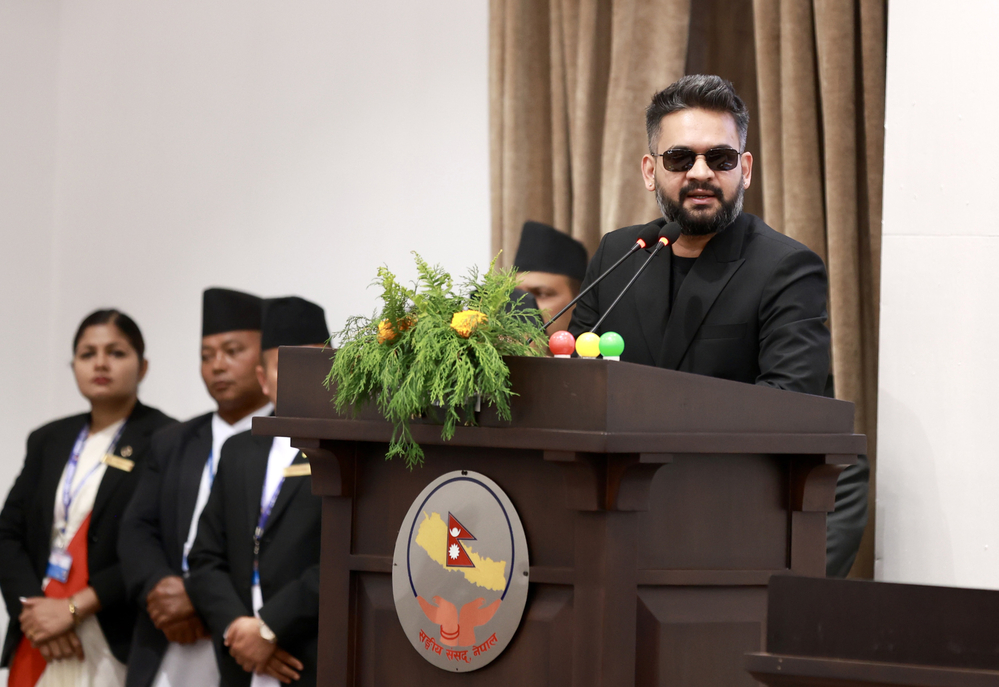
After taking oath as Prime Minister, Shah has a certain style in his public appearances. He is often seen wearing the same glasses in parliament meetings, public ceremonies, military parades and group photos with foreign ambassadors. But in cabinet meetings, private discussions or official business meetings, he is often seen without glasses. So far, he has not met any foreign ambassador alone. But dark glasses seem to be mandatory in formal photo sessions with ambassadors. It is very rare to see him without glasses at public events.
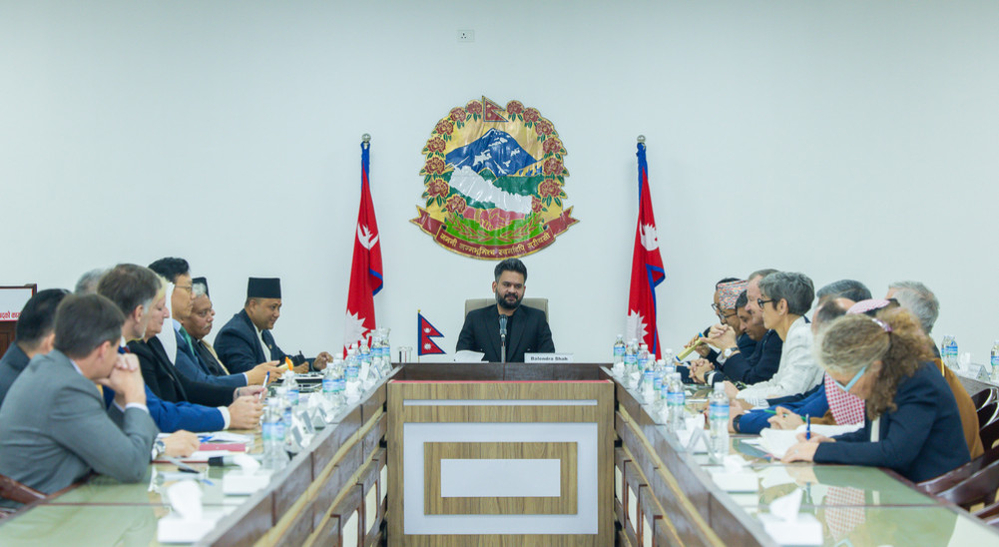
This does not seem like a coincidence to those who observe Shah's public activities. However, there is a certain style in all of them, in terms of when they appear, how they present themselves, and when they suddenly disappear from the scene. That style has been repeated time and again not only in public life but also in activities inside the parliament. For example, on 22 Chaitra, when the then vice-president of the party and MP DP Aryal was elected as the Speaker of the House of Representatives unopposed, ministers and MPs stood up to congratulate him. But Shah got up from his seat and left silently.
Another incident that took place in the parliament about two months later caught everyone's attention. The opposition had been protesting in the parliament for a long time, demanding that the system where the prime minister should answer questions from the MPs be implemented. Amidst the pressure, Prime Minister Shah appeared in the parliament meeting on 17 Jestha in a surprise move. Many expected him to answer questions already submitted by the MPs, like previous prime ministers. But Shah did not want to follow that style.
After suddenly asking for time from the Speaker, he went to the rostrum and said that the MPs had been trying to ask questions for a long time and requested time for a direct question-answer session from there. The opposition MPs immediately protested. They argued that the rules of procedure provide a certain time for preparation before asking questions. But Shah had a different plan.
According to sources close to Shah at the time, he did not plan to give written answers to pre-prepared questions or read a prepared speech like previous prime ministers. Instead, he was prepared to go to Parliament and ask MPs to ask questions immediately and then stand and answer them. Through this, he tried to present himself differently from others.
However, his statement regarding the Nepal-India border in the House of Representatives was controversial. While answering the questions raised by the MPs regarding Limpiyadhura, Lipulekh and Kalapani, he had stated that Nepal had also encroached on Indian land in many places. Criticism and protests started inside and outside the Parliament regarding this statement of Prime Minister Shah. Was Speaker Aryal himself aware of the Prime Minister's Question and Answer Program? Asked on 18 Jestha, he did not give a direct answer to Kantipur. Instead, he asked, 'What did you think would happen?' When he said, 'It seemed like he was not informed beforehand,' he replied briefly, 'You guys should understand that yourself.' After that, he did not say anything further. That was the first address given by Prime Minister Shah in the Parliament. By then, he had started being accused of not being comfortable with Parliament or the parliamentary process. He had also started being accused of such things because he had spent the first session of Parliament without saying a word. However, Prime Minister Shah's style was not unexpected for many. To understand why Shah is unpredictable, it is necessary to understand his personality beyond public behavior. To understand his personality, one must reach out to Kumar Ben, also known as Kumar Byanjanakar. He is known as the Prime Minister's political advisor, strategist, and Shah's closest friend for more than a decade. On Friday evening of the last week of Jestha, when he reached Ben's residence in Jwagal, Lalitpur, he had already had dinner. Coincidentally, he was talking on the phone with Prime Minister Shah. There was no government-related or other political talk, they were talking about a video game.
Ben smiled and informed that Prime Minister Shah had already eaten and was currently playing the new James Bond-based video game '007 First Light'. During the conversation, he also showed a screenshot of the game sent by the Prime Minister.
‘Like me, the Prime Minister also eats dinner early,’ Ben said, ‘He is not a food connoisseur. He likes simple Nepali dal-bhat-vegetables.’ But he likes watching movies, listening to songs and playing video games.’
Shah’s personality, as described by Ben, is completely different from his public image. According to him, Shah wakes up early in the morning, exercises regularly at the gym inside the Prime Minister’s residence. He eats at around 8:30 in the morning. He usually chooses dal-bhat-vegetables. His lunch choices include veg maam and fried rice. According to the Prime Minister’s Secretariat, he usually reaches Singha Durbar by 9:30 in the morning, and even at the latest, he reaches the office by 10:30. He returns from the office around 5:30 in the evening. This style of the country's executive is new to the Prime Minister and Council of Ministers' Office in Singha Durbar. In previous governments, cabinet meetings used to last for hours, and ministers would come and go in and out of Baluwatar until late at night.
Shah does not like sweet, sour, very spicy or oily food. Ben says that he can fall asleep by around 9:30 at night and gets eight to nine hours of sleep. He is not much of a book reader. But he is very active on social media. According to his aides, Shah reads three to four hundred comments daily. He has made the network his main medium for understanding public opinion. In his spare time, his other world is video games. He has played the famous game 'Persona-5', based on the story of teenagers fighting corruption and injustice, to the fullest. ‘One of the reasons the Prime Minister is so sharp and intelligent is because he plays video games,’ says Ben about Shah’s habit. When he is not playing video games, Shah likes to write songs. Ben says that his habit of writing songs has continued since childhood.
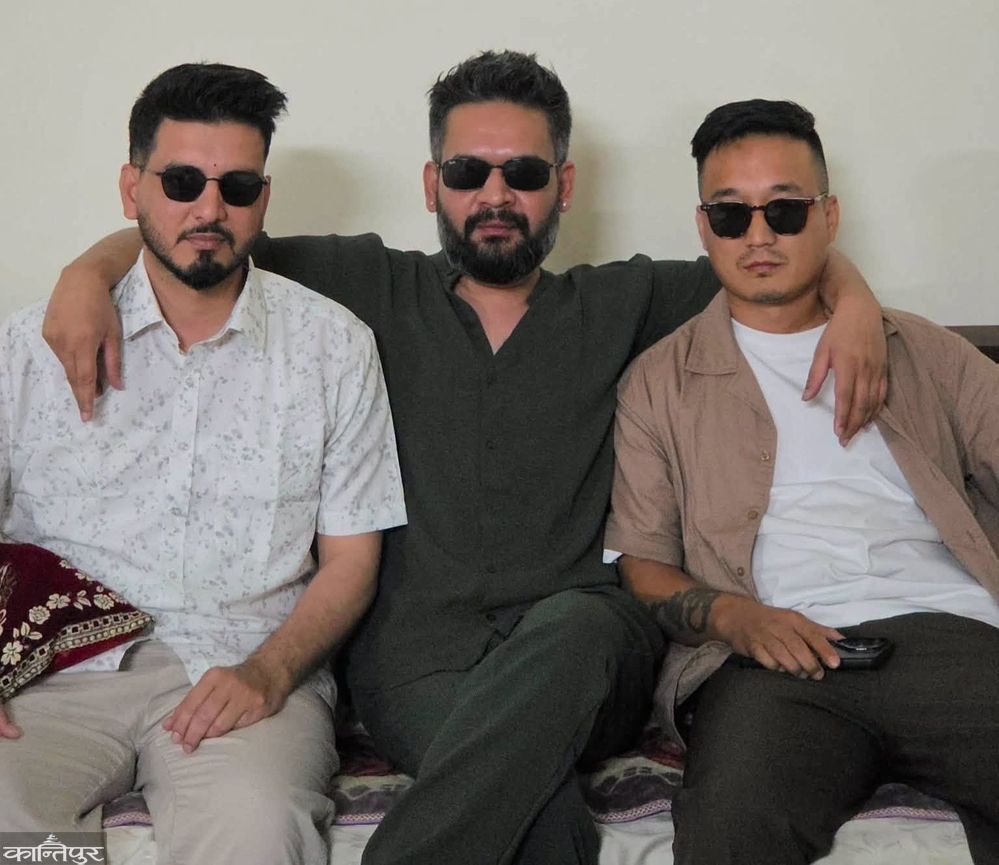
Their friendship, which dates back long before they entered politics, is still the same. When they were mayors of Kathmandu Metropolitan City, they visited countries including France, Brazil, Indonesia and Sri Lanka together. The visit to the Cannes Film Festival in France in May 2024 is one of them. Ben remembers cooking his own food when he could not find the food he liked abroad. Sometimes he would cook dal, pickles and gundruk that he had brought from Kathmandu, and sometimes he would buy things from the local market and prepare Nepali dishes.
According to Ben, the current Minister for Infrastructure Development Sunil Lamsal is also an old friend of theirs.
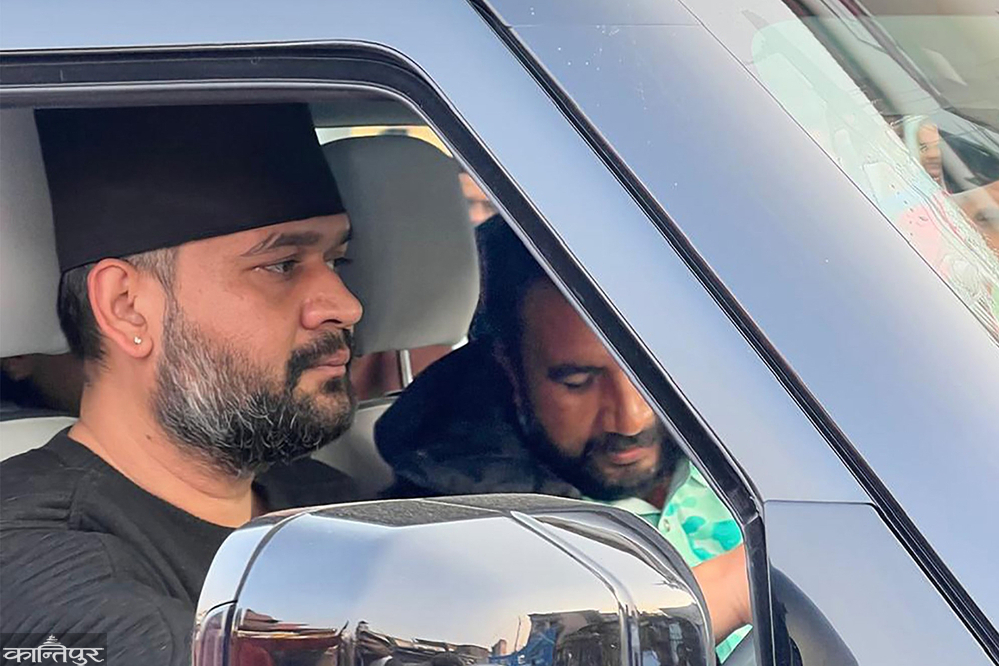
Prime Minister Shah's drinking habits are also discussed from time to time. However, Ben says that the Prime Minister does not have the habit of drinking as is discussed outside. 'The Prime Minister drinks very little alcohol,' he said, 'only two months in 12 months, sometimes.' Shah's other hobby is driving his own car for long distances.
Even now, he mostly drives his own car. Sometimes, he goes to Kumar Ben's house without any prior notice and spends hours there.
Ben remembers that Shah had his first serious discussion about his decision to enter politics at this house after his father's death on 15 Mangsir 2082.
Even after entering politics, Shah did not speak much during the election campaign. He traveled about 11,000 kilometers from east to west in 40 days, but if you add up the speeches he gave at the entire election meeting, it would take only 27 minutes. However, amidst the silence, he defeated former Prime Minister KP Sharma Oli by a huge margin, which indicates the kind of leadership Nepali voters were looking for and what they were ready to accept as an alternative to the traditional political style.
If there is one place where Balendra Shah consistently, openly speaks his own style, it is Facebook. He writes regularly on Facebook, and the same post is automatically published on X (the old Twitter).
On Saturday, 23 Jestha 2083, at 10:15 pm, he posted a sarcastic sentence, ‘I also want to become an ambassador, if you have the PM’s number, please give it to me.’ The post was targeted at Secretary Krishnahari Pushkar, who had contacted the Prime Minister directly and asked for the appointment of an ambassador.
Within hours of the post being made public, Education Minister and government spokesperson Sasmit Pokharel joked, ‘I will send you a message.’ MP Tika Sangraula Jwala commented, "I have the number, but I won't give it." Another MP, Ranju Darshana, also added her voice. She said, "You can't be a PM or an ambassador, choose one first."
Shah's supporters consider his style of presenting himself as a normal person and joking with colleagues in public despite being the head of the government to be his natural style. However, some leaders of the 'Gen-G' movement, which played an important role in his becoming the Prime Minister, see it differently. In their understanding, the problem is not in the joke, but in the timing. When such a message comes from the Prime Minister, some other events are also connected. For example, the government itself postponed the House of Representatives meeting scheduled for April 14 at the last minute. The Council of Ministers had taken this decision to move forward with the ordinance on the Constitutional Council and cooperative fraud management. While it was being widely criticized, Shah posted a stylish photo on Facebook on April 26. The photo of him wearing a white shirt and striped pants instantly went viral on social media.
Within hours, hundreds of photos created using AI based on it began to spread across social media. The debate over the ordinance faded into the background. A week later, on June 2, when criticism was being directed at the poor conditions of the holding center where squatters were being held from the settlements that were cleared by using a dozer on the banks of a river in Kathmandu, Shah posted another photo in the same outfit. This time, he had a DDC cheese in his hand. In the caption, he wrote, ‘Say cheese, DDC’s cheese.’ After being criticized for being a commercial campaign, he also wrote a comment stating that DDC is an organization of the Government of Nepal.
The impact of that post was immediately visible. According to officials of the Dairy Development Corporation (DDC), the demand for yak cheese has increased by about 30 percent. Sanjeev Jha, head of market management at DDC, said, “We have started getting calls from supermarkets asking them to provide more cheese.” However, not everyone took it as a joke. Social activist Sushma Baraili mentioned that on the same day, she had just watched a video of a pregnant woman and her newborn baby in a displacement camp who were not getting nutritious food. “On the other hand, our head of government is posting funny pictures saying ‘cheese’,” she wrote on social media.
Not only DDC, Prime Minister Shah has also tried to brand private products. After Finance Minister Swarnim Wagle presented the budget on 15 Jestha, the Prime Minister stayed for a while longer. He shook hands with MPs from both the ruling and opposition parties. On his way out of Parliament, he stopped for a moment with MP Vidushi Rana and showed off the Goldstar shoes he was wearing. Later, on Kantipur Television's program
'Fire Side',
Rana said she was surprised to see Shah recalling the incident when she was the mayor of Kathmandu Metropolitan City talking about Goldstar shoes. 'I didn't think he would pay that much attention,' she said. When asked if the Prime Minister was trying to promote any particular brand, Rana said it was just a coincidence. 'I met him on my way out of Parliament,' she said. 'As soon as I greeted him, he said: Look, I'm wearing Goldstar.' On the day of his weekly holiday, Prime Minister Shah shared a photo with Home Minister Sudhan Gurung and Infrastructure Development Minister Sunil Lamsal and wrote the caption 'Team that builds the nation'.
A photo of him sitting at a local tea shop was also made public at that time. Critics interpret this as a strategic style. Gen-G leader Amit Urja says, ‘Shah understands how digital algorithms work well. That is why he creates new topics from time to time to change the focus of public debate.’
In his opinion, Prime Minister Shah is very good at raising popular topics that can attract the attention of the people. Saying that this style is done with the aim of ensuring that no political dispute remains at the center of public debate for a long time, he adds, ‘It weakens the rule of law and only entertains the people for a while.’

Another young activist, Arnab Chaudhary, also considers this a continuation of the old style rather than a new political culture. ‘Former Prime Minister KP Sharma Oli was famous for his style of deflecting criticism through proverbs, satire and jokes,’ says Chaudhary, ‘Humor and satire have their own place.’ But, the question of who, when and in what context is using such a style is equally important . The current leadership calls itself a representative of a new political generation . But it seems that it is using the same style as the previous ones to overshadow the main issue and avoid accountability .’ Prime Minister Shah’s response to the series of criticisms seems very simple . On June 1, he wrote on Facebook, ‘After working all week, I get teased on my day off, this is not a problem . Consider the day sad the day I stop teasing .’ On the surface, such posts by Shah seem like ordinary expressions that any person could make . But critics have a different argument . According to them, Shah is not an ‘ordinary person’, whom Nepali voters have brought to power with unprecedented support . Many of those voters are now expecting a clear vision and leadership from him about the future of the country .
Those who know Shah closely say that his private life is confined to a limited circle. His style of work as Prime Minister also seems to have developed in the same pattern. Although Shah has not formally announced it since assuming office, many leaders of the Rashtriya Swayamsevak Sangh (RSS) say that in practice he has implemented a rule. According to them, the Prime Minister has significantly limited his personal meetings with foreign diplomats, high-ranking government officials, party leaders, MPs, heads of security agencies, businessmen and media persons. Since becoming Prime Minister, he has met the diplomatic community collectively only twice, on 25 Chaitra and 11 Jestha.
According to a diplomat who attended one of the meetings, the style of both meetings was almost the same. The ambassadors introduced themselves, and the Prime Minister read out a written statement prepared by the Ministry of Foreign Affairs. “He listened to us calmly, but didn’t ask many questions,” the diplomat told Kantipur on condition of anonymity. At least two foreign diplomats said the style was unusual. Ambassadors usually prioritize personal meetings with the prime minister after a new government is formed. This is expected to provide an initial direction for relations between the two countries and build mutual understanding. The Shah government, however, met the ambassadors collectively only twice. “We had not seen such a practice before,” said a diplomat from an Asian country. “Whether this is a deliberate policy or the way this government works, we cannot conclude right now.” This practice of limiting the prime minister’s access is not limited to outsiders. It seems to be strictly followed within the government machinery as well. One example of this is the Krishna Hari Pushkar case. According to government officials familiar with the incident, on 21 Jestha, Pushkar had sent a mobile message directly to the Prime Minister, expressing his concern about the vacant ambassadorial post. He had sent the message in the morning, and in the evening, on the instructions of the Office of the Prime Minister and Council of Ministers, the police took him from his house and took him to the Valley Crime Investigation Office in Teku for questioning. The next day, Pushkar told Kantipur that he had sent the message directly after repeated attempts to meet the Prime Minister failed. According to an official from the Home Ministry, the reason for questioning him was that he had contacted the Prime Minister directly for personal gain and violated the administrative 'chain of command'. The police, however, released Pushkar after questioning as there was no sufficient legal basis.
Former administrators sharply criticized the incident. According to them, the practice of the police taking an employee into custody for directly contacting the Prime Minister is unprecedented in the history of the civil service and it unnecessarily indicates an authoritarian style of working.
After this incident, the Office of the Prime Minister and Council of Ministers removed Pushkar from the responsibility of the Vice President's Office and transferred him to an additional group. High-ranking government employees have also been instructed to take the matter forward through Chief Secretary Suman Raj Aryal without directly contacting the Prime Minister. However, officials say that the Prime Minister himself calls senior employees and holds separate discussions when he deems it necessary.
The rhythm of government operation has also changed after Shah became Prime Minister. In previous governments, the Council of Ministers meetings were sometimes held at the Office of the Prime Minister and Council of Ministers in Singha Durbar, and sometimes at the government residence in Baluwatar. Regular meetings used to be held on Mondays and Thursdays. Now, all meetings are held at Singha Durbar. There is no fixed schedule and most meetings do not last more than half an hour. The Prime Minister's residence in Baluwatar, which was once mocked as the 'party palace' because it was filled with political meetings, has now ceased to be used for government work.
According to Minister for Land Management, Cooperatives, Federal Affairs and General Administration Pratibha Rawal, Prime Minister Shah looks at any proposal ‘from many angles’. He listens to the minister concerned fully and does not force his decision. At the end of a cabinet meeting, he often asks the ministers, ‘Is there anything else to say?’ Rawal says that he also personally praises the ministers when they have done a good job. ‘The public statement that the Prime Minister does not speak or discuss is not correct,’ she said. ‘Ministers regularly go to meet the Prime Minister on government policy issues. We also meet on issues that require the party’s opinion and there is no problem getting time with him.’
MP KP Khanal also says that his relationship with the Prime Minister is formal but work-oriented. Khanal, who has been working with Shah since he was the mayor of Kathmandu Metropolitan City, says, ‘We do not go to Baluwatar. If we have to meet the Prime Minister, we go to his office in Singha Durbar.’ The last time we met in Parliament, he asked how the cleanliness campaign was going.'
He also hugged another MP, Bablu Gupta, as he was leaving Parliament recently and asked him about his current affairs, saying, 'Where have you been? What are you doing?'
Leaders within the Rashtriya Swayamsevak Sangh (RSS) admit in informal conversations that there is some discomfort with Shah's working style. According to them, the Prime Minister seems to prefer to make decisions through a small circle of his old confidants rather than through the party's institutional mechanism. However, the party has publicly denied that there is any such distance.
Ganesh Parajuli, deputy leader of the RSSSP parliamentary party, says, 'Party issues reach the Prime Minister through Chairman Ravi Lamichhane. Government issues also come to the party from the Prime Minister through the same process.'
Analysts outside the party, however, are starting to see Shah's working style differently. According to Bhaskar Gautam, who teaches international relations and diplomacy at Tribhuvan University, Nepal's weak institutions have always given powerful individuals the opportunity to shape state institutions to their liking. He analyzes that Shah is no exception.
'The Prime Minister is taking selective steps to strengthen the culture of impunity and weaken the core spirit of the rule of law,' Gautam told Kantipur. 'His focus seems to be more on governing through personal decisions than on institutional development. There is not enough emphasis on building a structure where the state's resources are distributed fairly and equitably among the citizens.'
Whether Gautam's assessment is correct or not will be clear from the government's work in the coming months.
The government has already issued eight ordinances since assuming office on Chaitra 13. According to Law Minister Sobita Gautam, the draft ordinances were prepared by the Office of the Prime Minister and Council of Ministers. Prime Minister Shah had given policy instructions on which issues to include, including the Public Procurement Act, the Constitutional Council, the abolition of political appointments, and the abolition of the employee trade union system. However, he had given the responsibility of preparing the draft ordinance to a team led by Law Minister Sobita Gautam. The team included secretaries from various ministries and the Prime Minister's Chief Personal Secretary Sudip Dhakal.
According to those who have worked with Shah since he was mayor of Kathmandu Metropolitan City, his working style has not changed much even after becoming Prime Minister. The clearest example of how Shah makes decisions was not seen in Parliament, but in a small room in the Constitutional Council meeting room. Shah had called his first meeting on 24 Baisakh as the chairman of the six-member council that recommends appointments to important positions in constitutional bodies, including the Chief Justice. Before the meeting, there was an expectation both inside and outside the council that the name of acting Chief Justice Sapna Pradhan Malla of the Supreme Court would be recommended. She was the senior-most judge in the Supreme Court and was also the choice of most of the council members. But Shah decided differently. Breaking the tradition of seniority, he proposed the name of Justice Manoj Sharma, the fourth-ranked judge. He had already ruled out any potential challenge to the meeting through an ordinance.
According to information given to Kantipur by council members, Shah wanted to make a person with no clear political affiliation the Chief Justice.
Congress leader Bhishma Raj Angdembe and National Assembly Speaker Narayan Dahal had registered written dissenting opinions in the meeting. But Sharma was recommended after three members close to the Rashtriya Swayamsevak Sangh (RSS) in the council supported Shah's proposal. That meeting was also the first formal meeting between Shah and the leaders of the opposition parties after he became the Prime Minister. Earlier, it was a tradition for prime ministers to consult the opposition before making such important appointments.
Those who know Shah closely do not hesitate in their decisions. He sticks to the same ‘yes or no’. According to them, the file is either approved or returned immediately. The same style was seen in the decision to appoint the Chief Justice.

The Prime Minister’s style of communication with the people remained the same. Even after almost three months of assuming office, Shah has not made any public address in the name of the nation. Critics are interpreting this as an example of a communication style that is indifferent to the voters who elected him and incompatible with democratic accountability.
Finally, Prime Minister Shah addressed the public for the first time on Asad 7. He gave his first public speech since becoming Prime Minister while addressing the first general convention of the Rashtriya Swayamsevak Sangh (RSS). At the beginning, he had said, ‘I say don’t speak, the day will come when we will speak.’
The formal topic of the speech was party strengthening, good governance and political direction. But a large part of it seemed to be focused on responding to the criticism leveled against him. In some cases, he adopted a style of rejecting the basis of the criticism rather than accepting and responding to it.
On the same day, UML leader Pradeep Gyawali, while addressing the general convention, had suggested that the Rashtriya Swayamsevak Sangh (RSS) use its mandate carefully. Saying that there should be no excessive haste that would weaken democratic institutions, he had compared the running of the state to a vehicle. ‘As much as an engine is necessary in a car, brakes are also necessary,’ Gyawali had said. Shah replied to Gyawali during his speech, ‘That concern may be appropriate for a vehicle plying on local roads. Our vehicle is running on the expressway. We brake only when we reach our destination.’