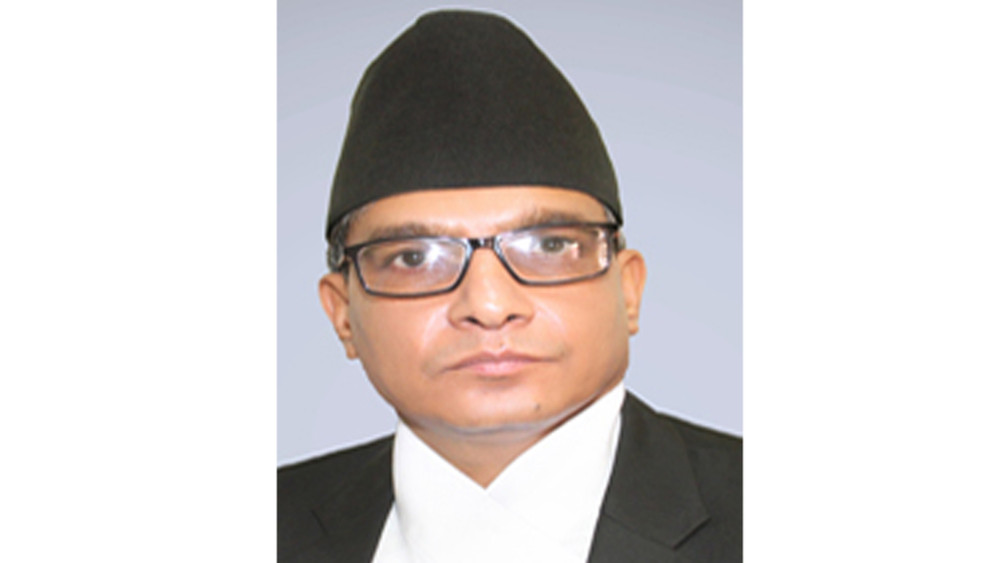
Breaking with the tradition of recommending based on seniority, the Constitutional Council has forwarded the written dissent of Manoj Kumar Sharma, the fourth-ranking candidate, the National Assembly Speaker, and the leader of the main opposition party.
We use Google Cloud Translation Services. Google requires we provide the following disclaimer relating to use of this service:
This service may contain translations powered by Google. Google disclaims all warranties related to the translations, expressed or implied, including any warranties of accuracy, reliability, and any implied warranties of merchantability, fitness for a particular purpose, and noninfringement.
The Constitutional Council has recommended Manoj Kumar Sharma as the 33rd Chief Justice. The council meeting held under the chairmanship of Prime Minister Balendra Shah on Thursday recommended Sharma, who is ranked fourth. With this, the tradition of making the senior-most judge of the Supreme Court the Chief Justice has been broken.
The Constitutional Council recommended the name for the Chief Justice by a majority decision. Council members National Assembly Speaker Narayan Dahal and main opposition Nepali Congress parliamentary party leader Bhishma Raj Angdembe have submitted written dissent to the decision.
After Prime Minister Shah, who chaired the meeting, put forward the name of Sharma, who is ranked fourth, National Assembly Speaker Dahal and Nepali Congress parliamentary party leader Angdembe had expressed dissent. When they raised the issue of tradition, Shah argued that ‘tradition should no longer be called tradition, justice delivery and expertise should also be taken into account’.
Shah had also said that written dissent could be filed in the proposal. ‘When the proposal to recommend by violating the seniority was made, we both disagreed,’ said one member. ‘We also submitted a written opinion stating that there could be no agreement on the proposal that violated the law and tradition.’
In the past, the Judicial Council used to send a list of judges who had qualified as per the constitution and the Constitutional Council would recommend the person who was at the top of it. The Judicial Council had sent the list of six judges who had qualified to the Constitutional Council on 26 Falgun.
Article 129 (3) of the Constitution states that ‘a person who has served as a judge of the Supreme Court for at least three years shall be eligible for appointment as the Chief Justice.’ Among the judges of the Supreme Court, Sapna Pradhan Malla, Kumar Regmi and Hari Prasad Phuyal are above Sharma in the seniority. After the then Chief Justice Prakash Man Singh Raut retired on 18 Chaitra, Pradhan is the acting Chief Justice based on seniority.
The Constitutional Council has decided to hand over the responsibility of the judiciary to Sharma, who has a doctorate for the first time in the history of the judiciary and has a high record in case disposal, the Prime Minister's Secretariat has said. According to the Secretariat, Sharma was far ahead of other contemporary judges in the objective evaluation of the judiciary's performance during the Fourth Five-Year Strategic Plan (2076-2081).
Sharma has finalized 7,388 cases and petitions. In the last fiscal year 2080/81 alone, he disposed of 2,181 cases, the Prime Minister's Secretariat has also said. 'Among the proposed judges, he is the only judge to cross the 7,000 mark, which has clearly confirmed his proactivity and speed in the administration of justice,' the Prime Minister's Secretariat said.
The Constitutional Council's recommendation will now be sent to the Parliamentary Hearing Committee. The committee will issue a public notice requesting a complaint in Sharma's name, and if a complaint is received, it will investigate and hold a hearing. During the hearing, lawmakers can ask their questions, and Sharma can also submit an action plan. President Ram Chandra Poudel will make the appointment after the hearing is approved.
The parliamentary hearing committee had previously rejected the recommendation for the Chief Justice only once. In July 2075, the hearing committee had rejected the name of Deepak Raj Joshi. After that, Om Prakash Mishra became the Chief Justice based on seniority. After the restoration of democracy, no Chief Justice had been able to complete a six-year term, retiring earlier due to the age limit of 65. 56-year-old Sharma will be able to serve as the Chief Justice for the full term (until 2089) after his appointment, while Justices Pradhan, Regmi and Phuyal will not be able to become the Chief Justice.
Born in Birgunj on 4 Ashad 2027, Manoj Kumar Sharma has done his BL from Nepal Law Campus in Kathmandu and LLM in Business and Constitutional Law from Pune University, India. He also received a PhD in ‘Freedom of Association in the Context of Nepal’s Labor Law’ from Tribhuvan University. He is the nephew of former Chief Justice Damodar Sharma. Manoj Kumar Sharma, who obtained his advocate’s license in 2051, also provided legal advice to various companies and organizations while practicing law. Sharma taught law to BBS level students from 2060 to 2065.
He became a permanent judge of the Supreme Court on 6 Baisakh 2076. He has been a member of the Constitutional Bench since 23 Magh 2080. From 22 Paush 2079 to 12 Bhadra 2081, he was a member of the Access to Justice Commission and became its chairman. Sharma was a member of the Information Technology Committee of the Supreme Court from 2077-2079.
He was an additional judge in the Court of Appeal from Jestha 2070 to Mangsir 2072. The interim constitution of 2063 had a practice of appointing additional judges in the Court of Appeal. Sharma was an additional judge in Butwal from Jestha 2070 to Bhadra 2071 and in Patan from Asoj 2071 to Mangsir 2072.
What do legal experts say?
Bipin Adhikari, a professor at the School of Law of Kathmandu University, says that even if the constitution or law does not prohibit the appointment of anyone other than the senior-most judge as the Chief Justice, there should be a concrete and institutionally justified reason for it. 'I do not see a strong reason to break the tradition that has existed for decades,' he said. 'Appointing junior judges overtaking senior judges without sufficient reason can create a place for the executive to increase its influence in the judiciary. This can create a situation where judges are cautious while making decisions due to the fear that their promotions may be affected.'
Nepal Bar Association General Secretary Kedar Koirala said that the Constitutional Council's decision was a surprise. He also informed that an advisory committee meeting has been called on Friday to formulate its opinion on the matter. "The bar will make its opinion public after the meeting," he said.