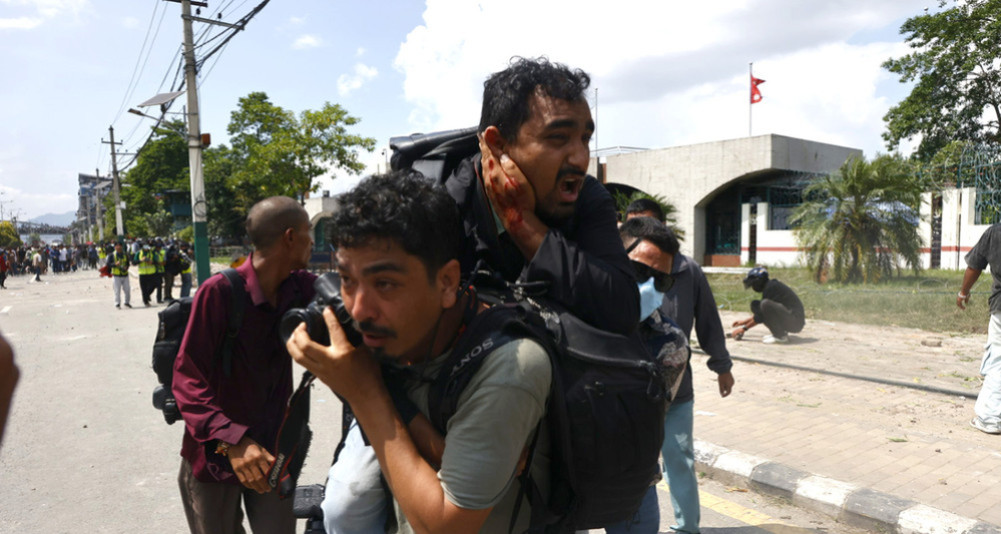
According to a report by the Federation of Nepali Journalists, 139 incidents of press freedom violations have been registered during the year. In these incidents, 21 female and 197 male journalists have been victims, while 31 media organizations have been directly affected.
We use Google Cloud Translation Services. Google requires we provide the following disclaimer relating to use of this service:
This service may contain translations powered by Google. Google disclaims all warranties related to the translations, expressed or implied, including any warranties of accuracy, reliability, and any implied warranties of merchantability, fitness for a particular purpose, and noninfringement.
Various statistics have shown that the year 2082 has become a challenging year for Nepali journalism from the perspective of freedom of the press and expression, which are considered the lifeblood of a democratic system. The latest annual reports published by various national and international organizations working in the field of media rights have shown that there has been a multifaceted attack on the Nepali press.
The physical attacks on media outlets and media personnel during the Gen-G movement in Bhadau and the interference with press freedom have confirmed that the Nepali media is very unsafe this year.
The conclusion of 3 separate reports published by the Federation of Nepali Journalists, Media Action Nepal and Freedom Forum based on their respective fields of work and monitoring methods is the same - Nepali press freedom was in serious crisis in 2025 (2081/82). These reports have exposed various aspects of physical security, legal troubles, economic crisis and policy regression.
The year '082 was not very encouraging and pleasant for us. "The incidents of press freedom violations have increased to the maximum and the professional and physical safety of working journalists is becoming more challenging," said Ram Prasad Dahal, General Secretary of the Federation of Nepali Journalists. "The financial side of the media has reached a very shabby state. Due to the discriminatory advertising policy adopted by the government, especially small media outlets have reached the point of closure, which has directly attacked the right to press freedom and information."
According to the report prepared by the Freedom Forum based on the period from January 1, 2025 to December 31, 2025, the incidents of press freedom violations have reached the highest point in the past 5 years. A total of 114 incidents of press freedom violations have been recorded during the year, directly affecting 139 journalists.
Similarly, the data collected by the Media Monitoring Branch of the Federation of Nepali Journalists until December 31, 2025 also reflects the severity of the situation. The Federation has registered 139 incidents of press freedom violations during the year. In these incidents, 21 female and 197 male journalists have been victims, while 31 media organizations have been directly affected. According to the federation, the most common incidents were 53 incidents of threats and abuse, and 42 incidents of attacks and vandalism. In addition, 18 incidents were purely related to the professional insecurity of journalists.
Another report released by Media Action Nepal covering the period from May 4, 2024 to May 1, 2025, also considered this year to be tragic. The report states that 32 incidents of violence occurred during this period, affecting 40 individuals and media houses. Analyzing the parties involved in the violence, Media Action Nepal stated that state parties were directly involved in 16 incidents, non-state parties in 23 incidents, and foreign representatives were directly involved in one incident.
Gen-G movement and attacks on media
The Gen-G movement of 23 Bhadau and the protest of 24 Bhadau were as important as they were politically and socially, but they proved to be equally disastrous from the point of view of media security. According to the Federation of Nepali Journalists, 42 incidents of attacks, vandalism and arson have been registered on media outlets this year.
The media outlets fell under the spell of both the protesters and the state. 16 media houses were arsoned and vandalized across the country, while the broadcast of 12 television channels was disrupted. Journalists working to collect news were subjected to abuses by both the protesters and the police administration.
Four journalists were shot during the protest and many others were injured. Journalists Shambhu Dangal, Dipendra Dhungana, Shyam Shrestha and Umesh Karki, who were working to report on 23 Bhadau, were shot. Similarly, other journalists who were engaged in reporting were also attacked. Kantipur Television was set on fire and the then editor of the television, Vijay Poudel, and news chief Rupesh Shrestha were assaulted.
According to the Federation of Nepali Journalists, this year, media property worth Rs 599 million has been damaged due to physical attacks and vandalism alone. Similarly, 35 community radios across the country have been permanently closed due to the sharp decline in the advertising market, increasing operating costs and insecurity.
'During the Gen-G movement, media houses were damaged and journalists were treated with leniency by both the state and the protesters. Despite the constitution providing for complete press freedom, the Nepali press has moved towards an increasingly insecure and challenging direction,' General Secretary Dahal told Kantipur. 'Overall, this year has been disappointing. We urge both the state and non-state parties to reduce the leniency towards the press in 2083 BS like in 2082 BS.'