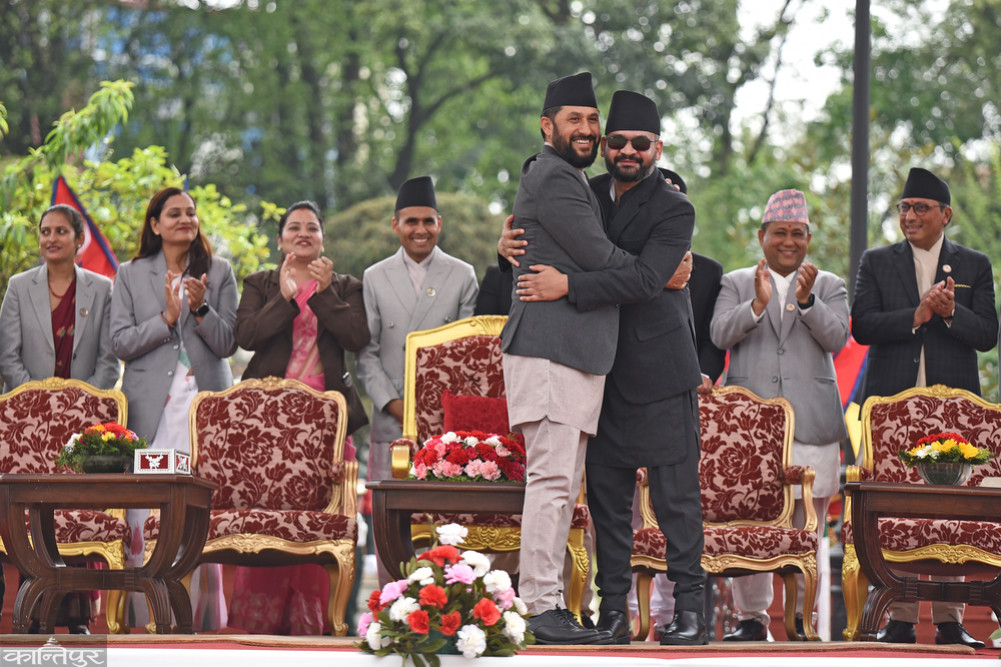
Will a law be enacted to ensure the authority's jurisdiction over the decisions of the Council of Ministers? The real test has begun for the government formed with the expectation of good governance and change.
We use Google Cloud Translation Services. Google requires we provide the following disclaimer relating to use of this service:
This service may contain translations powered by Google. Google disclaims all warranties related to the translations, expressed or implied, including any warranties of accuracy, reliability, and any implied warranties of merchantability, fitness for a particular purpose, and noninfringement.
Although the government has set a 100-day agenda with good governance and governance reforms as its main priority, policy-administrative reforms and necessary law-making have been seen as major challenges for this.
The agenda made public by the Rashtriya Swatantra Party (RSWP), which came to power with about two-thirds of the votes on the basis of the Gen-G movement, has prioritized the issues of controlling corruption and maintaining good governance. The government's readiness to address this, from drafting bills to decisions on administrative reforms and implementation, will set the institutional foundation for good governance and governance reforms.
The government formed on Chaitra 13 under the leadership of senior RSWP leader Balendra Shah had made a 100-point governance reform agenda public the very next day. It has been said that it will be implemented in a phased manner. However, there is uncertainty regarding issues related to law-making. Meanwhile, the government has committed to investigating cases related to misuse of public office and illegal acquisition of wealth, including former Prime Ministers Sher Bahadur Deuba, KP Sharma Oli and Pushpa Kamal Dahal, and has initiated money laundering investigations against some former ministers and business groups.
Intensification of money laundering investigations against former Prime Ministers Deuba, Oli and Dahal
A survey by Transparency International, an international organization that monitors corruption and good governance, has also placed Nepal on the list of highly corrupt countries. On the other hand, the Financial Action Task Force (FATF) has also placed Nepal on the negative list (grey list). Nepal has been on such a negative list due to the failure to make the expected improvements in the implementation of laws related to the prevention of money laundering, investigation and prosecution of financial crimes. The biggest obstacle to getting out of this is corruption in the name of policy decisions.
The weak investigation into major scandals, even if it happens, is the obstacle of Section 4 (b) of the Commission for the Investigation of Abuse of Authority Act 2048.
Baluwatar's Lalita Niwas land case, Patanjali land case, irregularities in the construction of regional international airports in Pokhara and Lumbini, Jhapa's Giribandhu T-Estate land case, Tikapur land case, the case of collusion in leasing land of Nepali Trust to Yeti Holdings, misuse of government budget allocated for the maintenance of the then Maoist fighters, Taragaun land case and other major scams have taken place under the cover of policy. It is alleged that there is collusion between politics and administrative leadership and businessmen in these irregularities and scams. Most of the irregularities in the name of such policy decisions have not yet been thoroughly investigated. In recent years, the Commission for the Investigation of Abuse of Authority has filed cases in special courts by making political and high-ranking administrative officials involved in some major cases as defendants. However, there is also criticism from the general public against the authority for not making major leaders in power and authority as defendants.
Former Prime Ministers Madhav Kumar Nepal and Baburam Bhattarai, who were seen as the main decision-makers in the Lalita Niwas case, have not been investigated. The hearing of the writ petition filed in the Supreme Court, making the CIAA a defendant, alleging that both of them were granted immunity, has not been concluded for 6 years.
The CIAA bill to suppress corruption in policy decisions is 'hostage' in Parliament
However, in (b) of the same article, it is mentioned that ‘the Commission shall not investigate and investigate or take any action in connection with any act or decision taken in a meeting of the Legislature or a committee or any act or decision made by any member in such a meeting or any policy decision taken collectively by the Council of Ministers or any of its committees and any judicial action taken by the court under this Act.’
When the then government moved forward with the bill, it not only did not move forward with the said provision of the bill without amending it, but also proposed a narrower bill to decentralize and prevent authority from entering even into the decisions of the Provincial Assemblies and Provincial Councils of Ministers and registered it in the National Assembly on 6 Magh 2076. After lengthy discussions in the National Assembly, the provision was passed without amendment and sent to the House of Representatives on 27 Chaitra 2079. After a theoretical discussion in the House of Representatives, it was sent to the State Affairs and Good Governance Committee on 27 Chaitra 2080. The chairman of the committee was Ramhari Khatiwada.
The Authority Bill was stalled in the parliamentary committee
A subcommittee was formed on 25 Kartik 2081 under the leadership of MP Hridayram Thani to revise the two bills related to the prevention of corruption and abuse of authority. The subcommittee, which included representatives of all parties including the Congress, UML, the then Maoists, and the Rashtriya Swayamsevak Sangh, unanimously submitted the reports on both bills to Chairman Khatiwada on 4 Pus 2081 after discussion. Among them, the Prevention of Corruption Amendment Bill was passed by both houses of parliament on 5 Falgun 2081 and has been implemented, while the Authority Bill has been stuck in the committee. [Related_News_Section_3]
The then ruling leaders disagreed with the amendment made by the subcommittee to the bill to allow it to investigate even the decisions of the Council of Ministers. The bill's life ended with the dissolution of the House of Representatives.
The amendment proposed by the subcommittee to allow the Authority to look into policy-level corruption was sharply criticized for being stalled due to the reluctance of the then Prime Minister KP Sharma Oli and the President of the ruling coalition party, Congress, Sher Bahadur Deuba.
With the exodus of the old ruling parties and the arrival of a new government built on the foundation of good governance and change, this issue has once again become a public concern.
Against this backdrop, we asked Sobita Gautam, Minister of Law, Justice and Parliamentary Affairs, what she would do now with the Authority Bill, which is at the heart of good governance.
‘Not only the authority in the then parliament, but all the bills are null . We will definitely keep the good things of yesterday in the reference, but the bill will come from the beginning,’ she told Kantipur .
The Thani-led subcommittee has amended Section 4 (b) of the Act and added a provision stating which decisions fall within the policy level and which decisions do not. The first point added by the subcommittee states that ‘any decision made regarding public procurement, except in cases where a decision has to be made by the Council of Ministers itself, shall not be policy level from now on.’
The second point states that ‘any decision that enters into the authority or exceeds the jurisdiction of such an authority or body on a matter that has to be decided by another authority or body according to law shall not be policy level’, while the third point states that ‘any decision made in a way that benefits, facilitates or benefits only a particular person or organization, except in cases where it is equally applicable to the general public according to law, shall not be policy level’.
The scenario of law-making in the light of the Authority Bill
When asked whether the new government would move forward with the points of the bill already passed by the subcommittee or take a different position, Law Minister Gautam said, ‘We have yet to discuss this with the Prime Minister.’ Let's not say anything now without discussing this issue with the Prime Minister, but we will take the agreements reached in the past as a reference.' She said that the ministry is also preparing dozens of other draft laws related to good governance, not just the authority bill.
Former administrator Sharada Prasad Trital says that the trend of making laws in the past based on the interests of middlemen, businessmen and vested interests and their own benefits should end with the new government. He believes that similar vested interests were behind the stalling of the authority bill in the past.
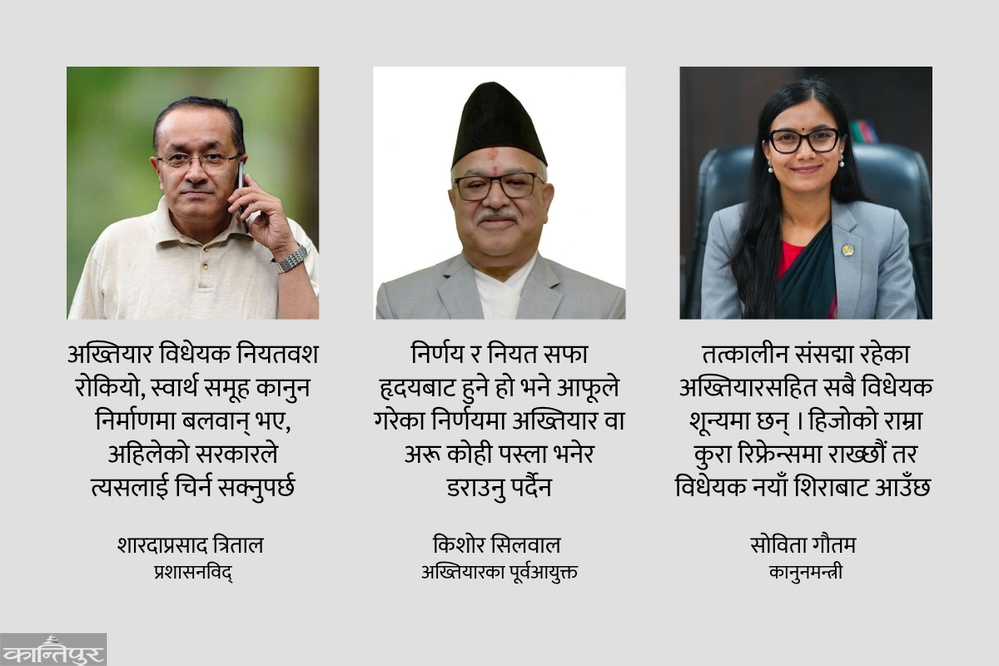
'The authority bill was stalled intentionally, if vested interests became powerful in lawmaking, the current government should be able to overcome it. We should take ownership of the good aspects of the stalled bills after reaching the parliament,' he said. 'It is enough for administrative reforms to be made by the Council of Ministers and other government mechanisms. However, for policy reforms, the relevant laws should be made quickly. The government should not delay in that.'
Interview: 'Yesterday, corruption deals were made in Nepal, now they are being made in Singapore and America'
Thani says that the real test for the current government, which was formed with the expectation of good governance and change, is whether the law will be made to ensure the authority’s jurisdiction over the decisions of the Council of Ministers.
‘Such a provision must be made to prevent corrupt decisions by the Council of Ministers, the biggest corruption cases have been committed under the policy cover of the Council of Ministers,’ he added. ‘The government should take ownership of the bill put forward by the subcommittee to initiate an investigation into major corruption and prevent such scandals from recurring in the future. Even the then Rashtriya Swayamsevak Sangh (RSS) MPs have agreed to this bill.’
Nepal’s level of corruption control has not improved
'In line with the spirit of good governance, the government should move quickly towards policy reforms and law formulation. The Authority Bill was deliberately stalled. Interest groups have become powerful in law-making. The current government should be able to overcome it and move forward,' says Trital, 'it should take ownership of the good aspects of the bills that have been stalled after reaching the parliament.'
The announcement by the Congress, NCP, Rashtriya Swayamsevak Sangh (RSS) and RPP to investigate the assets of those who have reached high positions since 2046
The 100-point pledge made public by the RSS during the election and the 100-point list of good governance of the government formed under its leadership prioritized corruption control, good governance, and related policy, administrative, and procedural reforms. However, the main concern is how the government formed with the new mandate will take up the stalled bills, drafts under discussion in the Council of Ministers, and related procedures brought forward by the dissolved House of Representatives. [Related_News_Section_7]
‘Our main priority is good governance. Where should we amend the law, where should we make a new one? We are studying it and making an action plan,’ said Law Minister Gautam.
Not only the Authority Bill, but also the Conflict of Interest Act, Election Management Act, and NGO Act related to good governance could not move forward from the committee. In the past, when the bill was shelved, the system to prevent people facing criminal cases from becoming candidates in elections, a clear law on conflict of interest, and effective regulation of foreign funds entering through NGOs are still incomplete.
The Election Law Amendment Bill prepared by the Election Commission three years ago is stalled in the Ministry of Home Affairs, while dozens of laws related to good governance, including financial discipline, public frugality, and fiscal accountability, have not been reformed. Although procedures were established 10 years ago to prevent abuse in the name of financial remedies, those with access and influence are still misusing government funds due to lack of action. The support limit of up to 1.5 million has not been met. The Authority makes suggestions every year through its annual report for controlling irregularities and good governance. However, it has not been implemented.