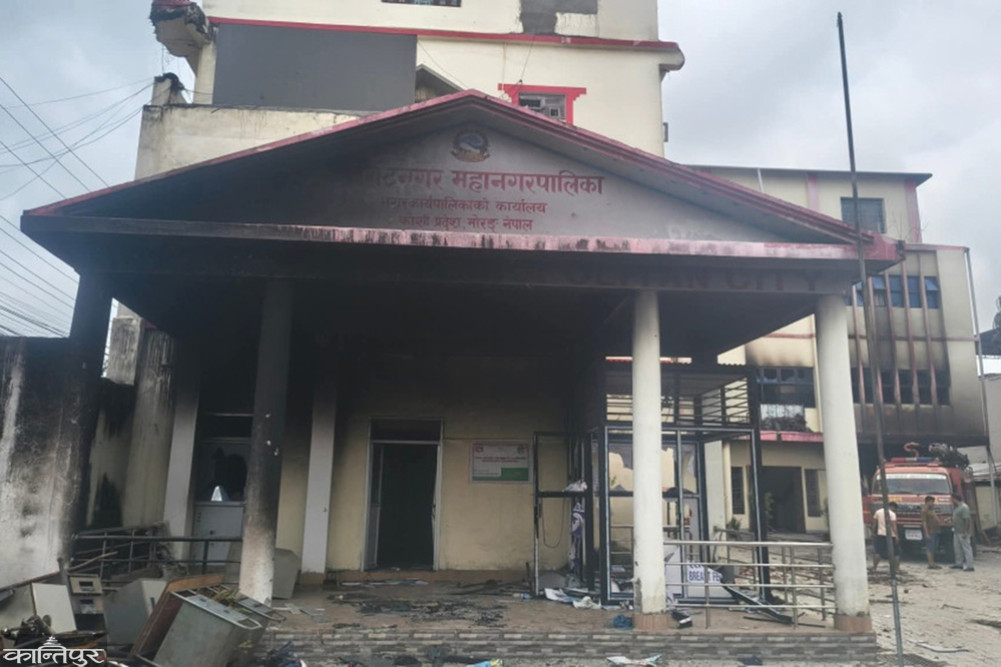
According to the details collected by the Karki Commission, the impact of the arson attacks on structures including the Parliament Building, Singha Durbar, and the Supreme Court in Baneshwor, Kathmandu, was also seen in the districts.
We use Google Cloud Translation Services. Google requires we provide the following disclaimer relating to use of this service:
This service may contain translations powered by Google. Google disclaims all warranties related to the translations, expressed or implied, including any warranties of accuracy, reliability, and any implied warranties of merchantability, fitness for a particular purpose, and noninfringement.
During the Gen-G movement, there was extensive damage in the demonstrations even in districts outside Kathmandu. However, it has been found that the local administration did not anticipate such damage.
According to the information collected by the Karki Commission, after the Parliament building, Singha Durbar and Supreme Court in Baneshwor, Kathmandu, were set on fire, its impact was also seen in the districts. It is mentioned that public property was damaged even after the mobilization of the Nepali Army in some districts.
To collect more facts about the incidents that took place during the movement, the Commission had demanded a detailed 'incident report' from the then Chief District Officers of the most affected districts. The details were collected to get accurate information about the situation before, during and after the movement.
In the information received, the Chief District Officers have mentioned that although the leadership of the movement was basically from the Gen-G group, it was influenced by various levels. They say that so-called social activists, political party organizations and activists from other parties, and some groups active on social media played a role in inciting the protesters.