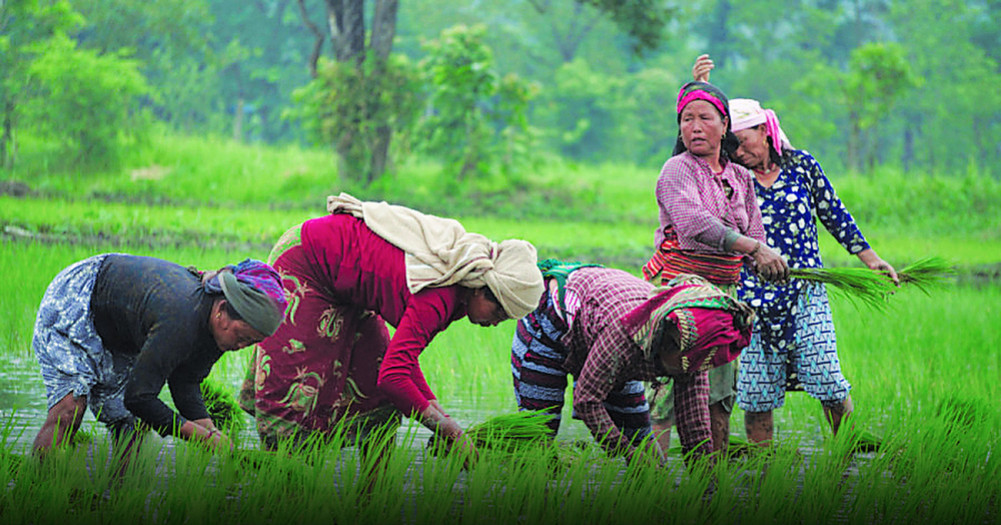
It is too late to adopt a policy to utilize wasteland and prevent land fragmentation by attracting economically active manpower to agriculture. For this, the concept of contract farming and land banks should be implemented.
We use Google Cloud Translation Services. Google requires we provide the following disclaimer relating to use of this service:
This service may contain translations powered by Google. Google disclaims all warranties related to the translations, expressed or implied, including any warranties of accuracy, reliability, and any implied warranties of merchantability, fitness for a particular purpose, and noninfringement.
The agricultural sector, which is important for food and nutrition security, employment generation, and livelihoods, has made a significant contribution to the national economy of Nepal. According to the National Census 2078, 50.1 percent of the population is economically engaged in the agricultural sector. The agricultural sector contributes about 24 percent to the gross domestic product.
A landlocked and agriculture-based country like Nepal should assimilate the efforts made in the past and use the available means, resources, technology and opportunities to address the current challenges and establish the agriculture sector as a sustainable and attractive profession.
The planned and institutional development of the agriculture sector in Nepal began in 2008 with the establishment of the Department of Agriculture. Along with structural reforms, institutions have been formed, reorganized and modified in various periods for agricultural research and extension.
The Nepal Agricultural Research Council was established in 2048. In 2052, the Department of Agriculture, the Department of Animal Services and the Department of Food Technology and Quality Control were established by modifying the institutional structure of the agriculture sector. After the implementation of federalism in 2072, new structures related to agriculture and livestock development were established at the federal, provincial and local levels and agricultural development programs are being operated in accordance with the spirit of the constitution.
In this context, agricultural research, extension and development activities have been conducted in collaboration between the government, non-government and private sectors working in the agricultural sector since the past. Various policies, strategies and long-term plans have been formulated and implemented to guide agricultural development plans and programs. The Policy Framework for Agricultural Development 2048, Long-term Agricultural Plan (2052-2072), National Agricultural Policy 2061, Crop and Commodity Special Policy, Agricultural Commercialization Promotion Policy and currently the Agricultural Development Strategy (2072-2092) are being implemented.
The agricultural sector, which is our culture, tradition and lifestyle, is basically subsistence-oriented. In 2010/11, when about 71 percent of households were dependent on agriculture, the total value added of the agricultural sector was about 5 trillion rupees. Now, when about 60 percent of the people depend on agriculture, it has reached about 12 trillion rupees. However, the productivity of agricultural workers is only 1,024 US dollars per capita per year and the productivity of agricultural land is only 4,143 US dollars per hectare. In this sense, the productivity of agricultural workers and agricultural land has not increased satisfactorily. In the past, agricultural development initiatives focused on increasing production and productivity through the use of advanced production materials and technology. Along with marketization, import reduction and export promotion through commercialization, diversification, modernization and industrialization of agriculture are being transformed in a timely manner towards food and nutrition security, food hygiene, climate adaptation, ecological agriculture, and protection and promotion of farmers' rights and interests.
Access to various technical services such as advanced seeds, seeds, seedlings, sawdust, irrigation, etc. required for agricultural production has led to a significant increase in production. For example, the import of chemical fertilizers has increased from about 35,297 tons in 2001/2002 to about 500,000 tons annually. The irrigated area has expanded from 1,126,601 hectares to 1,579,647 hectares by 2081 Falgun, of which 39 percent of the land is irrigated for twelve months.
The production increase and export promotion program is also increasing the export of agricultural commodities such as cardamom (about 7 billion rupees), ginger, tea, coffee, and chhurpi (about 4 billion rupees). With the increase in production, the availability of food per capita has increased annually, improving food and nutritional security. According to the Food and Agriculture Organization of the United Nations, an adult person needs a minimum of 91 liters of milk, 48 eggs, and 14 kg of meat per year. Currently, 89.6 liters of milk, 55 eggs, and 15 kg of meat are available.
Despite the overall increase in production, only 45 percent of families are currently able to meet their food needs throughout the year from their own agricultural production, while 55 percent of households are food insecure.
Agriculture itself is a sensitive and risky profession. Despite many positive indicators in the agricultural sector as a result of past efforts, the average annual growth rate of the agricultural sector is limited to around 2.5 percent. Problems such as the continuous migration of agricultural workers, fragmentation of land (per farmer family 0.55 hectares, number of plots 2.8), lack of adequate irrigation facilities throughout the year (only 55 percent of the irrigated area), even arable land remaining barren (estimated 30 percent of arable land), the availability of improved seeds has not been as expected and the seed replacement rate is only 23.14 percent, the use of chemical fertilizers is low compared to neighboring countries, the increasing use of arable land for non-agricultural purposes, the inability to produce agricultural products in line with the changes in the demand structure in the consumer market, increasing production costs, the decreasing competitiveness of domestic agricultural products in the domestic and external markets, the negative impact of climate change, increasing disaster events, damage caused by wild animals and community animals have been seen in the agricultural sector.
In the last two decades, the migration of labor and capital from the agricultural sector to foreign employment, service industries and industrial sectors has continuously increased. Especially due to the increasing migration of youth and men, female farmers are taking on additional responsibilities in agriculture. This has not been able to develop and expand women-friendly technology sufficiently, and the capacity of women farmers has not been enhanced in line with their changing roles.
Potential, opportunities and future direction
Nepal's geographical diversity has great potential for the production of diverse agricultural products. The opportunities created by being located between two major economies, being an area where a large part of the population is dependent, and the expected development of the industrial sector cannot be denied, but the agricultural sector remains a priority sector for economic development in Nepal.
The increasing demand for diverse and processed products rather than traditional agricultural food products in the market due to the increasing proportion of urban population, increase in per capita income, and changes in eating habits can also be taken as an opportunity. The restructuring of the state has created additional opportunities for commercialization by ensuring production materials, technical services, and product markets in the agricultural sector. In this way, the foundation has been laid for the commercialization and diversification of the agricultural sector, and the dimensions of rural livelihood are being linked to the market side.
As opportunities for the commercialization of agriculture are being created, operational, policy and programmatic cooperation between the federal, provincial and local levels is necessary to utilize these opportunities. Strengthening agricultural education, extension and research, agricultural human resource development and capacity building, and human resource management of other service groups required within the agricultural structure are also equally necessary.
The government has declared an investment decade in its budget statement of 2081. If the limited average growth rate of 2.5 percent in the agricultural sector cannot be increased through modernization, commercialization and industrialization along with increased investment, it will have a negative impact on national food security as well as the country's economic and social structure. Therefore, possibilities and opportunities should be sought from this sector for the positive transformation of the entire agricultural sector.
For this, the government should take a clear policy to reduce imports and promote exports. We should make full use of comparative advantage and competitive advantage to achieve self-sufficiency in basic food and increase the production of agricultural products that are in high demand in the international market.
Emphasis should be placed on the development and dissemination of studies, research, and technology to reduce and adapt to the risks and impacts of climate change and to ensure the protection, enhancement, and sustainable use of natural resources, the environment, and biodiversity.
It is imperative to prioritize programs to reduce risks and uncertainties in the agricultural sector. Organic fertilizers should be promoted to prevent soil degradation due to excessive use of chemical fertilizers, minimize post-production losses, and discourage the use of agricultural land for non-agricultural purposes, along with healthy soil management measures.
It is too late to adopt a policy to attract economically active human resources to agriculture, properly utilize barren land, and prevent land fragmentation. For this, the concept of contract farming and land banks should be implemented.