Most of the cases that are not resolved in the local judicial committees reach the courts, and the courts refer those that appear to be amenable to resolution to the mediation centers. Lack of resources and poor practice have prevented the mediation centers from being effective, which has not reduced the caseload in the courts.
We use Google Cloud Translation Services. Google requires we provide the following disclaimer relating to use of this service:
This service may contain translations powered by Google. Google disclaims all warranties related to the translations, expressed or implied, including any warranties of accuracy, reliability, and any implied warranties of merchantability, fitness for a particular purpose, and noninfringement.
The Local Government Operation Act, 2074 BS, has given municipalities and rural municipalities the authority to resolve local-level disputes within the ward and municipality.
For this purpose, mediation centers have been established at the ward and local levels. However, it seems that many cases that could be resolved at the ward level still reach the courts. ‘It was expected that the pressure of petty cases would decrease after the formation of the local level,’ said Ramchandra Basnet, Information Officer of the Jhapa District Court, ‘but in practice, the number of cases is increasing.’ According to him, in the fiscal year 2081/082, out of 814 cases sent to the court for mediation, only 153 were settled and 41 are in process. Till Kartik of the current fiscal year, out of 240 cases sent, only 41 were settled and 74 are still in process.
The mediation center has been operating at the Jhapa District Court for a decade and a half for the long-term resolution of disputes between litigants. Most of the cases that are not resolved in the local judicial committees reach the court, and the court sends the cases that are found to be resolved to the mediation center.
However, about 90 percent of the cases that reach the center are returned to the court after they are not resolved. There is a system in place for mediation discussions to last for three months and unresolved cases go to regular hearings. 'The court sends the cases that can be resolved to mediation, but if they are not resolved at the center, they return to the court,' said mediator advocate Naresh Khati.
The mediation center was established in Jhapa according to the District Court Rules, 2060. It became a sessional center after a separate desk was built in 2067 BS. Currently, the center is operating in the library room on the top floor of the court. There is no separate building for the center.
The judge sends the cases that he considers suitable for mediation to the center based on the nature of the case. Advocate Ajay Ghimire said that there is a legal provision that allows cases to be registered directly at the center. The court has stated that individual-plaintiff (worldly) cases such as partition, divorce, land disputes, transactions, assault and fraud are more likely to come for mediation.
In the mediation process, both the plaintiff and the defendant can select a maximum of three mediators each.
There are currently 49 listed mediators under the Jhapa District Court, which includes advocates, social workers and employees.
In the Morang District Court, structural problems have become an additional challenge. The mediation center, which had a separate three-room building before the Gen-G movement, is now operating from a narrow room after it was burned down during the movement, said Information Officer Hem Bahadur Budhathoki. ‘Earlier, the facilities were complete, now the situation is pathetic,’ he said.
According to the Morang court, out of 1,584 cases sent for mediation last year, 1,111 were resolved. However, only two of the 120 cases sent till Kartik of the current fiscal year have been resolved. There are currently 29 registered mediators in Morang.
The court's 'neglected room'
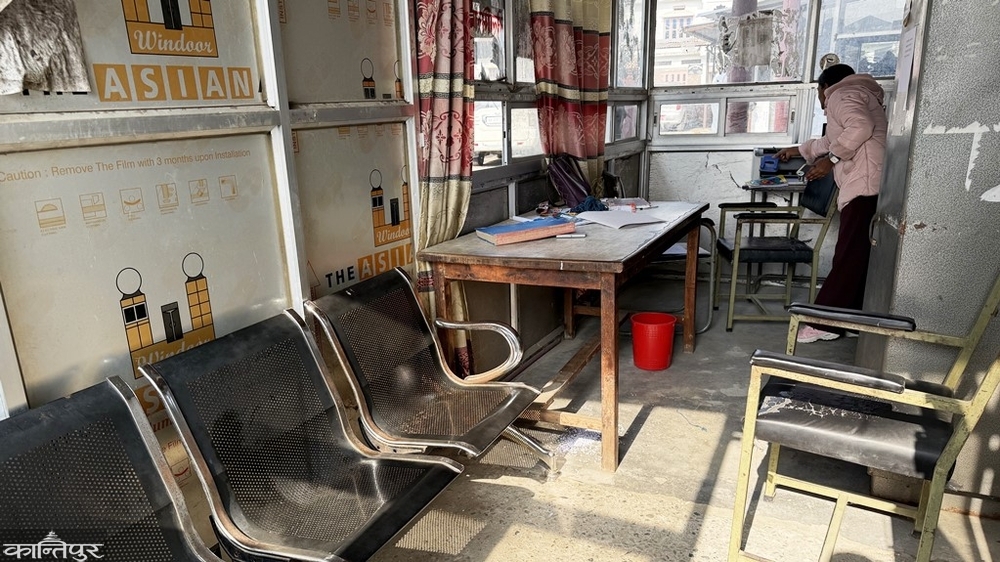
There is a small room attached to the main gate of the Sunsari District Court. There is only a small table and three chairs in the ordinary room surrounded by zinc and glass. A few files are visible inside and above the rusty tin drawer. Compared to other branches of the court, it can accommodate no more than six people at a time.
This is the most 'neglected' room in the court. The government has established mediation centers in courts across the country with the aim of resolving disputes through a quick, easy and simple process. However, this center, which has been operating in the Sunsari District Court for years, has not been effective due to lack of resources and infrastructure.
Despite being established outside the main gate of the court, the mediation center has not been able to operate as expected due to lack of infrastructure. The hearing of cases registered at the center has to be held in the hall of the District Bar Association nearby. Although the court aims to resolve disputes by appointing mediators and reaching an agreement between the disputing parties and reducing costs, it has not been effective in practice.
There are currently 35 registered mediators in the Sunsari District Court. The number of mediators, which was 32 earlier, has recently been increased. Advocates, social workers and journalists have also been trained and registered.
A group of mediators selected by the litigants from among the listed mediators can resolve disputes through mediation in civil cases other than those related to the government. The settlement rate of cases in this center, which was established with the aim of resolving cases through discussion, a comfortable environment and mutual agreement, is not encouraging in the last four months.
Of the 203 cases sent to the mediation center till Kartik of the current fiscal year, 170 cases have been resolved while 167 cases have been returned without being reconciled. Currently, 33 cases are in the mediation process, informed Mani Dahal, the deputy judge of the court.
Dahal said that due to lack of resources and infrastructure, the work could not be done as much as desired. According to him, the court is preparing to move to a well-equipped building within the next week and it is believed that the mediation center will also gain momentum after that.
The non-cooperation of legal practitioners, the inability of registered mediators to play an effective role, and some litigants not trusting the mediators are the reasons for the inactivity of the mediation center, said an advocate of the Sunsari District Bar Association.
Case is about to be settled
The divorce case involving Manita Limbu of Maiwakhola Rural Municipality-4, Taplejung, as the plaintiff and Suren Limbu as the defendant was settled on a single day on November 29. Since the plaintiff and defendant themselves agreed and appeared in court, the case did not have to be sent to the district court's mediation center. However, most of the cases sent to the center are not resolved.
According to court clerk Sammi Kapoor Shah, only three cases have been resolved through mediators since Shrawan of the current fiscal year. While District Judge Bikash Shrestha had sent 43 cases to the mediation center. Of these, seven cases are currently in the mediation process. Shah informed that only the cases related to fraud, forgery and cancellation of registration of the settlement agreement, in which Tejbir Limbu of Meringden Rural Municipality-2 is the plaintiff and Krishna Kumar Chongwang is the defendant, have been resolved through mediation. The mediator in the case was legal practitioner Dhan Bahadur Thapa. All three cases resolved through mediation were related to these parties. According to Shrestedar Shah, the number of cases resolved by the plaintiff and defendant themselves without sending them to the mediation center is 52. Including 159 cases where responsibility has been transferred, there are a total of 339 cases in the district court as of Mangsir. Of these, 52 cases were resolved by the plaintiff and defendant themselves, while only three cases were resolved through a mediator.
According to a legal practitioner, there is a practice of divorce by mutual consent, women who have obtained citizenship after coming to their husband's house to remove their name from the husband's list, and women who go for foreign employment register cases and settle them by agreement. However, he says that it is becoming challenging to reconcile and settle the remaining cases. 'Fighters are like the Nepali number 36,' said mediator and legal practitioner Vedanidhi Poudel. 'We make 63 by understanding, we create an environment where we turn them in the same direction and talk, but in the end it is difficult to reconcile.'
Poudel claims that he does not allow anyone other than the fight in the room during reconciliation and allows both parties to have direct discussions. 'If others enter, one says one thing, the other adds something.' They don't let the quarrelers face to face,' he added, 'After discussing for one or two hours, it seems like they will reconcile, but when they come out, it gets worse again.'
Balram Bhattarai, Vedanidhi Poudel, Dhan Bahadur Thapa, Thakur Singh Limbu, Sammi Kapoor Shah and Santosh Prasai are currently serving as mediators in the Taplejung District Court. Recounting his experience of conducting discussions for three hours, mediator Santosh Prasai said, 'Some people don't want to discuss even for half an hour, while others discuss for two to three hours, putting their points forward, asking and answering questions.'
According to him, most of the cases are not resolved at the lower level and come to court, so the chances of a settlement are low. ‘People often come to court only after trying in the ward, rural municipality or municipality,’ said Prasai. ‘The parties who come like that seem reluctant to settle because they want the matter to be decided by the judge.’
Mediator Poudel said that during the three-stage discussion, the disputants are given as much time as they want and the legal aspects are also clarified. ‘We show both the easy and difficult aspects, listen to them carefully and suggest possible solutions,’ he said, ‘but even then, some cases are not settled.’
Eight cases settled in three years
The Panchthar District Court bench had recommended 133 cases for settlement through the Mediation Center in the fiscal year 2081/082. However, only 4 of them were settled.’
Before that, in the fiscal year 2080/081, out of 93 cases recommended by the court for mediation, only 2 were resolved through mediation. In the current fiscal year 2082/083, out of 25 cases recommended by the court, only 2 cases were resolved through mediation.
Thus, in the last three fiscal years, only 8 cases have been resolved through mediation through the mediation center. Although about 800 cases are registered in the court annually, the number of cases that are recommended to the mediation center and even among those that are resolved through mediation after discussion is very low. There are currently 6 listed mediators in the list of mediators of the Panchthar District Court. All of them are legal practitioners.
There is a provision to form a mediation center in the district court as per the National Mediation Act, 2068 and its Regulations, 2070. The mediation center has been formed in the district court as per the same legal provision. Although there is a provision that any Nepali citizen who has passed the bachelor's degree can be listed as a mediator, there is a provision that they must undergo 48 hours of mandatory training from the Supreme Court's Mediation Center.
Qualified and trained mediators at the mediation center formed in the court facilitate the settlement of cases. Before the discussion begins in the cases recommended to the center by the bench, both the plaintiff and the defendant can choose one mediator each. The court's senior judge Rajkumar Niraula informed that there is a provision to discuss and reach a settlement through the mediation of the mediator chosen by the parties. However, even if the legal practitioner who is handling the related case is on the list of mediators, he cannot facilitate the settlement of his own case.
‘There is a legal provision that prevents legal practitioners appointed to write, review and advocate cases from facilitating the settlement of cases they are handling themselves,’ said legal practitioner Yudhishthiraraj Amgai, ‘That is why we cannot facilitate the settlement of cases on our side.’
He shared his experience that when only legal practitioners are included in the list of mediators in most courts, the centers have difficulty in settling a significant number of cases. ‘On the one hand, by the time the court reaches the stage where the parties to the case are in a state of mind to reach a verdict by paying damages and fines to the opposing party,’ said Amgai, ‘on the other hand, when only lawyers are on the list of mediators, sufficient time cannot be given due to their busy schedule. If mediators from other fields besides lawyers are included, the number of settlements could increase slightly.’
The rate of cases resolved through mediation is decreasing
The success rate of cases resolved through mediation in the Dhankuta District Court has been decreasing in recent years. Out of the 330 cases sent to the Conciliation Center under the Dhankuta District Court from the fiscal year 2080/081 to date, only 72 have been resolved through conciliation.
Out of the 142 cases sent for conciliation in the fiscal year 2080/081, 17.61 percent or 25 cases were resolved through conciliation at the center. Similarly, out of the 157 cases sent in the fiscal year 2081/082, 28 percent or 44 cases were resolved through conciliation.
Indra Kumar Yonghang, the District Court, Dhankuta, informed that out of the 31 cases sent for conciliation in the five months of the current fiscal year, only 3 were successful. He said that the cases not resolved by the center will be re-heard in the regular hearing process. Out of the 31 cases sent for conciliation in the current fiscal year, 7 are still under discussion.
Shrestedar Yonghang said that the main reasons for the ineffectiveness of mediation are the reluctance of the parties to the case to mediate and the lack of coordination between the legal practitioners on both sides.
According to him, cases of assault, domestic violence, real estate, inheritance, emotional distress, border disputes, civil and individual criminal nature are of a nature that can be resolved through mediation. ‘Mediation is a win-win process for both parties,’ he said. ‘If it can be made effective and long-term, it can become a good practice.’
Mediator and senior advocate, Professor Dr. Gopal Bahadur Bhattarai said that the practice of mediation in court will lead individuals and communities to the path of understanding. ‘For mediation, we try to convince the parties and create an environment of understanding,’ said Bhattarai, ‘by adopting diplomacy, we explain the situation of the case and the possible future consequences.’
He said that cases that could be resolved through mediation are still going to trial because they cannot analyze the possible future consequences. ‘We work using skills, psychology, philosophy and law in mediation,’ he added.
Community mediation societies are also active at the rural municipality, municipality and ward levels to facilitate cases. A separate mediation room has been arranged in every court for the mediation center.
According to the Mediation Act, 2068 BS and the Rules, 2070 BS, there is a provision that parties coming for mediation can be charged a maximum of Rs 500 as transportation expenses and a maximum of Rs 10,000 for obtaining a settlement in court, with the agreement of the parties, said Dhan Bahadur Khadka, the chairman of the Community Mediation Society formed in Dhankuta Municipality. "Those who do not have money or cannot pay will not be forced to do so," Khadka said. "No one should be deprived of mediation services just because they cannot pay."

