”The RSP has become suspicious of the government's reluctance towards the issue of nationalism and the map we have raised in the Parliament.” - Shishir Khanal.
We use Google Cloud Translation Services. Google requires we provide the following disclaimer relating to use of this service:
This service may contain translations powered by Google. Google disclaims all warranties related to the translations, expressed or implied, including any warranties of accuracy, reliability, and any implied warranties of merchantability, fitness for a particular purpose, and noninfringement.
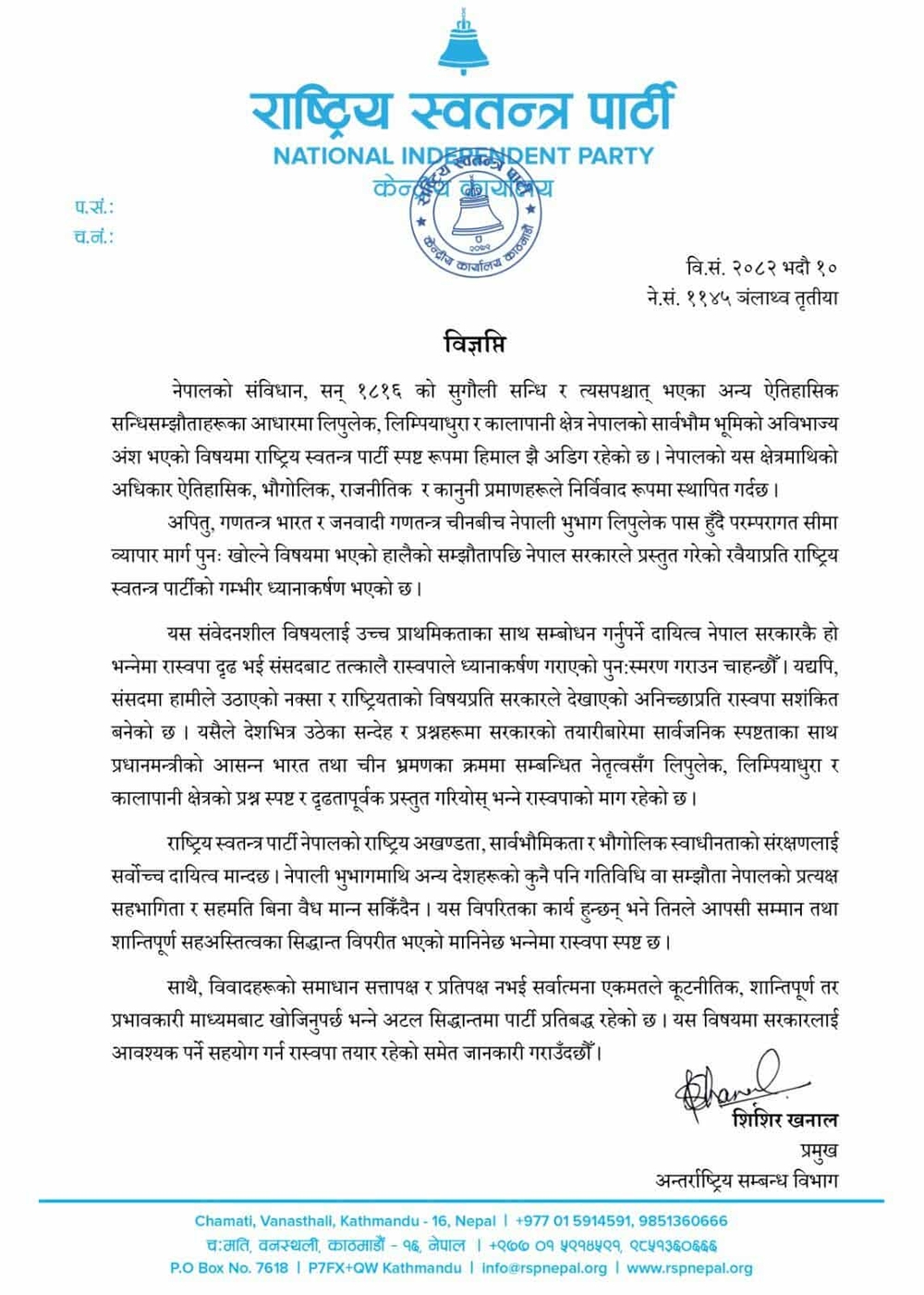
The RSVP has alleged that the government is not serious about the India-China agreement to trade through the Lipulek Pass. Shishir Khanal, head of the International Relations Department, RSWP, issued a statement on Tuesday and said that the attitude presented by the Nepal government after the India-China agreement has attracted the serious attention of the counterparties.
"On the basis of the Constitution of Nepal, Sugauli Treaty of 1816 and other historical treaties that followed, the National Independent Party is clearly adamant about Lipulek, Limpiyadhura and Kalapani areas being an inalienable part of Nepal's sovereign land," the RSWP said. We want to remind you again. However, RSVP has become suspicious of the government's reluctance towards the issue of nationality and the map we have raised in the parliament.' Khanal also says that RSVP is firm that the Nepal government has the responsibility to deal with sensitive issues with high priority and has drawn the attention of the government through the parliament. RSVP also says that the government did not take the matter raised by them seriously. "The RSP is suspicious of the government's reluctance towards the issue of nationalism and the map we have raised in the Parliament," the statement said.
With public clarity about the preparation of the government to the doubts and questions raised in the country, during the upcoming visit of the Prime Minister to India and China, RSVP has also demanded to clearly and firmly present the issue of Lipulekh, Limpiyadhura and Kalapani areas to the relevant leadership.
The RSVP has also made it clear that any activity or agreement of other countries on Nepalese territory cannot be considered valid without the direct participation and consent of Nepal.
The RSVP has also requested the government to find a solution to the disputes through diplomatic, peaceful but effective means, without calling the ruling party and the opposition.