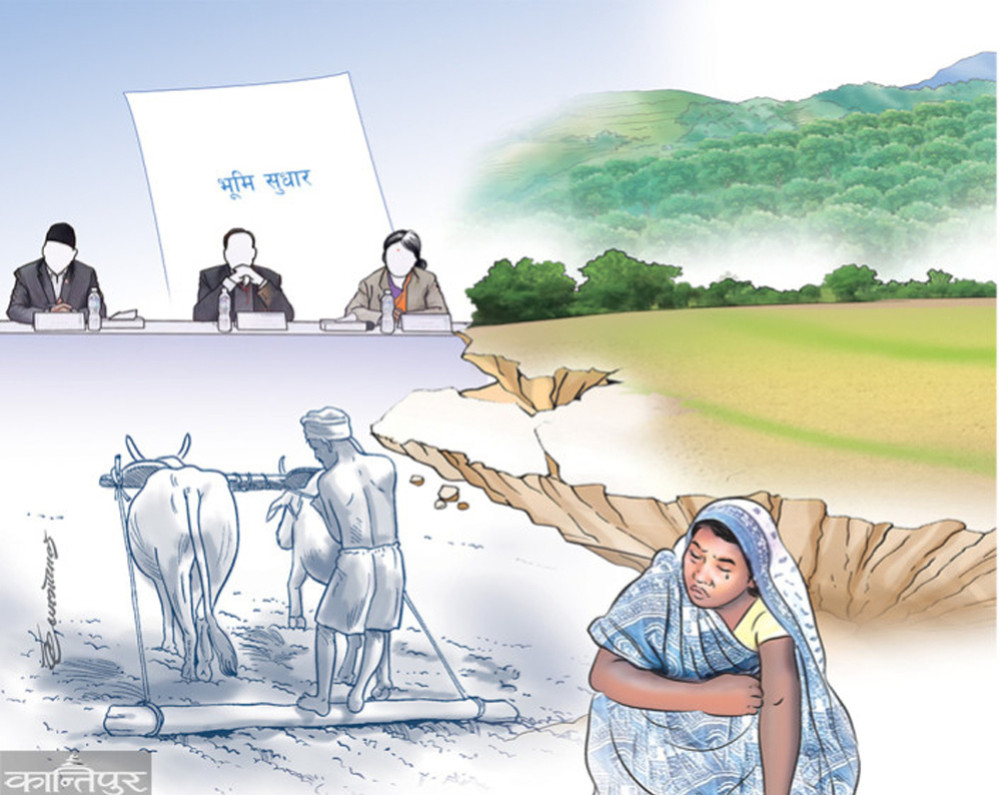
Why is there such a quick amendment to the Land Act? Under cover, the government has been accused of showing the problems of landless Dalits and squatters but pursuing other interests behind the scenes.
We use Google Cloud Translation Services. Google requires we provide the following disclaimer relating to use of this service:
This service may contain translations powered by Google. Google disclaims all warranties related to the translations, expressed or implied, including any warranties of accuracy, reliability, and any implied warranties of merchantability, fitness for a particular purpose, and noninfringement.
Bhairavlal Gurung lives in the central region of Chitwan National Park. He is also the President of Land Rights Forum Chitwan. According to him, there are 36,000 families of landless Dalits, landless squatters and unorganized dwellers in the intermediate area of Chitwan-Nawalpur alone.
The settlement of Lalpurja is also thick here. However, thousands of families like Gurung are struggling to register even the land they have been enjoying for 6 decades. However, they have not been successful.
When the surveyor comes in 2025, those who know and understand have registered the land in their names and took Lalpurja. Why should we spend money to register if we can eat for free? "Now we have only been cheated," says Gurung, "Due to some fataha, there is only politicization of the landless and unorganized like us."
Since 2052, the government has created the concept of considering the area around 7 km of the national park as an intermediate area, and the issue of squatters and unorganized people living in this area has become more complicated. Elsewhere, while the land commission was distributing red parts, more stringent laws were made for the residents of this area. Initially, most of the intermediate areas were squatters. Later, some of the landless people gradually turned into unorganized ones after many people bought some land outside the central area. "Our fight is with the intermediate area," says Gurung, "The forest does not allow measuring within 7 km of the park area." According to him, there is a dense population of squatters and unorganized residents in this national park and Krishnasar area. Apart from these areas, many squatters have got Lalpurja. Even now, the Land Commission is distributing parts in many places. However, the residents of forest and intermediate areas have not been able to get parts.
Civil and Land Bill creates a rift in the power coalition
Bardiya is a squatter in the central area since Lakshmi Mall 028 of Krishnasar conservation area. "Even in the place where we have been living for 54 years, we have not been able to get red parts, we are tired of struggling," she said, "We heard that the law has been amended many times before. It seemed like it was for us. However, the forest has not yet agreed to measure our land.
It is mentioned in the Eighth Amendment of the Land Act that landless Dalits, landless squatters and unorganized people who have been living for 10 years can be given land once in the same place they are living. However, the Forestry Act and the National Parks Act state that no matter how long they have been settled in, no land can be given in any place where forest and intermediate areas have been established in the old Napi. The government has also brought amendments to the laws related to forests and parks with a plan to remap the lands designated as forest, butyan and intermediate areas and bring them under the name of the government and distribute them to squatters and unorganized people.
problem on one side, selfishness on the other
The unusual activism of the government is currently seen in the amendment of the Land Act 2021. In the decade after the promulgation of the Constitution, the Land Bill has been amended three times and now it is in the Parliament for the ninth amendment. In 2007, the sixth amendment was made to the Land Act. Then the Seventh Amendment was made within three years. The government made the eighth amendment in the middle of 16 months saying that even those amendments did not do the expected work. The bill, which was registered by the government on May 23, 2008, is now in the parliamentary committee as it did not yield the expected results. Coincidentally, Prime Minister KP Sharma Oli is leading the seventh, eighth amendment and the now proposed ninth amendment.
Why is the land law amended so quickly? Under cover, the government has been accused of showing the problems of landless Dalits and squatters but pursuing other interests behind the scenes. Minister of Lands, Cooperatives and Poverty Alleviation Balram Adhikari says that this time, amendments are being made to the Act to solve the problem of the landless.
So far, the government has formed various commissions, committees and working groups for the 19th time in the name of solving the squatter problem. But the problem is you. "The reason why this problem has not been resolved so far is because most of the economic manipulation and politicization of votes are done in the name of land," said an official of the Ministry of Land Management, Cooperatives and Poverty Alleviation.
If the land bill is not taken to the committee for discussion, it will become a misconception: Maha Minister Thapa [Interview]
"The bill brought for the 9th Amendment has also come into controversy because it was viewed from the same point of view," says land engineer Biswas Nepali, "It was drawn into the controversy by adding the issue of demarcated land." If only the real landless Dalits and squatters were prioritized, there would not have been so much controversy. According to the Land Commission, the number of unorganized, landless Dalits and landless squatters applying to get land is estimated to be over 1.5 million. 11 lakh 29 thousand 517 applications have been received in the records officially released by the government. In which 88 thousand 995 landless Dalits, 168 thousand 441 landless squatters and 9 lakh unorganized residents.
'Many settlements without Lalpurja are located in community forest land, in the middle area. They have not been able to get Lalpurja due to forest and park obstruction. It was said that the bill was brought forward to remove this difficulty, but the issue of plotting and sale of land in excess of the limit was added to it, causing confusion," says Nepali, "In the name of unorganized, rich and wealthy people will get land to the extent specified by the government.
benefits to land owners
When Oli was the prime minister, the eighth land amendment was passed. Prime Minister Oli is accused of making the Eighth Amendment to fulfill the interests of 'Giribandhu Tea Estate' rather than squatters and unorganized residents.
In the eighth amendment, 12 'a', 12 'b', 12 'c', 12 'd' and 12 'e' new sections were added after section 12 of the original act. In which, the special arrangements related to the regulation of limited exemptions were covered, from the arrangements for use, sale-distribution, lease, lease or rent to monitoring and inspection. The Eighth Amendment of the Act made arrangements so that even if the industries, establishments, companies or organizations in operation till 28th of January 2016 purchased land in excess of the limit without the approval of the government, the limit would not apply. In the case of holding land exceeding that limit, in the case of Madhesh and inner Madhesh, a fee of Rs 150,000 per bigha, Rs 50,000 per plant in Kathmandu Valley and Rs 10,000 per plant in other hilly areas.
In the next section, the provision that land can be sold and distributed was also kept in it. If an industry, establishment, company or organization is dissolved for any reason or goes into 'liquidation', the liability of such industry, establishment and company or organization will not be hindered for sale and distribution. The provision was made that the land can be kept in excess of the limit by the notified order of the government and even the land kept in such a way can be sold and distributed once by the company or organization for the purpose of lease or transfer to the bank or financial institution for debt settlement and liability payment. Giribandhu Tea Estate tried to take advantage of these provisions added in the eighth amendment.
The land bill that shakes the foundation of the coalition
It is understood that the government has removed such arrangement to facilitate the real estate businessmen to be able to sell-distribute the land even in non-agricultural and industrial areas. Now even in the committee, MPs have openly opposed the government's intention. In the proposed bill, the section 12(g) of the Act, which provides for the approval of DPR and environmental studies, has been named as 'Special provision regarding the limitation exemption of real estate business'.
Even though the Eighth Amendment allows real estate companies to keep or buy land within the limits specified by the notified order of the government, there was confusion as to whether or not they could sell and distribute. To make it clear, the government has made another amendment in section 1 of section 12(g) and added a provision that the company that has obtained permission to do real estate business can sell and distribute the land within the limits specified by the notified order for construction of houses and housing. This seems to be the government's intention to benefit especially the big housing companies. As soon as the 'notified order' is said, the arbitrariness of the government will be lost, and the parliamentarians are demanding to remove it from the parliamentary committee.
In section 12(g) by adding another sub-section 2, the government has added a provision that 'when selling and distributing houses and apartments, the land kept for the collective use of the buyer must be filed and dismissed so that the collective ownership of the buyer is maintained'. Earlier, housing and apartment land used to be in the name of the respective company. As the land used for housing and apartments will be collectively owned, the way for such companies to keep the land within the limits has become wider.
In this section, the government has added another amendment by benefiting the real estate businessmen. For example, in section 3 of Article 12(g), it is stipulated that when the land use area is classified by the local land use council, such land classified as a residential area or a commercial area cannot be sold by parcels or parcels without developing houses in accordance with the prevailing law. In the bill presented for the ninth amendment, the government has added a restrictive phrase in this section, stating that 'land purchased with permission from the local land use council before the classification of land use area, even if it has been classified in any area, there will be no hindrance to sell such land by dividing it and developing the land, building houses in developed areas and selling it'.
In this, the rights activists have understood the big interests of businessmen and land mafia and the pressure on the government. In this provision, a provision has been inserted to allow real estate professionals to develop land and build houses regardless of any classification of land, including agricultural and industrial areas, before using the land-use area.
Land use policy came only after the law was made in 076. It took three years to come up with the regulation due to the maneuvering of land traders, but its implementation was done with the regulation issued in 079. Then the land was classified into 10 areas including agriculture, residential, commercial, industrial, mining and mineral, forest, river/river, lake/wetland, cultural and archaeological importance. According to that, the work of separating agricultural and non-agricultural land was done by the local land use council. However, despite the promulgation of the Act, even during the three-year period when the regulations were not issued, the land owners had bought and kept a large amount of land in the agricultural and industrial sectors, but they were unable to sell and distribute it. The current amendment tries to make it easier to open the way from developing it to selling and distributing it.
Loose provisions in the name of unorganized
In section 52(a) of the Seventh Amendment of the Land Act 2021, section 1 states that the government of Nepal will provide land to landless Dalits within three years as specified for one time. 52(b) of the Eighth Amendment provided for the provision of land to landless squatters. But the government has also been inserted to revolve (c) passage (c) section 4 of 52 (c). For the reason, there is another fear of the distribution of land distribution in the name of the disbursement.
Subscription of Congress and Opposition parties have demanded that disagreement from this quadruplane has been approaching this document. Department of Subplosive 4 (c) in the area of the land, the land of the country, is currently placed in the river and the right-wing area, currently located land and road-seedl. However, the government has opened it to register it to provide gathery, hats, market, market, land, or land. & Nbsp;
was placed in the Round Bill, Story Break-BREAK-BREAK, Hatgartette or Market, Water Guamhatte or Messed in the data, the household (065) was made Excerpts स्योनिकोmore, and in the book of the regional draft while such land begins or If such land conditions should be barred to provide landaneless dalitable, landless squatters or unorganized settlement, not in the data. & Nbsp; Surprised that this fleece is abused by the land of Mandhi and land brokers. In the process of landing up the disorganization, the government has tried to amend the Law of September 3 of Act 52 (c). The nearest economic situation in the situation in the current act, the nature of the resolve, assessment, assessment, the duration of land and other areas is the need to give. However, the government has removed doubts by removing many such bases. The government has proposed to the current bill, not to land in the current bill, not removed as the status, economic conditions of Basabas, the economic, financial state. & Nbsp;
Proposed Land Bill have been amended. In the discussion of the committee, the government is accusing the government of the businessman to keep the interests of the housework in the center, and nbsp; & nbsp;
Critero-Break landless and landless squatters receive 130 squaremids in the valley, metropolitan, the sub-maneate area, or about four anniversary lands in urban areas. However, the clepened in the same place gets a 150 square meter (four came]. However, in addition to this, the standard of the standard of receiving separate lands for agriculture is also mentioned in the criteria. Landless Dalit and landless squatters in the Terai and Inner Madhes get 270 (about 11 years (four ropanic) for housing and agriculture.
but is disorganized habits in this area, the 10,000 squares (about two ropanis) class and agriculture (about 20 ropanis) for the housing. Similarly, landlines and landless squatters for accommodation in Himal and Mountains have been 340 (6,000) class and 10,000 (20 ropanic) squares for agriculture (20 ropanic) class. During the revised system now has been in the Terai-Madhesh, no matter how many small lands have been in the Terai-Madhesh, the general land will be provided to register according to the criteria.
government suspects the fear of the forest and non-valuable squatters due to non-proficient land abuse to land and the landless squatters to give them a legal obstacles to land. Forest, the jurisdone generated land has been shown the forest and national parks and wildlife facility Act show due to unable to distribute target groups. Adding to the Forest Act on Subdivorous 2 on Sub-Doser 3 of the forest, the forest area or the Bootan area is not obstacled in the name of the government.
revealing the restructuring of the land in this way, the stakeholders have expressed concern by registering the government without registering the open forest area land. After decade, the government of the Intermediate and Nbsp in Intermediate and Nbsp in the intermediate and NBSP; Story-BREA GROUNTER NEashuwar Neupane says that the landwhene has not been able to get land for land and the park ear. 'We have not said that the settlement should be registered with the open space, a settlement. From the law, we said, 'She said,' She said, 'She said, "She said," She said.
'is now talking about a forest content. However, Neupane needed to amend the problem of land, "said Neupane," said the government said, 'NBSP;. The bill has grown a number of land that allows a maximum land and selling the policy of selling land. '


![भूमि विधेयकलाई समितिमा लगेर छलफल गरिएन भने गलत धारणा बन्छ : महामन्त्री थापा [अन्तर्वार्ता]](http://assets-cdn.ekantipur.com/uploads/source/news/kantipur/2025/miscellaneous/gagan-2722025020922-1000x0.jpg)

