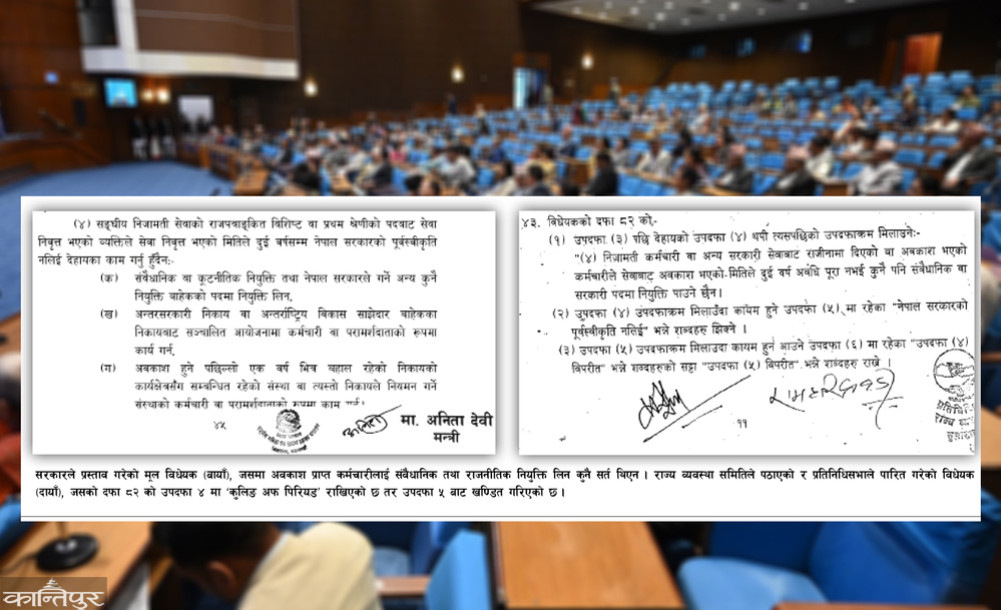
Contrary to the agreement in the committee, the chairman and secretary sent the bill to the house, the MPs passed it without reading it.
We use Google Cloud Translation Services. Google requires we provide the following disclaimer relating to use of this service:
This service may contain translations powered by Google. Google disclaims all warranties related to the translations, expressed or implied, including any warranties of accuracy, reliability, and any implied warranties of merchantability, fitness for a particular purpose, and noninfringement.
It has been found that the employees and parliamentarians of the State Order and Good Governance Committee Secretariat of the House of Representatives have committed serious fraud in the provision in the civil service bill that no government appointment can be taken for two years from the date of resignation or retirement from government service.
Although the State Order Committee, which is responsible for discussing the bill and preparing a report and submitting it to the House of Representatives, has stipulated that 'employees who have resigned or retired from civil service or other government service will not be appointed to any constitutional or government position before the completion of two years from the date of retirement', it has been found that the House of Representatives has also included another clause that breaks it. In section 82 (4) of the
bill, there is a provision that "A civil servant or an employee who has resigned or retired from other government service shall not be appointed to any constitutional or government position before the completion of a period of two years from the date of retirement." But in order to break it, in section 82, (5), (a) it is made ineffective by providing that appointment cannot be taken only in "constitutional or diplomatic appointments and any other appointments made by the Government of Nepal".
Committee members and MPs have said that while the committee is preparing the report, the committee's chairman Ramhari Khatiwada and secretary Suraj Kumar Dura should take responsibility for the lack of the latest provisions. On the other hand, although the House of Representatives meeting with the MPs of the committee passed the provision of 'cooling off period' without looking at it, a question has been raised about the entire Parliament. According to Congress MP Hridayram Thani, the responsibility of making the final report was given to the committee chairman Khatiwada and the secretariat, but now another arrangement has been mentioned, so they should take the responsibility.
"The final meeting was not held before submitting the report to the House. The chairman of the committee told us not to doubt it. We believed it, but only after the bill was passed, we came to know that there was a problem," he says. The report was submitted to the House of Representatives on June 1, about a month after it was unanimously passed by the
committee. In the meantime, committee chairman Khatiwada, committee secretary Dura, joint secretaries of the Ministry of Law and Ministry of General Administration worked to arrange the related provisions in the bill. The MP has alleged that another clause has been added to make the 'cooling off period' system ineffective. Maoist chief whip Hitraj Pandey, who is also a member of the
committee, made it clear that the 2-year 'cooling off period' was passed unanimously with the provisions applicable to all employees going on leave, and said that any disturbance in it would not be acceptable. "We have passed the bill with the provision of a 2-year cooling off period. The committee has passed the provision to prevent any employee from being appointed again after retirement," says Pandey, "but now there is a different provision. One thing to say, while writing, another thing could not be done. It should be seen whether it is human error or intention. There is a suspicion that something has happened from the government because this bill is too strong. They (committee chairman and secretary) should give an answer as to how this happened, the cooling off period was passed unanimously. As the chairman of the committee said that he gave what was passed, now the speaker should give the answer.'' Looking at the process from making the bill to passing it, it seems that there was confusion during the submission of the report from the State Order Committee to the House of Representatives. In the bill proposed by the government, there was a provision to get constitutional, diplomatic or government appointments, but not to work in the private sector, to work in intergovernmental bodies and international development partners, and not to be a consultant in projects other than those.
Similarly, there was a rule that even if you are in the regulatory body of the work area within the last 1 year of retirement, you cannot take a job there. In the bill proposed by the government, there was also a provision of non-receipt of pension as an action against section 82 (5). The 11-member sub-committee led by Dilendra Badu, formed to resolve the controversial issues of the
bill, had arranged a 'cooling off period' of 2 years. Such a 'cooling off period' was passed by the sub-committee, which does not require a 'cooling off period' to become ambassadors and judges, which is only for constitutional and government appointments. There was a dispute on this matter in the
committee. The committee unanimously agreed to keep a 2-year 'cooling off period' for those who resigned or retired from government service.
The members of the committee unanimously passed the rule that 'Civil servants or employees who have resigned or retired from other government services will not be appointed to any constitutional or government post before completing the two-year period'. The lawmaker also participated in the discussion of the meeting of the House of Representatives to pass the bill, saying that the provisions of the bill including the 'cooling off period' are good. The MPs took part in the discussion and passed the report and the provisions in the original bill without properly studying it.
This provision can be amended by the National Assembly. Congress MP Thani says that the 'cooling off period' should be corrected by the Speaker or the National Assembly. "The speaker should have adjusted the cooling off period and kept it as it was passed by the committee," he says. Since the government has already accepted the provision of cooling off period in the state law committee, it should be accepted in the national assembly as well.' They even warned of collective resignation. Despite that, the committee had provided for a two-year 'cooling off period' in the report of the bill. Umesh Mainali, the former chairman of the Public Service Commission, says that the corruption of the government officials has strengthened the doubt that the civil service bill will not be passed by the parliament. "This is the mischief of the staff. They used to add their own whims in the Parliament like this before. I did not think that the Civil Bill would be passed again due to such activities," Mainali said. Based on the discussion in the committee, the work of the committee secretariat is to prepare the report. It has the support and coordination of law and relevant ministry officials. The entire responsibility rests with the committee secretariat. The clauses in this bill are contradictory. Another provision has been put in place so that what the committee is trying to do does not happen," says Sharma. He said that the discussions about the cooling off period and the arrangements made now do not match.
Chairman of the committee, Ramhari Khatiwada, says that after the parliamentary committee has made the provision for a two-year 'cooling off period', General Administration Minister Rajkumar Gupta has a hand in making the subsequent arrangement. "It is not bad that the parliamentarians say that I should take responsibility for the provisions made in the bill as the chairman of the committee. We sent it with a clear mention of the two-year cooling-off period. In another section, we put the provision that no appointment can be made even with the prior approval of the government, but why did the minister of general administration keep the provision of 82 (5a)?" is We put the report passed by the State Order Committee in the House and gave it to the MP. But the full bill was not in the hands of the MPs when the minister tabled it. He had said that he would not change the salary and full stop as submitted by the State Arrangements Committee, but why did the Minister keep the provision of the bill as it was after the arrangement committee said that no appointments can be made even with the consent of the government? We only looked at the amended section, we investigated who has the weakness in it and took action," he says, "Why was another provision against the law passed in the committee so reluctantly put in the last section? He said that when the MP passed the bill on June 15, he agreed that the report of the committee was good.
Now, looking at the report, he claims that he has come to know that there are conflicting arrangements. The committee has clearly written that an employee who has resigned or retired from service will not be allowed to take any constitutional or government appointment before completing a period of two years from the date of retirement from service. In the next section, it was sent in a different writing,' says Khatiwada, 'The National Assembly should correct the issue of cooling off period, we will not allow the cooling off period to be removed under any circumstances.' The members of the
committee expressed their suspicion that after being pressured by Prime Minister KP Sharma Oli and Congress Chairman Sher Bahadur Deuba, Speaker Khatiwada himself may have put in place a contradictory arrangement. After the bill was passed by the committee, Chairman Khatiwada had several discussions with Prime Minister Oli and Party Chairman Deuba. Prime Minister Oli expressed his displeasure with Khatiwada for keeping a 'cooling off period'.
A former secretary says that the latest situation was created because the government and parliament leadership did not take action when the chief secretary, general secretary and secretaries were 'lobbying' not to have a 'cooling off period' arrangement. "The chief secretary, the general secretary of the parliament and the secretaries went against the bill passed by the parliamentary committee, they did wrong," says the secretary, "the parliament's leadership should have dismissed the general secretary and secretary of the parliament who went against their decision." At that time, the Chief Secretary was going to tie the knot, now that there is such a provision in the bill, it is seen that there is something wrong. Chairman of the committee Khatiwada said that some provisions of 82 (5) will be requested to be removed during the subsequent arrangement by requesting the speaker. After assent by the Speaker, the bill will be sent to the National Assembly. The National Assembly also has a place to remove the shortcomings found in the bill. After passing the National Assembly and coming to the House of Representatives, the Speaker will send the bill to the President. After the assent by the President, the bill will come into force as a law.
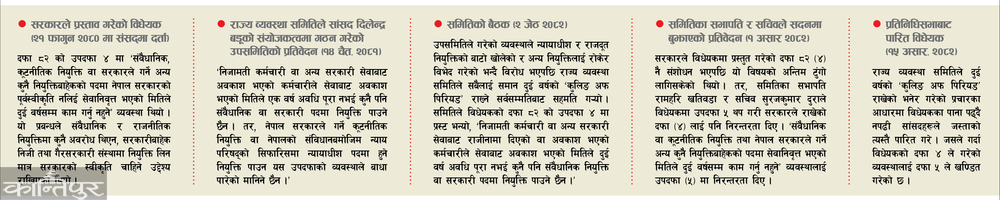
The bill proposed by the government
(Registered in Parliament on 21 February 2080)
Article 82, sub-section 4, had the provision that 'one should not work for two years from the date of retirement without taking the prior approval of the Government of Nepal in a position other than constitutional, diplomatic appointment or any other appointment made by the government'. This arrangement did not have any obstacle in constitutional and political appointments, it was intended that appointments in private and non-governmental organizations apart from the government should only require the approval of the government.
The report of the sub-committee formed by the state system committee chaired by MP Dilendra Badu
(14 Chait, 2081)
(2nd June 2082) After protesting that the arrangement made by the
(1 June 2082)
(June 15, 2082)