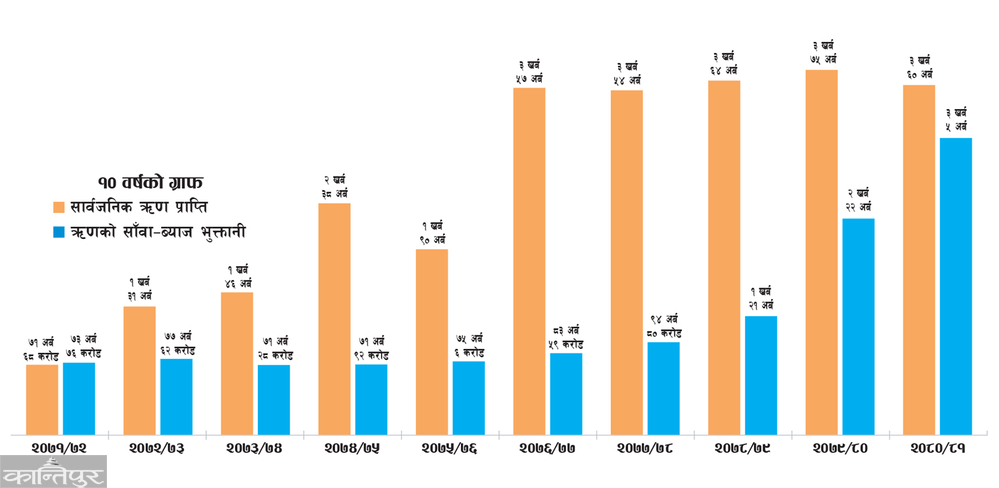
In 10 years, 25 trillion 91 billion 83 crore loans were raised
We use Google Cloud Translation Services. Google requires we provide the following disclaimer relating to use of this service:
This service may contain translations powered by Google. Google disclaims all warranties related to the translations, expressed or implied, including any warranties of accuracy, reliability, and any implied warranties of merchantability, fitness for a particular purpose, and noninfringement.
In the past 10 years, the government has spent 11 trillion 97 billion 71 crore rupees on the payment of principal and interest (debt service) of public debt. The government has paid 3 trillion 2 billion 95 crores (20.30 percent) in principal and interest of external loans and 8 trillion 94 billion 76 crores (74.70 percent) for principal and interest of internal loans in the financial year 2071/72 to 2080/81.
According to the Public Debt Management Office, only 3 trillion 25 billion 488 million rupees have been paid in interest in a decade. The remaining 8 trillion 72 billion 22 billion 98 lakh rupees is the loan principal. Recently, as the principal-interest payment obligation of the public debt continues to increase, the government has to borrow to pay the principal-interest of the debt. In the last 10 years, the government has raised 25 trillion 91 billion 83 billion rupees in public debt.
The government raised public debt of 3 trillion 60 billion rupees in the financial year 080/81, of which 2 trillion 34 billion 42 billion is internal and 1 trillion 25 billion 66 billion is external debt. In the same year, the government spent 3 trillion 5 billion 37 million rupees to pay the principal and interest of the loan.
In that, 2 billion 23 billion 34 crores (73.13 percent) were spent to pay the loan principal and 82 billion 30 million (26.87 percent) to pay the interest. It shows that more than 85 percent of the raised government debt is spent on principal and interest payments of old loans.
Since the debt liability is increasing, since the financial year 080/81, more budget has to be allocated for financial management than capital expenditure. Experts say that this situation has arisen because Nepal took a huge loan especially after the earthquake of 2072 and some of the public loans were used in unproductive areas. They say that the size of the union's capital expenditure is decreasing because the budget has to be allocated to the local level and the state along with the obligation of salaries and allowances.
Even in the current financial year, while allocating 3 trillion 52 billion rupees for capital expenditure, 3 trillion 67 billion rupees had to be allocated for financial management. In FY 2080/81, the total debt servicing cost is 5.35 percent of GDP. Out of that, total principal payment is 3.92 percent and total interest expense is 1.44 percent based on GDP.
There is an action plan of the government to pay 5 trillion 22 billion 19 crore rupees in the financial year 2082/83 and 5 trillion 92 billion 75 crore rupees in 2083/84 for the principal and interest of the loan. Due to the higher volume of subsidized loans, even though the amount of debt obligations is almost equal, more interest is paid on internal loans. The Public Debt Management Office said that although foreign loan interest rates are relatively low, the risk of exchange rate changes remains.
Total public debt has reached 26 trillion 22 billion by last May. Deputy Prime Minister and Finance Minister Bishnu Paudel says that the challenge of raising development resources is increasing as the burden of public debt increases. According to him, the government's investment in social security and development activities is shrinking due to the obligation to spend most of the revenue on public debt payments. He says, "the obligation to spend most of the revenue on public debt payment has increased the challenge of pushing away the resolution to achieve the goal of sustainable development."
Economists believe that developing and underdeveloped countries are facing more problems due to high trade deficit, slow economic growth, decreasing order of development aid and relatively low direct foreign investment and capital flow from the external sector. Because of this, the internal revenue mobilization capacity of developing and underdeveloped countries is weakening.
In the absence of internal resources, a situation has arisen in which a blueprint for development needs to be decided in order to make maximum use of the resources of potential areas including private capital and development aid. They say that although the revenue ratio is relatively good compared to the Gross Domestic Product (GDP), it is a challenge to make it sustainable.
Economist Dilliraj Khanal says that ever-increasing public debt can cause risks. "Due to the continuous increase in internal and external debt, since the financial year 080/81, the allocation under the title of financial management has exceeded the size of capital expenditure," he says, "As the gap between the level of capital expenditure and the budget allocated for the financial system widens with increasing debt repayment obligations, there is a risk of shrinking the ability of the government to invest." Khanal says.
'Government will have to further reduce capital expenditure in the coming years due to increasing government debt principal-interest payments. It is not enough to allocate sufficient budget in the productive and infrastructure sectors, nor can the budget be given for programs to reduce poverty, increase income and employment. Therefore, there is a possibility of a serious budget crisis in the coming years.
Economist Khanal says that while a large part of the government budget is being spent on debt repayment, the maturity period of the large amount of debt taken in the past is also beginning to be completed, so there is a possibility of a big problem in the effective management and sustainability of the government debt in the coming days. "If this situation is not improved, the increasing amount of public debt indicates a high risk," he adds, "the experience of Sri Lanka and Pakistan shows what happens if a country falls into debt (debt trap) and cannot pay its debt." Although the growth rate of public debt has been low in recent years, it is seen that the debt has increased by an average of 17 percent per year. In fiscal year 2071/72, the public debt reached 24 trillion 34 billion rupees in 080/81, which was 540 billion rupees.
In the past 10 years, the domestic debt collection average is 86.45 percent. In most years of this period, the government has collected more than 90 percent of the target domestic debt. External debt collection averages only 49 percent of the annual target. Since the government could not collect more than half of the target external debt, it seems that the government has prioritized internal debt collection. Because of this, the government has become more responsible for paying the internal debt than the external one.
Gopikrishna Koirala, Head of Public Debt Management Office, said that it is not correct to say that the same amount of public debt raised every year is being spent on debt service. How much public debt principal and interest is paid each year depends on how much debt matures that year. Some years more than raised and some years less paid," he said, "In the next few years, the debt payment pressure is a little higher. Because some of the loans taken earlier are maturing in the near future.'
Koirala admitted that public debt has come under pressure due to increasing government expenditure and dwindling sources of income. "In recent years, development expenses and loan principal and interest have to be spent from loans," he added, "but looking at the ratio of GDP, Nepal's situation is satisfactory." As long as this ratio is 60 percent, there is no need to be afraid. He said that if the loan investment goes to the areas that generate revenue and returns, it will help in the expansion of the economy. He says that there will be problems if the debt is spent on current expenses, salary allowance, pension etc.
The National Planning Commission had given a 'ceiling' of 19 trillion 65 crores for the next financial year's budget. Finance Minister Paudel presented the budget of 19 trillion 64 billion 11 crores for the financial year 082/83 to the Federal Parliament on 15th June. This is only 1 trillion 3.81 billion more than the allocated budget of the current financial year. The government had brought a budget of 18 trillion 60 billion 300 million for the current financial year, but due to the inability to collect and spend revenue, it has been reduced by 1.5 trillion.
Compared to this financial year, the current expenditure for the next financial year has been reduced, while the capital expenditure and the financial system expenditure have been increased. 4 trillion 17 billion 83 crores have been allocated for the financial transfer to the provincial and local levels for the next financial year. This is less than the current year. For this year, the government had allocated 4 trillion 8 billion 87 million rupees towards financial transfer to the state and local levels.
The government has planned to spend 13 trillion 15 billion from revenue and 53 billion 45 billion from foreign grants in the coming financial year. Even if these resources are added, 5 trillion 95 billion 66 billion rupees will be insufficient, to fulfill which 2 trillion 33 billion 66 billion rupees will be collected from foreign loans and 3 trillion 62 billion rupees from internal loans, it is mentioned in the budget statement.
How much debt is reasonable?
The ratio of public debt in Nepal's GDP has been gradually increasing since the financial year 2075/76. It decreased slightly in the last financial year. The total debt which was 22.28 percent of GDP in the financial year 2071/72 was 42.67 percent till June 2080/81. As of last May, this ratio is 42.94 percent. This shows that public debt as a proportion of GDP has risen sharply in recent years.
Economists do not agree on the maximum limit (tipping point) that government debt can be taken as a percentage of GDP. According to economist Sameer Khatiwada, the use of government debt has helped economic growth, even if it is high in proportion to GDP, there is no need to be afraid. "But if there is no contribution to economic growth or if it is low, there is a risk even if it is very low in proportion to GDP," he said.
Some international media have analyzed public debt to GDP ratios of up to 90 percent as a 'tipping' point. Even then, their analysis shows that as debt continues to increase, the real economic growth rate will decrease. For a low-income country like Nepal, the maximum credit limit is said to be 60 percent. "In a country like Nepal with low income, less developed financial market, economic openness and weak institutions, there may be different opinions on what percentage of government debt should be GDP," says economist Khatiwada.
According to the Global Debt Database (Global Debt Database) published by the International Monetary Fund, the ratio of public debt obligations to GDP varies in countries that have adopted a federal system. According to this, the total government debt (general government debt) in the year 2019 among the countries with advanced economies (advanced economies) is the highest at 108.68 percent of the United States and the lowest at 13.91 percent of Russia. Among countries with emerging market economies (Emerging Market Economies), Brazil has the highest percentage at 88.71 and the UAE the lowest at 27.27 percent. Among the low-income countries (low income countries), Ethiopia has the highest percentage of 57.60 and Nigeria has the lowest percentage of 29.14 percent.
Among developed economies, the United States has the highest percentage of federal (central) government debt at 92.57 and Russia's lowest at 13.11 percent. Among countries with emerging market systems, Pakistan has the highest at 85.56 and Mexico the lowest at 36.44 percent. Among low-income countries, Sudan has the highest at 200.37 and Nigeria the lowest at 26.46 percent. Based on the mentioned data, the ratio of public debt liability to GDP in Nepal seems to be low compared to other countries that have adopted the federal system.
Last time, the World Bank and the International Monetary Fund (IMF)'s 'Debt Sustainability Analysis (June 2024)' showed that the amount of foreign and total public debt in Nepal's public debt is risk-free. What is the use of
loans?
The issue of where public debt is used is of great importance. It is up to the government to decide how to use the public debt. Various studies have shown that the use of government debt for capital expenditure will boost economic growth. There is no need to worry about the increase in government debt when credit is used in the productive sector.
Past sectoral data on internal credit utilization in Nepal is not available. For the past 3 years, internal debt has been mentioned as a sub-heading in the budget book and allocation has been made. In the FY 2080/81 and current FY budgets, domestic debt appears to have been allocated mainly under the headings of capital expenditure and financial transfers. In the budget statement of the financial year 2081/82, the Ministry of Finance says that a strategy of using medium and long-term instruments has been taken by restructuring the internal debt and managing to raise investment through project special bonds.
In the last few years, as the revenue mobilization has decreased and the foreign subsidies have decreased, the utilization capacity of subsidized external loans has decreased, and the burden of internal debt is increasing. But experts say that it is important to be aware of its far-reaching effects.
'We are very weak in public expenditure'
Only Bhandari, former secretary
Is it a problem that the government's public debt exceeds the annual budget?
 Public debt is not a problem in countries that are trying to develop socially and economically. It is not otherwise that there is general interest in it, and that questions arise. In general, there is no theoretical basis to explain why per capita debt has reached this level. The state has to raise foreign and domestic debt without reaching internal resources. Looking at the quality of service development, spending needs, etc., the current debt should not be considered too much.
What does the financial management allocation of the annual budget more than the development expenditure indicate?
In recent years, there has been a distinct change in the structure of public expenditure. Current expenditure is rising and our efforts to curb it are futile. We need transformative change in the overall state of public finance management. Despite the best efforts of the state and the private sector, our capital expenditure has been low for many years. As the loan has already been taken, it should be paid according to the schedule. Internal debt is slightly higher. Internal loans are taken for a short period of time and the interest rate is high. Therefore all internal debt is not repaid. For some time, the Treasury bill is being rotated through renewal and rescheduling.
There is a certain grace period towards foreign loans. Then the payment should be made according to the schedule. We have not implemented hedging to protect the public debt from fluctuations in foreign currency exchange rates. Therefore, we are repaying the loan taken when the exchange rate of the US dollar was 35/40, now at the exchange rate of 135/140 rupees. This has also increased the debt liability.
How much should public debt be compared to GDP?
The limits of public debt in developing countries are somewhat more acceptable. Attention should be paid to the services of common citizens and many facilities of socio-economic development. Some developing countries have a debt to GDP ratio of up to 75 percent. In emerging economies, such debt is around 45-50 percent of GDP. We have 43 percent public debt is not that difficult situation.
Is there a question that public debt is being spent in unproductive areas?
Not only the public debt, but also resources including internal revenue should not be spent indiscriminately. Accountability of foreign debt should be given not only in the country but also in the parliament of foreign countries. Therefore, there is no question of spending the loan in unproductive areas. But our sensitivity to overall expenditure is very weak. Apart from the
project, it should be seen whether the programs run by foreign aid are also running effectively. Preparation of a multilateral development assistance project takes a year or two. It also takes four/five months for the contract. We also hire national and international expert consultants. But the work cannot be completed on time and the cost increases. In this way, because we could not pay attention to the preparation, did our expenses go to unproductive areas? From the point of view of public finance management, whether it is debt or revenue income, it should be spent in the productive sector.
What is the reason why we are not able to get external loans as per the target? To get
assistance, the first step is to study the needs. The project documents. A contract is then negotiated. Loan compliance, payment schedule, terms etc. These works sometimes take three/four years. Internal debt rises quickly as it is fixed from the annual budget. In some cases, foreign aid that is under discussion is also included in the budget. But that help will not come if the negotiations are not successful or the conditions are not acceptable. On the other hand, the faster the concerned ministry initiates the process, the faster the loan will be received.
'When revenue collection does not increase, there is pressure on public debt
'
 Although the growth rate of public debt started to increase from the financial year 2071/72, it has been rising at a high rate since 2077. It has two dimensions. Especially after covid, the rate of revenue collection has been very low. In the past, the government stopped the import of some essential commodities citing pressure on foreign exchange reserves. At that time, the affected revenue collection has not yet picked up speed. There have been signs of improvement in this financial year, but revenue has not been collected as per the potential. The situation where the need for development will increase but the revenue collection cannot increase accordingly has had an impact on the public debt. There is no need to panic if revenue collection increases when public investment increases.
For the past three years, the government has had to allocate more annual budget for financial management than the development expenditure. What is its sign?
The funds earmarked under the heading of financial arrangements are used to repay loan principals and invest in public institutions. Interest payments on loans are included in the current account. Therefore, if the public debt liability increases, the interest expense will also increase, thus putting pressure on the current account. It should be seen how much of the money allocated in the financial system has been used for the investment of public institutions and how much has been used for debt repayment. It is better if that amount is used for the capital expenditure of the public institution. The situation of low investment in the capital sector but high expenditure on capital and interest is a matter of concern.
The principal-interest payments are not so much in the case of external loans. Since its interest rate is usually low, the liability is also low. Comparatively, since the interest rate of internal loans is expensive, a lot of money is spent on interest payments.
As of last May, public debt is about 43 percent of GDP. Recently, this ratio is increasing. How do you see it?
In the past, very good financial discipline had to be practiced to keep the size of the debt from increasing. But due to the earthquake of 2072, the covid epidemic and others, the debt increased to a high size. If the public investment has been in the productive sector, there is no need to worry that the ratio of GDP has reached this level. However, if the liability of the state increases due to the use of loans in unproductive areas, it should be corrected in time.
There are many questions about the use of public debt. Are loans being used in unproductive areas?
Till four years ago, 77 percent of the total external debt was invested in the financial sector. This 'trend' continues even now. What percentage of domestic credit has been utilized in the productive sector has not been analysed. Regarding the economic sector, how much percentage is spent in the real productive sector (yielding) and how much is leaked is determined by the state of governance. Now questions about the use of public debt are not raised in every sector. There may be some leaks. But it is not yet possible to say how many percent went to the productive and non-productive sectors.
We have not been able to raise external debt as per the target. It seems to have a direct impact on domestic debt. Does this mean that the debt service burden has increased?
This is linked to the functionality of the government. Most of the capital expenditure has been financed through public borrowing. As the government could not spend, the capital expenditure was reduced and external debt was not raised as it did not have to spend. Currently, most external loans are based on research. If you can spend, you get a loan, if you can't, you don't. As the government is unable to raise external debt, it is the internal debt that is burdened.

