Although there is a lot of potential in tourism, adventure destinations, production, art and culture, it is concluded that Gandaki is not getting the maximum benefit due to policy ambiguity and short-sightedness.
We use Google Cloud Translation Services. Google requires we provide the following disclaimer relating to use of this service:
This service may contain translations powered by Google. Google disclaims all warranties related to the translations, expressed or implied, including any warranties of accuracy, reliability, and any implied warranties of merchantability, fitness for a particular purpose, and noninfringement.
Stakeholders have pointed out that international flights, road network and policy reforms should be emphasized for the further development and expansion of tourism in Gandaki province. They said that despite the huge potential of all types of tourism, adventure destinations, manufacturing, art and culture, Gandaki is not reaping the maximum benefits due to policy ambiguity and short-sightedness.
In the 'Gantavya Gandaki' program organized by Kantipur Media Group in Pokhara on Wednesday, Chief Minister Surendra Raj Pandey said that 'connectivity' is the most important thing for promoting tourism.
'Road connectivity has become a challenge, air transport facility is available but sometimes due to weather and sometimes due to management problems, passengers have not been able to reach their destination on time,' he said. He mentioned that even though an international airport has been built in Pokhara, commercial international flights have not been operated.
Chief Minister Pandey says that the Pokhara International Airport cannot be operated just because the provincial government wants it.
"If international flights are operated from here, it will be convenient for foreign tourists coming to Gandaki province," he said. He also informed that the provincial government is continuously coordinating with the relevant agencies and stakeholders to speed up the expansion of the Prithvi highway used to come to Pokhara.
Chief Minister Pandey also informed that tourism is the first priority of the provincial government and on 080 Chait 4, the provincial government declared Pokhara as the tourism capital of Nepal. "This has further established the brand of Gandaki Province and Pokhara at the local, national and international levels," he said. He also said that the provincial government has set the goal of developing tourist destinations in districts with different diversity, keeping Pokhara as the center.
Chief Minister Pandey informed that the state government is implementing various programs this year by prioritizing the policy of 'Invest Gandaki', 'Home and abroad first', 'Be an entrepreneur and do something in the country'. He said that Gandaki has great potential for religious historical heritage, tourist destination, lake, religious Shaktipeeth, adventure sports (including bungee jump, paragliding, boating, hot air balloon) and mountain climbing.
With the priority of the tourism sector in the policies, plans and programs of the provincial government and Pokhara Metropolitan City, tourism branding is gaining momentum, said Krishnachandra Devkota, vice president of the Gandaki Province Policy and Planning Commission. He emphasized on the need for policy arrangements for tourism development of Gandaki through the coordination and cooperation of all three levels of government.
"For the development of Pokhara, it is necessary to take the lead in creating a favorable environment for cooperation between the government of Nepal, the private sector and other development partners and building tourism-friendly infrastructure," he said, "The accountability and professional capacity of the private sector should also be enhanced." After the announcement, Devkota informed that the provincial government has made short-term, medium-term and long-term strategies for tourism development.
In the first session of the 'Gantavya Gandaki' program, 'Politics and Tourism Policy', the head of Pokhara Metropolitan Municipality, Dhanraj Acharya, informed that the year 2025 is going to be celebrated as the Year of Visiting Pokhara to increase the arrival of tourists. He said that the metropolis is creating a policy by prioritizing the tourism sector.
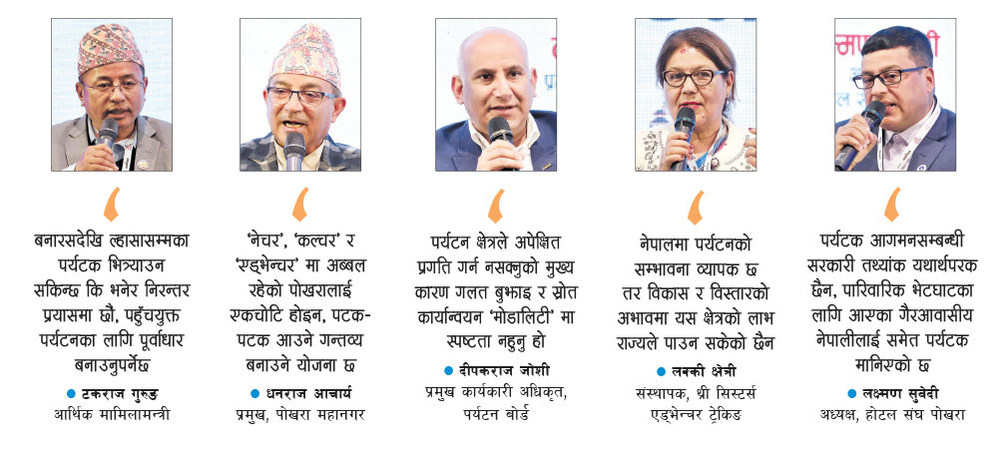
He says that there is a plan to make Pokhara, which excels in nature, culture and adventure, a destination to visit again and again, not just once. "We are working in a planned way to sustain the tourism of Pokhara," he said, "7 and a half billion projects related to tourism have been started. This will help to create new infrastructure in the field of tourism.'
Acharya, head of the metropolis, said that the role of the private sector will be important for the regular operation of Pokhara International Airport. "It is enough if Pokhara Airport can be connected to the national network," he said. He informed that 'Agro-tourism' has been prioritized. Minister Gurung said that they are trying to connect Hinduism and Buddhism with tourism. "We are constantly trying to see if we can bring in tourists from Banaras to Lhasa," he said, "we have to build infrastructure for accessible tourism."
Chief Executive Officer of Nepal Tourism Board, Deepak Raj Joshi, said that the main reason why the tourism sector has not made the expected progress in recent times is the misunderstanding about tourism and the lack of clarity in resource implementation 'modality' or use.
According to him, tourism is a purely technical and commercial field. But in Nepal, it has been developed to take it to villages like education, health and social sectors. "Dispersing limited resources in unproductive areas has not resulted in results," he said, "in Europe, France, Spain, Thailand, Malaysia, wherever you look, there are tourism activities in limited areas, but the benefit of that is to take them from village to village."
Joshi's comment was that the government agencies including the Nepal Tourism Board tend to pay more attention to immediate work but spend less time on long-term planning. "Currently, tourism councils or boards are coming from province to province, the same is the case in India, but in Scotland, if the resources and programs belong to the province, the implementation will be done by the union," he said, "we do not have clarity on the modality." This results in resources being allocated but not being spent. Even if it has been spent, it is not being done in a productive way. Lucky Chhetri, the founder of
Three Sisters Adventure Trekking, opined that women can work effectively in the field of adventure trekking given the opportunity. 'Due to the lack of development and expansion, the state has not been able to benefit from the tourism sector,' she said, 'if developed with priority, this sector can contribute greatly to the economic progress of the country.' did According to him, since most of the rescue operations are to be done in difficult places, skilled technical manpower is needed, but such manpower is not enough. She pointed out that although the Annapurna region is one of the top 10 trekking regions in the world, Pokhara companies are lagging behind in mountain climbing.
Lakshman Subedi, president of Pokhara's hoteliers' association, commented that the government data on tourist arrivals is not realistic. He said that the board has also counted non-resident Nepalis who came for family meetings as tourists, bringing the number of arrivals to more than 11 lakh. "Children abroad and non-resident Nepali who come to visit family and relatives, they don't do business in hotels, restaurants, travel trekking, etc., they come back after visiting family," he said, "they are not tourists." Mentioning that there are more than 100 and more than 1200 hotels in the vicinity, he informed that there are only 425 members in the association. He admitted that even the association was not able to extract the exact data of tourists.
'The government has said that the hotel that has been running for 30 years will not be renovated if it is not assessed for environmental impact,' he said, 'It would have been mandatory for buildings with more than 25 rooms to be assessed for environmental impact.'
Kantipur Media Kailash Sirohia, president of the group, said that there is a strong possibility that Gandaki province will become more influential. Gandaki can become strong not only in terms of tourism but also in terms of production. Pokhara is an industrial city, Pokhara is a leader in the field of education and health. Districts like Manang and Mustang are geographically difficult and weak in terms of infrastructure,' he said, 'There is great potential for cultivation of apples and other crops in the Himalayan region, but they have not been able to get incentives and markets.' He said that the government's plan and the readiness of the private sector are needed to build the economy.
Sirohia said that Gandaki still has a long way to use the potential in tourism, agriculture, education, health, enterprise and infrastructure. He also mentioned that some laws related to the implementation of federalism have been made by the states, but some laws that should be made for the states have not been made by the union.
In terms of some laws, we find that the state comes before the state and the union comes after. The Gandaki state government has already demonstrated its ability by making liberal laws related to mass media,'' he said. Chairman of Kantipur Media Group Sirohia also asked to give priority to every question related to the construction of road infrastructure. "Build a road infrastructure in this city that can be easily accessed from destinations like Kathmandu, Chitwan, and Bhairahawa," he said, "It is unfortunate that commercial international flights have not yet started in two years after the opening of the international airport."

