We use Google Cloud Translation Services. Google requires we provide the following disclaimer relating to use of this service:
This service may contain translations powered by Google. Google disclaims all warranties related to the translations, expressed or implied, including any warranties of accuracy, reliability, and any implied warranties of merchantability, fitness for a particular purpose, and noninfringement.
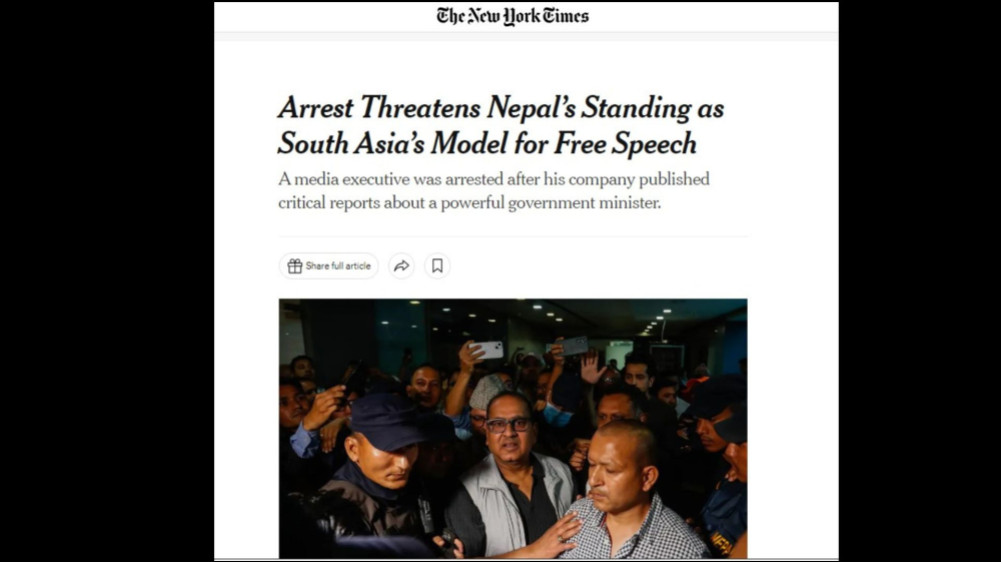
The American newspaper New York Times commented that because of the arrest of Kailash Sirohia, president of Kantipur Media Group, for writing news about a minister in Nepal, who is a model for freedom of speech in South Asia, Nepal is also on the path of authoritarianism like Pakistan, Bangladesh and India.
Referring to the arrest of President Sirohia, the newspaper said 'Arrest Threatens Nepal's Standing The report titled 'Yaz South Asia's Model for Free Speech' By publishing Questions have been raised about the Nepal government's commitment to freedom of expression .
It is mentioned in a report written by journalist Bhadra Sharma with the help of journalist Mujiv Masal from Delhi that the situation of Nepal, which is an exception when one country after another is moving towards authoritarianism in South Asia, has changed recently.
'Political debates were largely free in Nepal and it was easy to question the powerful,' the newspaper wrote, 'The openness of a country that has endured centuries of monarchical oppression and decades of insurgency showed that democratic expression need not be tied to economic conditions.' But the newspaper mentioned that Sirohia was arrested to avenge the critical news published against him by Nepal's powerful Home Minister Ravi Lamichhane.
Kantipur published news about Lamichhane, who was a television presenter before entering politics, becoming a member of parliament while retaining his second country US citizenship. The newspaper mentioned that Kantipur recently published a series of news about Lamichhane being involved in the embezzlement of cooperative savings.
With the New York Times, Yuvraj Ghimire, editor of DeshSanchar.com, has said that 'by arresting Sirohia, they have sent a message that criticizing the government will lead to arrest'. "The nature of Sirohia's arrest indicates that he was deliberately targeted."
Sirohia was arrested by the police from his office on May 8 to investigate the citizenship issue in retaliation for publishing the news of the co-operative's misappropriation of savings. After intense pressure from the national and international levels, he was released on bail on May 16, 9 days after his arrest.
The police released Sirohi with the agreement of the public prosecutor's office saying that there is no basis to confirm any crime that would result in a violation of citizenship, imprisonment and fine, and that the mistakes made during the issuance of citizenship should be addressed by the administration.
After Sirohia's arrest, the international press community, human rights organizations and the US Embassy in Kathmandu, the European Union, etc., asked the leadership and staff of the country's largest media group not to act in retaliation for the news. The International Federation of Journalists (IFJ), the world's largest press organization, Reporters Without Borders (RSF), the American Society of Professional Journalists (SPJ), and the Community to Protect Journalists (CPJ) also issued statements against the
arrest. had issued . Likewise, the Asian Human Rights Commission and Amnesty International also expressed serious concern about Sirohia's arrest and requested the Nepalese government for her immediate release.