We use Google Cloud Translation Services. Google requires we provide the following disclaimer relating to use of this service:
This service may contain translations powered by Google. Google disclaims all warranties related to the translations, expressed or implied, including any warranties of accuracy, reliability, and any implied warranties of merchantability, fitness for a particular purpose, and noninfringement.
Leaders of various political parties and former finance ministers have said that financial resources are the main challenge in the targets set by the budget. They commented that most of the policies and programs are a continuation of the past and said that emphasis should be placed on implementation. The leader of the opposition party commented that the budget will not succeed in ending the economic crisis.
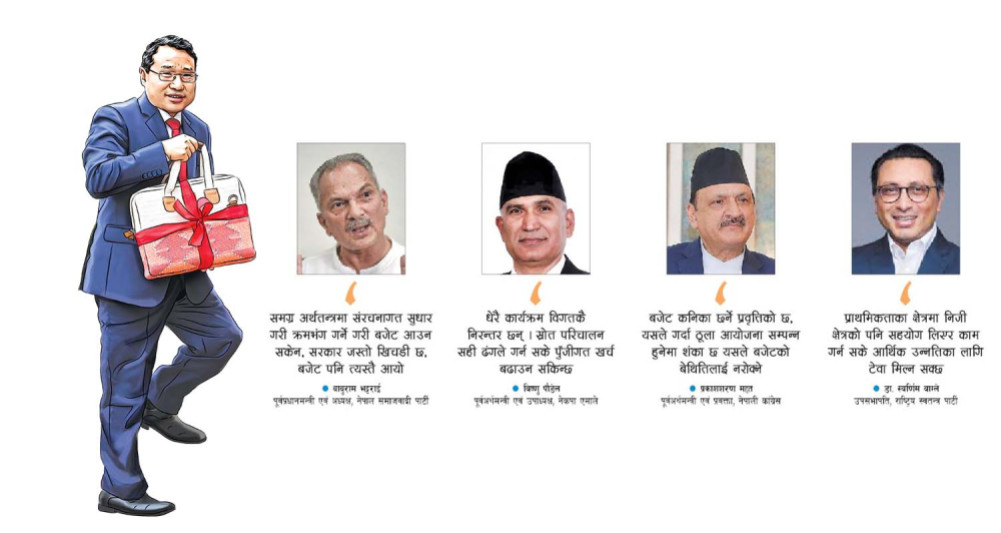
Former Prime Minister Baburam Bhattarai commented that the new budget is another form of continuation of the past. Commenting on the budget presented by Finance Minister Barshman Pun in the joint session of the Parliament on Tuesday, he said that the budget has not been able to increase production, create millions of jobs and increase the quality of education. "Budget could not be brought in order to disrupt the overall economy by structural reforms," he said. "It's not just about socialism. The main objective is to increase production. But there is no plan for equitable distribution.'
Bhattarai commented that the 'Khichdi' budget has come according to the structure of the government. "This budget is right wing and left wing populist," he said. Stating that there is a risk that the prosperity slogan will only be used in the 20 percent budget allocated for capital expenditure, Bhattarai said, "Some popular programs and slogans have been given." While the Decade of Agriculture has been announced, the budget has decreased.'
UML vice-president and former finance minister Bishnu Paudel said that the budget is trying to be balanced in all aspects and some programs are also included to overcome disappointment. He commented that economic growth, employment, good governance and increasing the morale of the private sector have laid the foundation for creating an investment-friendly environment. He said, "The programs are such that the target can be met, but attention must be paid to the implementation from the beginning." He said that the government should promote a policy of easy coordination to encourage production and the private sector. He argues that since the size of the budget is implementation-oriented, it will not be difficult to manage resources to meet its goals. Capital expenditure can be increased if resource mobilization can be done properly. Because of this, it will not be difficult to improve the economy," said Paudel. Mentioning that many programs are a continuation of the past, he suggested that emphasis should be placed on implementation for the prosperity of the country.
Former finance minister Prakasharan Mahat, who is also the spokesperson of the main opposition party Congress, has commented that there is no reform program in the budget and this will not stop the budget crisis. He said that even though there was a break in making a big budget, this budget is above the reality. A decade-long reform program has been announced in the budget, but there is no mention of how to improve it. There is a tendency to scatter budgets. Due to this, doubts have arisen that big projects will be completed," Mahat added, "They have said to go on the path of reform. But he did not say where to make improvements. He mentioned that there are not many topics presented in the budget, and he said that only after the full text comes out, more can be said about it. Mahat said that the removal of VAT on apples, potatoes and onions was not right and claimed that it would not help domestic traders. "VAT has been removed in order to help the trader's setting," he said, adding, "Priority in allocation has not been discussed." Many issues have been tried to be touched on, but no results have been seen.
UML Vice-President and former Finance Minister Surendra Pandey has said that the main challenge of the budget is in raising and managing resources. Mentioning that resource management is weak in the current year, he said that the same challenge is likely to be repeated in the coming year. As mentioned in the budget statement, the target of raising 12 trillion revenue can be implemented. It is a challenge to meet the target of external grants and foreign loans. There is a situation where the revenue can be collected according to the
target," he said. "In the current year, grants and foreign loans have been achieved much less than the target. The situation may be the same next year as well.'' He commented that the government needs to pay attention in time as the increase in internal debt may affect the capital expenditure. It seems that there will be a decrease in the resources of this budget. Because of this, all sectors may be affected," he said. "There are many challenges in the implementation of the budget." Pointing out that political programs have been given priority in the
budget, Pandey said that there is confusion about ensuring the budget for those programs. Some programs are satisfactory to leaders and programs. What is the budget for the program? There is no certainty," he said. According to the concept of the constitution, although it is mentioned in the budget that a new phase of economic reform is necessary for building a socialist-oriented prosperous nation by making the national economy self-reliant, independent and advanced, there is no solid basis in equal distribution of products, quality education, health and social security to set that basis. He said, "There are some distribution-oriented and reformist programs, it is a political thing to say that they are socialist-oriented." Swarnim Wagle said that the main question is whether the sector that the government spends through the budget will create jobs or not. "I would like to give the finance minister the benefit of the doubt," he said, "If we can work with the private sector in priority areas such as digitalization, agriculture, tourism, industrialization and infrastructure, we can get help for economic progress." He said that the government may have guessed that. He also said that he felt that the budget allocated for the irrigation and agriculture sector would contribute to the development of this sector.