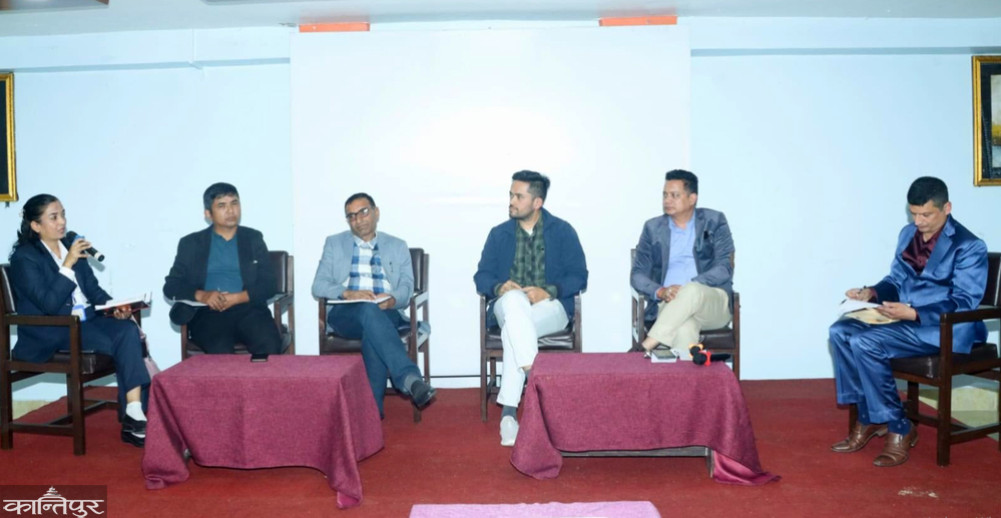
Participants of a public-private dialogue program on 'Exportable High-Value Agricultural Produce' organized in Biratnagar have demanded policy reforms for production, marketing, and export promotion.
We use Google Cloud Translation Services. Google requires we provide the following disclaimer relating to use of this service:
This service may contain translations powered by Google. Google disclaims all warranties related to the translations, expressed or implied, including any warranties of accuracy, reliability, and any implied warranties of merchantability, fitness for a particular purpose, and noninfringement.
Businessmen and stakeholders in Koshi Province have emphasized the need to formulate policies with agricultural production at the center.
Participants of the public-private dialogue program on ‘Exportable High Value Agricultural Produce’ organized by an NGO called ‘Innovate Next Impact’ in Biratnagar have demanded policy reforms for production, marketing and export promotion.
Cardamom entrepreneur Narayan Prasad Chimaria complained that cardamom produced in eastern Nepal has to depend on the Indian market. Stating that there is a problem due to the lack of government facilitation for export to third countries, he suggested that cardamom should be dried using solar or electric dryers to improve quality and that such equipment should be provided to farmers.
Coffee entrepreneur Abhinayak Malla said that despite the good potential and market for coffee cultivation in Nepal, production has not been able to meet demand. According to him, although there is a demand of about 2,200 metric tons of coffee annually, only 5,550 metric tons are currently being produced. He said that since the demand for Nepali coffee is high in the international market, production should be expanded while maintaining quality.
Churpi entrepreneur Rajendra Kumar Shrestha informed that Churpi worth Rs 4 billion has been exported in the last 11 months alone. He said that quality Churpi should be produced to increase export trade and pointed out that government incentives are needed for raising advanced breeds of cattle.
At the program, Koshi Province's Minister for Industry, Agriculture and Cooperatives Khagensingh Hangam admitted that the provincial government has not been able to do the expected work in market management, export promotion and production growth due to the federal government's failure to delegate authority. He also expressed his commitment to formulate policies by incorporating the demands of stakeholders.
Innovate Next Impact Director Tapendra Chand informed that the organization has been facilitating entrepreneurs in business development, marketing and exports. Program coordinator Isika Agrawal said that the demands raised during the dialogue will be summarized in a policy brief and submitted to the concerned bodies.