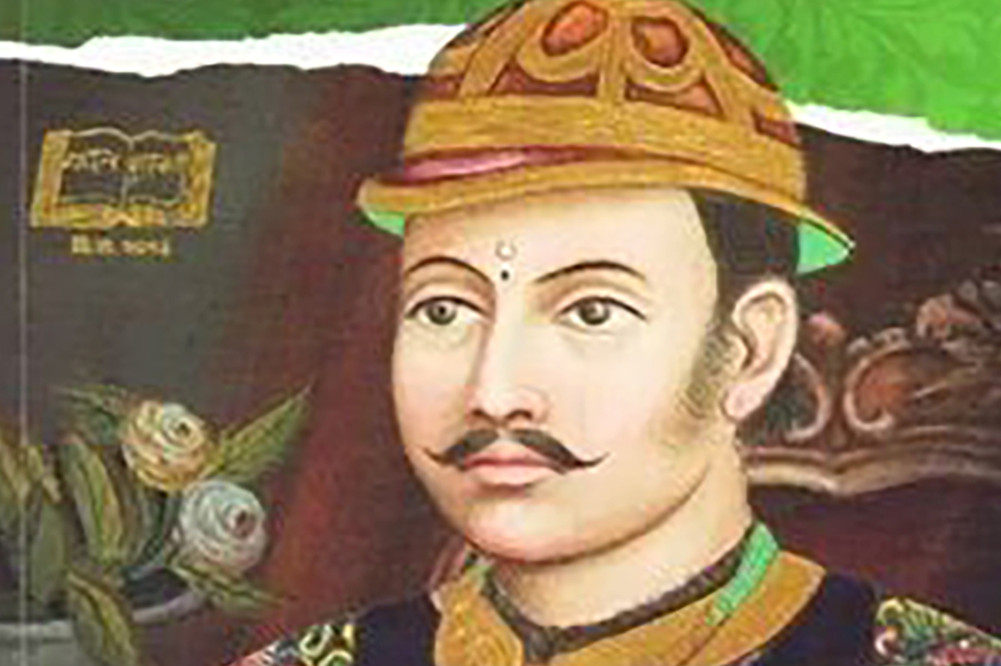
Under Bhimsen's rule, Nepal's trade with India and Tibet increased significantly. He also did a lot of work in military reform. He brought in French military experts and started modern training. The uniform of the Nepali army was also made French-style. He also tried to make the administrative system reliable and efficient.
We use Google Cloud Translation Services. Google requires we provide the following disclaimer relating to use of this service:
This service may contain translations powered by Google. Google disclaims all warranties related to the translations, expressed or implied, including any warranties of accuracy, reliability, and any implied warranties of merchantability, fitness for a particular purpose, and noninfringement.
इतिहासकै शक्तिशाली जनमतसहित वालेन्द्र शाह प्रधानमन्त्री बनेको तीन साता पुगेको छ । प्रधानमन्त्रीका रूपमा उनको भूमिका कस्तो रहनेछ ? उनलाई इतिहासले कसरी सम्झिन्छ ? अहिल्यै आकलन गर्नु हतारो हुनेछ । नेपालको राजनीतिक इतिहासमा ४० जना प्रधानमन्त्री भइसकेका छन् । तीमध्ये कतिपयलाई निरन्तर सम्झना गरिन्छ । कतिपय भने गुमनाम जस्तै छन्, औपचारिक सन्दर्भभन्दा बाहेक चर्चा गरिँदैनन् । ‘कोसेली’ ले केही प्रधानमन्त्रीको कार्यकाल सम्झना गरेको छ । ‘कान्तिपुर’ को सम्पादकीय समूहले पदमा रहँदा निर्वाह गरेको भूमिका र सार्वजनिक विमर्शमा नाम आइरहने १२ पात्र छनोट गरेको छ । उनीहरूको पदावधिको चर्चा गर्दा नेपालको मूलभूत शासकीय प्रवृत्ति उजागर हुनेछ भन्ने हाम्रो विश्वास छ ।
There could be no more tragic ending than this. The way Bhimsen Thapa accepted death is extremely tragic. He died in a horrific situation on July 29, 1839.
On the orders of King Rajendra and Queen Samajwadi Lakshmi Devi, his blood-soaked, semi-conscious body was thrown into the Vishnumati River. He survived in that state for nine more days. It was raining, but he could not give up his life. Finally, he died, and his body was not even allowed to be cremated with respect. His body was eaten by jackals, dogs, and vultures. It is also said that his body was cut into pieces and thrown in various places in Kathmandu. The place where Bhimsen Thapa died is now the Bhimmukteshwar Shiva Temple. It is located in present-day Tripureshwor. Baburam Acharya has written in his book ‘Ab Yashto Naldi Na Hos’, ‘As long as that Shiva temple exists, it is still a reminder of his heartbreaking, suicidal and inhuman torture.’
Such a death of such a great person has never happened in Nepali history, nor will it happen again. Before that, Bhimsen Thapa was under house arrest on charges of poisoning Devendra Vikram, the minor son of Queen Samajwadi Lakshmi. In the meantime, he heard that his younger wife was being disrespected. Such rumors spread throughout Kathmandu. As historian Chittaranjan Nepali wrote, it was said, ‘His wife Bhakta Kumari is going to be paraded around the city naked and he will have to watch this scene buried in a cave.’
In this way, Bhimsen Thapa decided to commit suicide. He stabbed himself with a khukuri while under surveillance. Some have even said that he was hit by glass. According to Chittaranjan Nepali, who has considerable sympathy for Bhimsen Thapa, his skull and hands also disappeared from his discarded body. All this incredible incident began when Rajmata Lalit Tripurasundari died. From that time, Bhimsen Thapa's downfall also began.
According to historian Triratna Manandhar, the first part of Bhimsen Thapa's biography was a story of pure conspiracy. Bhimsen Thapa only made one conspiracy after another to become powerful. He was able to reach the top because of the conspiracy. Bhimsen Thapa killed many people when he was in power, even his family members were mercilessly killed. On the advice of Swami Maharaj Rana Bahadur Shah, he was given the post of Mukhtiyari, and he ruled the country for 31 years.
Some time after getting the Mukhtiyari, a court was called. That place is located in the modern Ranmutteshwor. In that court, Sher Bahadur Shahi stabbed Rana Bahadur Shah with a sword. He died shortly after. Soon after, Sher Bahadur Shahi also died from the attack of Balnarsingh. Bhimsen Thapa was nearby when the incident happened. He reached the spot. Immediately, two of Sher Bahadur's bodyguards were cut down. Then the series of murders began.
After that, the series of murders continued for two weeks. 16 women and 77 men lost their lives. Even a sleeping child was killed at night. Tulsiram Vaidya and Tirtha Prasad Mishra have called it worse than Kotparva. However, as much as the Kotparva is discussed and Jung Bahadur and some others are portrayed as villains in this process, the series of murders carried out by Bhimsen Thapa is not done for the sake of it.
There are two opposing views about Bhimsen Thapa in Nepali historiography. Some have only sung his praises. Others have only criticized him. He remained extremely powerful throughout the time he spent in power, running the country in a kind of authoritarian manner. Vaidya and Mishra have written that after that murder, Nepal's politics changed. Power and authority passed from the royal family to the nobles. The role of the royal family became weak. The practice of coming to power through massacres became established. Later, Jung Bahadur also chose this path. Therefore, Bhimsen Thapa is also the one who shows Jung Bahadur the way to power. In particular, there are two conflicting views about Bhimsen Thapa in Nepali history writing. Some have only praised him. Others have only criticized him. He remained extremely powerful throughout his time in power, running the country in a kind of authoritarian manner. He was born in Borlange in 1775. He was a teenager when the French Revolution took place. He is credited with introducing modernity to Nepal. During his reign, he did some initial work to abolish slavery.
He banned some illegal forms of disputes. Under his rule, Nepal's trade with India and Tibet increased significantly. He also did a lot of work in military reform. He brought in French military experts and started modern training. The uniform of the Nepali Army was also made French-style. Similarly, he tried to make the administrative system reliable and efficient. Bhimsen Thapa was anti-British.
He even tried to form a union of Asian countries to drive out the British. During his time, the Nepal-British War also took place, between 1814 and 1816. As Nepal weakened in the war, Nepal was forced to sign the Sugauli Treaty. From Nepal's perspective, this was a very humiliating treaty. After this treaty, Nepal lost one-third of its territory. After that, foreign interference in Nepal's internal affairs began.
There is also evidence that Bhimsen Thapa's decision to fight the powerful British at that time was wrong. It is said that Bhimsen Thapa chose war to prolong his rule. Even during his time, there were many who said that he should not fight the British, but Bhimsen Thapa ignored them. If this is true, this is why Nepal's area has shrunk to its current size. At that time, Nepal had to lose at least 40,000 square miles. It is said that all the damage should go to Bhimsen Thapa.
What was clearly seen during the war was that Nepal's military technology was not as good as that of the British. There was also an imbalance of power. But the British were also impressed by the Nepalese's war skills and bravery. That is why the process of Nepalis being allowed to join the British army began during Bhimsen Thapa's time. The British ambassador of his time, Brian Hudson, has also written that Bhimsen Thapa was a person with many qualities.
The one who was most impressed by him was King Rana Bahadur Shah. He used to say, ‘I died and the country did not sink, Bhimsen died and the country sank.’ But some historians have unconfirmedly claimed that Bhimsen Thapa may have had a hand in the murder of Rana Bahadur Shah. One fact is certain that just as he rose to power and became strong, so did his downfall. He behaved the same way as he did. He became all-powerful by relying on the corpses of others, but later others relied on his corpse.