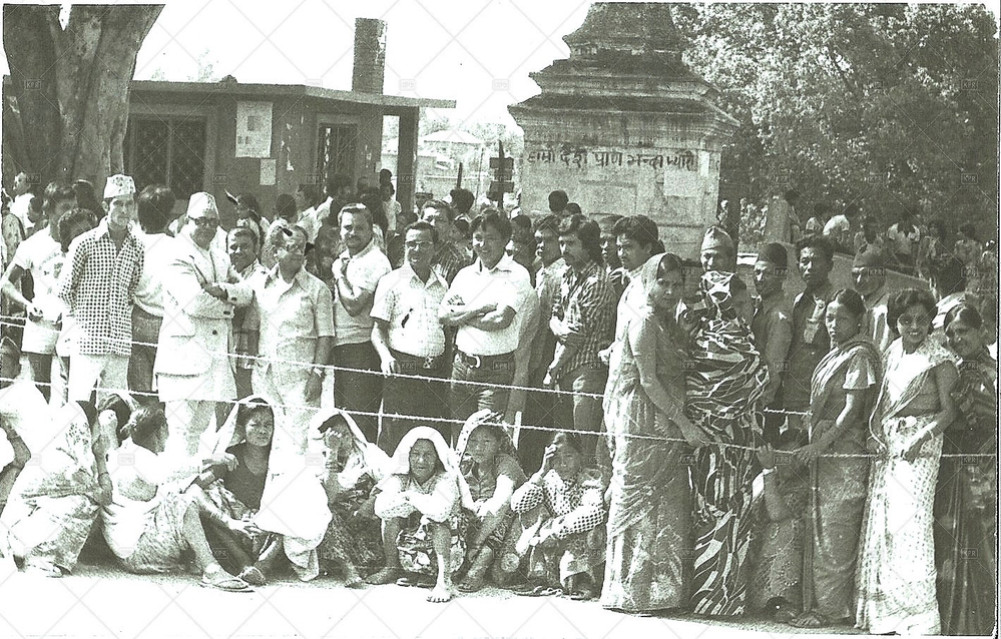
The 2036 BS referendum was not just a voting process, but also a historic turning point in determining Nepal's political future. At that time, out of a total of 7,192,451 voters, 4,813,486 (66.92 percent) exercised their franchise, while 3,72,069 (7.63 percent) votes were invalid.
We use Google Cloud Translation Services. Google requires we provide the following disclaimer relating to use of this service:
This service may contain translations powered by Google. Google disclaims all warranties related to the translations, expressed or implied, including any warranties of accuracy, reliability, and any implied warranties of merchantability, fitness for a particular purpose, and noninfringement.
On one hand, there was growing political instability in South Asia, the polarization of world powers, and the shadow of the Cold War, while on the other hand, the country was becoming restless due to the anger of the student movement of 2036. Students took to the streets to protest against the non-partisan rule of the Panchayat.
At the same time, the student movement intensified after the hanging of former Pakistani President Zulfikar Ali Bhutto. The government resorted to repression, but the student movement did not stop. As the movement expanded further, even districts outside the capital became restless.
Against this backdrop, the then King Birendra Shah decided to go for a referendum to avert a future crisis over the Panchayat system and to legitimize his rule. Some historians have also interpreted this announcement as King Birendra using the Panchayat system, which was implemented by King Mahendra in 2017 after dissolving the parliament, as a strategy to legitimize it through a public vote.
Bipin Koirala, a former Congress leader who is also the founding leader of the Nepali Sangh, says that the then King Birendra announced the referendum due to pressure from external forces rather than the student movement. He recalls that BP returned home on 16 Poush 2033, seeing the threat to Nepal's national identity due to the unrest in South Asia and the increasing polarization between world powers.
According to him, BP was not in favor of further escalating the student movement at that time. BP had tried to manage the student movement by believing that he should agree with the king on the issue of nationality when the influence of external powers was increasing.
'The student movement was a 'factor' in King Birendra announcing the referendum. But it was not the whole story. Especially, the external pressure was greater. BP understood the pressure on the king from external forces well. That is why BP returned home with a policy of unconditional national reconciliation despite the issue of hanging,' says Bipin Koirala, 'Now the king alone cannot save the country. Therefore, our fight in the matter of democracy is with the king. But we and the king should stand together to save the country, so BP had returned home saying, "Don't be afraid, don't be afraid." He says that BP's move also brought relief to the king. "After that, the king made a passport and visa overnight for BP for further treatment and arranged to take him to America for treatment," he said. According to Koirala, BP's perspective on the 2036 student movement was also different. BP was in favor of managing the student movement in some way or the other. "Within the Congress, Ganeshmanji and Kisunji were in favor of further inflaming the movement. External forces were trying to prevent the relationship between BP and the king from improving. The king was under pressure from that," says Koirala. "The decision to hold a referendum was the way out."
The book ‘Election History of Nepal-2’ published by the Election Commission states that on 10 Jestha 2036, at 6.45 am, King Birendra announced ‘a secret referendum of all Nepalis throughout the kingdom on the basis of adult suffrage regarding a new political system in Nepal’. The announcement was to hold a referendum to choose between two options: maintaining the current Panchayat system with timely reforms or establishing a multi-party system in its place. The announcement mentioned the establishment of a National Election Commission within a week and allowing all eligible Nepalis of legal age to cast a secret vote based on two questions.
The book mentions that there was a lot of debate and discussion among the pro-Panchayat and anti-Panchayat political forces on whether the referendum was appropriate or inappropriate.
After the announcement of the referendum, political polarization began to intensify in favor of and against the Panchayat. On 10 Jestha 2036, the day the king announced the referendum, Prime Minister Kirtinidhi Bista resigned. Then Surya Bahadur Thapa was appointed Prime Minister.
At that time, a political debate began on whether to participate in the elections led by Thapa. Multi-party leaders demanded that the Panchayat government and units should be dissolved in order to participate in the referendum, and that there should be amnesty for accused or convicted persons who had gone abroad or been imprisoned due to criminal cases. They also demanded that those who had reached the age of 18 should be allowed to vote.
Immediately after the announcement of the referendum, the National Election Commission was formed under the chairmanship of Bhagwati Prasad Singh. One commissioner was appointed in each zone and the collection of voters' names began from 14 Shrawan 2036. Exercising the authority granted by the Referendum Regulations 2036, the Commission announced the date and time of the national referendum to be from 9.15 am to 5.15 pm on 20 Baisakh 2037.
5,913 polling stations and 4,05 polling sub-stations were designated for the election across Nepal. The highest number of polling stations, 1,627 polling stations and 1,480 sub-stations, were in the Central Region, and the lowest number, 1,360 polling stations and 843 sub-stations, were in the Western Region.
In each polling station and sub-station, arrangements were made to allow representatives of both parties (independent and multi-party) to be present on one side of the ballot box and the place where names were verified. The ballot paper was on 4/4 inch paper with a border (Dharko) in the middle and on one side the yellow color of the Panchayat system and on the other side the blue color of the multi-party system (Election History of Nepal-2).
The banned Nepali Congress and some communist parties were campaigning in favor of the multi-party system. The then CPN-ML, Mohan Bikram Singh's Communist Party, had decided to boycott the referendum. However, Singh, the general secretary of CPN-Masal, says that they did not boycott the referendum but used it.
Singh told Kantipur that he had devised a strategy to use the referendum after seeing that the king would gain strength from boycotting. ‘Yes, we had initially made a policy of boycotting, but we reached a point where we understood that the panchayat would benefit from understanding all the perspectives and that we could take the movement forward by participating, so we participated in the referendum and joined the movement,’ he said, ‘We worked together with BP.’
According to Koirala, the founding president of the Nepali Sangh, the communist component, including Manmohan Adhikari and Sahana Pradhan, had participated in the referendum. But the Male and Masal, who had rebelled in Jhapa, had boycotted. Some of the components had voted in yellow, saying boycott. The Multi-Party Janabadi Morcha was formed with the joint efforts of Ramraja Prasad Singh and Prem Krishna Pathak to create an atmosphere in favor of multi-party politics.
At that time, the National Panchayat had propagated that if a multi-party system came into being, peace would be disturbed, nationalism would be destroyed, and religious encroachment would increase. The multi-party party advocated nationalism, democracy and freedom. A three-day exemption was given for campaigning.
The total number of voters in the referendum was 71 lakh 92 thousand 451. The names of those who had completed 21 years of age on 10 Jestha 2036 were collected as voters. 48 lakh 13 thousand 486 (66.92 percent) votes were cast in the referendum. Of the votes cast, 3 lakh 72 thousand 69 (7.63 percent) votes were invalid. 24 lakh 33 thousand 452 (54.79 percent) votes were cast in favor of the reformed Panchayat system.
20 lakh 7 thousand 965 (45.21 percent) votes were cast in favor of the multi-party system. In 19 out of 75 districts, more votes were cast in favor of the multi-party system. The districts that received the most votes were Morang, Sunsari, Siraha, Udayapur, Sarlahi, Kathmandu, Lalitpur, Bhaktapur, Chitwan, Rautahat, Kaski, Rupandehi, Palpa, Dang, Bardiya, Surkhet, Doti, Kanchanpur and Dadeldhura. From a zonal perspective, the Panchayat system was victorious in 14 zones (History of Nepal's Elections-2).
Another debate began among the multi-party leaders on whether to accept the vote results or not. Multi-party leaders accused the Panchayat of rigging the election. This referendum created an atmosphere of agitation. But the situation took a new turn when Congress founder leader BP Koirala appealed to accept the people's right to vote.
'BP said that no matter how unexpected the results, I will accept the people's vote. If BP had not spoken up at that time, there would have been a bloody situation by raising the issue of rigging in the election,' Bipin Koirala recalls, 'Ganeshman Singh, Krishna Prasad Bhattarai and Manmohan Adhikari had already responded that the voting was rigged. If BP had also said that he would not accept it, there would have been a threat to nationalism. That is why BP and I have a fight for democracy with the king, and on the issue of nationality, the king and we are together.'
Masal General Secretary Singh says that they did not accept the results of the referendum at that time. 'We did not accept the independent system because the panchayat was won through rigging. The majority was achieved by using power and through a lot of rigging. That is why we did not accept that this was not the real vote of the people,' Singh said, 'But the Congress leaders including BP agreed and accepted the results.'
Even after the referendum, the situation did not calm down. There was widespread opposition to the fairness of the election. The king immediately formed the Constitution Amendment Commission and attempted some reforms in the Panchayat regime in 2037 Mangsir. Arrangements were made for 112 seats in the National Panchayat to be elected through direct elections. Arrangements were added for 28 members to be nominated by the king, the Prime Minister to be elected by the Panchayat, the King to appoint ministers on the recommendation of the Prime Minister, and the Council of Ministers to be accountable to the Panchayat. These reforms made the Panchayat democratic, albeit to a small extent, and brought political openness, but political parties remained banned. Elections for the National Panchayat members were held in 2038. This was the first time that the National Panchayat members were elected on the basis of adult suffrage in the non-partisan Panchayat system.