What a time it has come, where one should be happy to see the river flowing. The Bagmati, which flows only for four months in a year, wanders for another eight months - carrying garbage, spreading the smell. The excrement of a rich man does not fall as a cloud, otherwise every person in Kathmandu would be covered in his own excrement in the rain.
We use Google Cloud Translation Services. Google requires we provide the following disclaimer relating to use of this service:
This service may contain translations powered by Google. Google disclaims all warranties related to the translations, expressed or implied, including any warranties of accuracy, reliability, and any implied warranties of merchantability, fitness for a particular purpose, and noninfringement.
It's three minutes past three. Day is Monday, month is August, week is first. And, place – Thapathali Bridge. South of the bridge – Lalitpur, North – Kathmandu. There is only 'yours and mine', not 'ours', in the earth that has been divided by people. If it becomes 'our', it becomes only 'man's'. Like our country, our family, our culture like this.
Thus, I am standing in the middle of a bridge in a country, in a city, in a district, on a divided earth - I . After joining Dhobi Khola about one kilometer east and Manohara river five kilometers east, Bagmati Barkha running west-south is muddy, not cloudy. Mud is not the color of the river, it is the color of excrement. Especially during the dry season, the river had to flow in the color of mud, i.e. muddy . But, Bagmati is not made of soil, it flows in the color of people.
The Bagmati, a small root that grows in Bagdwar on the 2,732-meter-high Shivpuri hill north of Kathmandu, travels about 50 kilometers in the valley and merges all 57 rivers or dhalmalas and exits sadly from Chobhar. The muddy look of the Bagmati seen in Thapathali is the true color of self-proclaimed civilized people like me in this city . They are living under the illusion that they have become clean and civilized by painting the Bagmati with its muddy color . Its true form has been lost for a long time, at least since four decades ago, Bagmati has not been able to show its form and flow. Especially Bagmati is my reflection, our reflection. I am ashamed to stand here and look at Bagmati. I see myself naked . I see forty million people like me naked who make this city from Kathmandu to Lajmandu. Clear sky, standing under white clouds wearing clothes, I can see everyone else walking and walking wearing clothes.
Bagmati, a small source that grows in Bagdwar on the 2,732-meter-high Shivpuri hill north of Kathmandu, travels a distance of about 50 kilometers to the valley, and merges 57 rivers or dhalmalas and sadly exits from Chobhar's gorge. I'm watching him before he leaves.
Fed up with the color of Bagmati or frightened by my own reflection, I stand in the middle of the bridge and take a breath of fresh air into my lungs and try to live a little longer. Although the dry water has reduced the smell of Bagmati, my nose can tell that it has not removed it. But, even if it is smelly, I need a bit of fresh air to survive for a while . Pulled a fistful of air, lived for a while . The oxygen in the smelly air went into the lungs, the carbon dioxide I sent into the air . I didn't want to tell myself that the smell that permeated the air was mine. So I thought to myself that it was the smell of the people living in the houses around me. Who else is as good as a man to hide his dishonesty and ?
The right bank of Bagmati is in the name of Kathmandu, the left bank is in the name of the district named Lalitpur . There is a thick stone wall on the side of Kathmandu, while there is a ghat with a pier towards Lalitpur. I stretched my eyes and looked, I was a little happy to see that the Bagmati was flowing, at least that the Bagmati was flowing. What a time it has come, where one should be happy to see the river flowing . The Bagmati, which flows only for four months in a year, wanders for another eight months, carrying garbage and spreading smell. The excrement of a rich person does not fall as a cloud, otherwise every person in Kathmandu would be covered in their own excrement in the rain. She used to count. Nature turns the water into steam and forms clouds, and manages the rest on the ground . It's his ability to make people look a little civilized . After the clouds fall, the speed of Bagmati increases . It has less smell . Especially Bagmati also bathes in Barkha . Standing here and looking at the Bagmati, it seems that he is a sad porter carrying the burden of forty million stomachs .
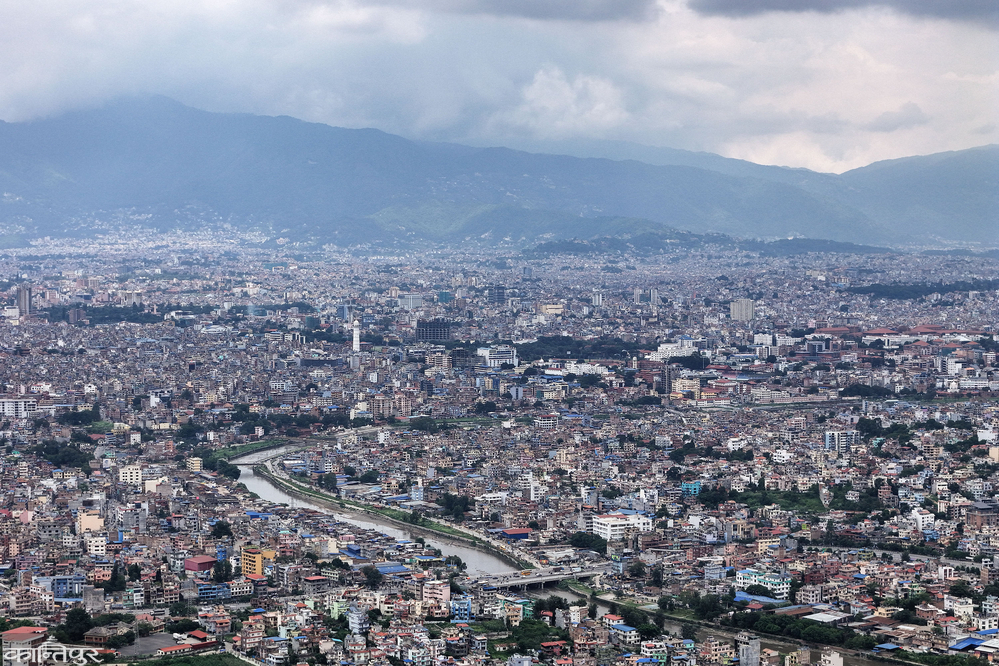
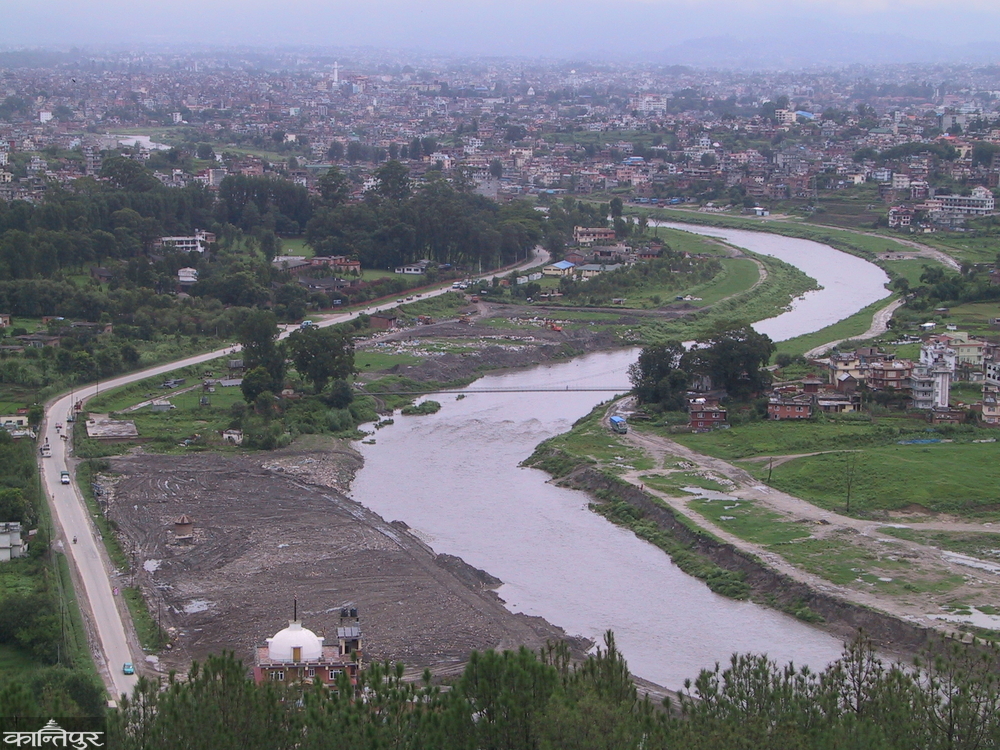
The porter has lost even his edge from the Bagmati, not even his bugger . How can there be a river without a bank or a bank? If there is no shore, there is a canal, there is no river. Bagar is the heart of the river. A river without a bank is dead just like a body is dead when the heart does not move. Bagar is the river's heavy burden. The shore, where the river sometimes makes a bed of stones, somewhere a bed of sand . The river slows down on the banks, strolls a few times . Bagmati, who has become a sewer, does not have such an exemption, that's why he is sad . A strong wall has been placed in his places of worship . At the place where he relaxes, cement figures have been erected saying park. Somewhere some plants have been planted in cement pots to show green. Bagmati, which has been made ugly by itself, is surrounded by trees wearing cement shoes in the name of making it 'good' again. Even the trees along the banks of Dhabikhola have been named after the prisoners. A few weeks ago, I took a picture of the prisoner trees in Dhobi Khola. Those prisoner tree numbers - 4354, 4355, 4356, 4356 and so on are visible in the picture saved in my mobile. A wall on the bank of the river, cement drums on the wall and plants inside those drums. Well done, the river bank . There is a big project called Bagmati beautification. Standing by the river in the valley, it seems like singing a song -
A man, what have you done to make beauty, to make cutie
We are watching, we are watching, we are watching
A Bagmati
By smelling, excrement and
As you drift away, you watch as you watch
000
From the east, I turned back to the west, to see the way Bagmati flowed. Roads or houses are built on the banks of Bagmati. Some temple and some park . The trees planted somewhere seem to be guarding as a policeman standing in green. The bridge has been crushed by a moving vehicle. I was also shaking . There is noise around Bagmati, there is excrement in the river .
After turning west, I headed north or towards Kathmandu . I entered 'The Eagle' cafe near the beach, and sat down. Made tea . Looking at Ayman's avocado tree, I said to Sahuji, 'I have never seen such an avocado tree.' He replied, 'Sewage made it so big.'
This city, where I lived for 35 years but never got to lie down on the sands of its shores, never got to take a dip . What kind of river is this, which is so close to me yet so far away . What kind of river is this, which is alien even though it is its own . What kind of river is this, which I rush to cross the road so as not to see it . I cover my mouth so that I don't smell it. At the Eagle Cafe, I became anxious with a sip of tea .
Sitting at Cheel Cafe, I remember drinking a stomachful of water at its fountain and see his condition here . On its shores, people have put stones, covered with ash, and carried heavy garbage. Bagmati, the drainage of water flowing from the area of about 3,700 square kilometers, which is about two percent of the country's total land area, cries because it cannot flow in winter, and cries because it cannot hold back during drought. In winter, he cries without getting water, in winter, he cries when he is wet with water . But, keeps on crying .
This bowl-shaped hole, which was a lake thousands of years ago . Standing there where the fish used to swim, today I am looking at Bagmati, which has become a canal and a sewer. I see a strong example of how quickly humans can ruin a place . That is, I am looking at the river that I killed and the city that I destroyed .
000
How did that Talmandu become the ugly Kathmandu of today? I start searching . It was Talmandu before it became a city within the Mahabharata mountain range at an altitude of 1,300 meters above sea level. In 2016, I read a study done by Harutaka Sakai's team on geological excavation of the Kathmandu Valley. The study concluded that the water level of Talrupi Valley decreased twice during 48,000 and 38 years ago. Sakai's team that studied the fossils in the rocks here said - during these two periods, the remains of the bamboo species Bambusoidea were found very much, and the amount of Leu called Pediastrum was also found to be increased . Both of these species are not found in deep lakes, but in wet places with low water content like wetlands. What is the reason for the
? They estimate, a big earthquake . About 51,000 years ago, there was a huge landslide in the Langtang area north of Kathmandu. In that landslide, a kind of stone called pseudotachylite was found, which is formed by friction during earthquakes . Harutaka's team said that the time when the water level of Kathmandu lake decreased is also around the same time, so there is a strong possibility that the earthquake reduced the water level . In this way, the water decreased and the land became visible. After the water left the valley, people took over the valley and slowly Kathmandu became not of Bagmati, but of people . Calculating inch by inch, people took about 57 branches of this valley, tributaries, rivers, and canals. He made the rivers canals, fulfilled his desires . The car moved, the sewer was disturbed . Throwing his scent in the river, he sprinkled himself with the scent of the perfume, and it fell on him .
Carrying the stomach burden of forty million people, after crossing the distance of about 50 km of this sad valley, cutting through the strong rocks of Chobhar, reaching Bagmati Kavre, Makwanpur, Sindhli, Sarlahi and Rautahat, Churelai falls into Madhesh . After flowing a distance of about 600 km from Bhagalpur in Bihar, India to Badlaghat in the north, the Bagmati joins the Koshi . The Koshi mixed with Bagmati merges with the stronger Ganges from the west at Kursela, southeast of Bhagalpur, mixed with Mahakali, Karnali, and Gandaki. Then, meeting the Brahmaputra flowing down from Assam, the mixed Bagmati Ganges reaches Bangladesh, where it joins the Meghna and other rivers and flows into the Indian Ocean at the Bay of Bengal . After becoming steam and taking the form of clouds, the Bagmati again goes north. In this way, the people of Kathmandu have spent their lives as they always carry Guhu and return as water. Has been quick . Has been a resident of the capital . In particular, it is the capital of Nepal, not the capital.
It was a magnificent city for hundreds of years . They are Indians who cross the Himalayas from the south or traders, monks or king maharajas who cross the same Himalayan mountain from Tibet in the north. His neighborhood was this valley, where Hindu-Buddhists used to perform satsang. French scholar Sylvain Livy, who arrived in Nepal in 1898, wrote in his book "History of Nepal" that this valley is a living museum of the civilization of this region. In the museum of that civilization, now the residents here have filled the stench . Bagmati and its brothers and sisters Manohara, Tukucha, Bishnumati, Nakhkhu, Balkhu, Hanumante, Dhobikhola, Godavari, Kodku rivers, which helped to make that civilization flourish, have carved their own history by robbing the banks of all of them - some as houses, some as roads, some as drains, some as cement parks.
After entering Nepal in the 1950s, staying here, visiting the whole of Nepal, Tony Hagan, who wrote a book called 'Nepal', has written Kathmandu as the cultural heart of Nepal . That cultural heart was made active by the bloody Bagmati . The valley, which survived by growing grain in the muddy soil of the lake, gradually began to grow houses. Farms became fields, rivers became canals. People made that magnificent city into this ghost town . That sequence continues .
 Cities are also made, but when the city thinks only about people, then the city is not livable or it becomes a place to live only with taxes . Therefore, this city has become a place to live not by desire, but by taxes. If only the latter is to be considered, Bagmati saw the Lichchavi of the 4th to the 9th century or the Mallas of the 13th to the 18th century . In 1768 saw the capture of Kathmandu by Prithvi Narayan Shah and visited the Basantpur Palace. At that time he saw the arrival of Prithvi Narayan, he also saw the exit of Gyanendra Shah in 2008, in the meantime he also touched on the destruction of Virendra . Bagmati always gave something to the people here, but no one paid for it. But then everyone started cheering for him. He went on mixing it up . He went to melt him . Studies have shown that in the period from 1990 to 2012, the settlement area in the valley increased from 38 square kilometers to 119 square kilometers, that is, it increased three times and now it has reached 180 square kilometers.
i.e. the city is expanding in such a way that even rainwater does not find its way into the ground and flows into the river. This city has been sealed with cement so that even rain cannot enter the ground. So that the Bagmati does not get water, i.e. it does not get flowing water, water has been collected by building a dam above the beautiful water of Shivpuri park. Another 94 meter high dam is being prepared below it i.e. Nagamati Dam. More than 27 billion is being spent to run the river by occupying the part where the water enters, collecting water on the hills.
However, scholars say that even that water will increase the flow of Bagmati by three centimeters in winter. The cost of thirty billion for three centimeters, that too by a poor country asking for a loan from the Asian Development Bank . Even that money will not bring fish back to Bagmati, it will save only life . In the 1980s, 23 species of fish were recorded in the Bagmati, but by 2000, it had dropped to 11, and researchers say that it is now almost dead in the middle of the city. A river without aquifers, a river without banks .
Many agree that humans, i.e., Homo sapiens, first came to the four billion-year-old earth about three hundred thousand years ago, fifty thousand or one hundred thousand. Five and a half million years ago, the Himalayas began to form, 48,000 years ago, the water in Kathmandu's lake went down to nothing, and then it happened again around 38,000 years ago. From 12 years ago, people have been occupying . Some people, king's house, temple monastery, farm fields, grain fields, grain cultivation, joyful processions, king's palace, people's huts were like this in this valley.
But, in the last 50 years, Kathmandu was completely occupied. Rivers became canals, houses were built in the fields, trees were planted on the hills and they became greener. He made Kathmandu from beautiful to ugly in half the age of a man . Fish chased away, sewage mixed . The road was extended, the house was built, the edge was cleaned and finally two-four camphor trees were beautified by wearing cement shoes, and now he is taking a selfie on them. In a magnificent city, the Bagmati flows stagnantly, often dead. He will probably never return to his old form, his bugger will never return and his color will never change again .


