Hanuman Jatra of Baglung, Virijat Mela of Bajang, 52-handed lingo throwing jtra of Chandannath Temple in Jumla and Bhagwati Jatra of Palpa have many legends, these fairs have kept the society and culture alive.
We use Google Cloud Translation Services. Google requires we provide the following disclaimer relating to use of this service:
This service may contain translations powered by Google. Google disclaims all warranties related to the translations, expressed or implied, including any warranties of accuracy, reliability, and any implied warranties of merchantability, fitness for a particular purpose, and noninfringement.
18-year-old Savin Bohra of Bajhang has started eating only one snack since July 8. He had shaved his hair the day before Ouncei, since then he has not eaten fish and meat, he has not even worn shoes on his feet. He has been sleeping in the Deoghar in the village after leaving home and is walking three/four kilometers barefoot daily. He did not do all these actions because of any health problem or due to illness. He is preparing to go to the Virijat Mela at Surma Lake in Bajhang on the day of Janaipurnima.
Four other people from Api Himal rural municipality-4, Chaubisen village of Darchula have also followed the same rule and stayed with Savin. In the village they have got the title of 'Balawire'. Those who go to Surma Mela for the first time are called Balavere. They have to walk in front leading those who are going to fill the fair from the village, while the laskar of 'Budhavere' who has already reached Surma Sarovar, walks behind Balavere. Since
, similar preparations are being made in the households of Bajhang. Those who go to the Virijat Mela have been on the lookout since the days of Ounce. They will walk barefoot on Janaipurnima day and reach Surma Sarovar at 4,333 meters above sea level, crossing Duskar Himalayan roads and beautiful paths. There is more excitement than fear in the minds of those who are going to this fair for the first time, which has the biggest and strictest rules in Bajhang district. Savin says, "I have been watching in photos and videos, I am happy that this time I will be able to go on my own."
It was a dream to reach Surma since childhood. It will be completed this year,' says Nirmala Shahi of Jayprithvi Municipality-7 of Bajhang, 'It may be a little sad, but where does everyone get the good fortune to touch such a beautiful land with bare feet?' It is believed that if you go to Surma lake and bathe in Surma Lake every year in the Surma Sarovar area, which is also the main tourist spot of Bajang district, you will get the desired fruit and get rid of sins. People who are going to Surma Sarovar Yatra have to stay clean from 15 days before, perform daily puja and eat only one meal. Those who go on the Surma Yatra for the first time are called Balaveer, while those who have gone before and are about to go again are called Budhaveer. Experts say that the name of this fair has been kept as Virijat because a group of heroes who travel barefoot go to the fair.
Those who come from Darchula to fill the fair gather at Ghanjar on the day of Ekadashi. Ram Ramita is performed there by singing various phaags, mangals and playing Deuda of Surma Devi. It is called Ratedi. After walking from there for one night in Veere Odar in Surma Rural Municipality, they reach Surma Sarovar the next day. Locals from Bajhang also pass through Selakhet of Jayaprithvi Municipality and stay at the Devasthali in Ghogada of Surma Rural Municipality on Ekadashi day. The next day they walk to Thakunnada where the main temple of Surma Devi is located. From there Veere's larco goes towards Surma Sarovar in the middle of the night. On the day of Shravan Chaturdashi, after the return of the heroes from Surma Sarovar, women devotees reach a place called Surma Kai Lotni to welcome them. There is a strange custom of women who have reached there to play on the floor.
In the Surma Mela, when the pilgrims coming from Bajhang road and Darchula's Marma meet near Biru Oda, people from both sides play Chabhai (song of praise to Surma Devi) together. On the day of Chaturdashi in the morning, take a bath in Surma lake and perform puja and the next day (on Janaipurnima day) the locals of Bajhang, who return from there, reach the main temple of Surma Devi in Thakunda village of Surma Rural Municipality, Pangarjadi. A large number of people who could not go to Sarovar used to participate in village fairs.
Among the 16 sisters of Mashta, Surma and Durga separated from Bajhang's Durgathali and passed through this road as Tharal when the locals saw Surma and entered the lake while chasing her with the intention of hunting. Elders say that a fair is held here every year as an atonement for chasing away the goddess. They say that when they found out that Surma was Devi as Tharal, the pursuers repented and uttered Chavah Chavah (chah chah) and later this word was corrupted into Chabhai (a song sung in Virijat).
This fair is not only religious and touristic but also culturally important in the district. Rare scenes such as traditional dhanka (a type of instrument) made from animal skin, damfe dance, chabhai khel played by a group of women can also be seen during the fair. To see the beauty and religious cultural performance of Surma region, now not only Bajhang and Darchula, but a large number of people from different parts of the country participate in Virijat. "This fair is not only important because it is celebrated for a long time and a large number of people participate," says Kshetrasingh Thekere of Darchula Api Himal Rural Municipality-4.
Young people are also trying to preserve this tradition that has been going on since ancient times. It is believed that every person of Bajhang's Surma and Chabispathivera Rural Municipality and Darchula's Api Himal Rural Municipality should visit Anirvaya twice in their lifetime. However, the younger generation says that they participate in Virijat to promote tourism while preserving the tradition. This is a religious act. An area like Surma is also an opportunity to introduce the world," said Khimanand Thekere of Api Himal Rural Municipality of Darchula. "The young generation also has a good interest and participation in it." To increase the attraction of the
fair, the local club organizes attractive sums of money and various sports competitions. Dan Bahadur Surmeli, president of Bajhang Industry and Commerce Association, who is also a resident of Surma, says that such competitions are playing a role in the development of the sports sector, preservation of culture and its promotion.
Recently most people in this region visit Surma throughout the year to observe the geographical beauty rather than the religious one. Three years ago, a team including an American journalist also studied the tourism potential of Surma Lake. Surma Sarovar, Tatopaniko Muhan, Biru Odar, Dhanseri Jiulo etc. places in this area are major attractions for domestic and foreign tourists. Until a few years ago, there was a rule that Dalits were not allowed to enter the Ghogada, Thakunna area of Surma during the fair period (15 days), but now that custom has changed.
000
This is the Jatra-Katha of Baglung. Red cloth breeches and shorts, for one person a long tail is made with a white cloth border of up to 12 meters. After applying abeer on the face, it looks like Hanuman. A unique Jatra of dancing with two thick sticks in hand is preserved in Baglung. Hanuman Jatra, estimated to be 300 years old, has been preserved by the Newars of Baglung. Legend has it that the Newars who migrated from Bhaktapur and came to Baglung also brought this Jatra together. The Newars here say that the Newars migrated from the capital to Baglung 1750 years ago.
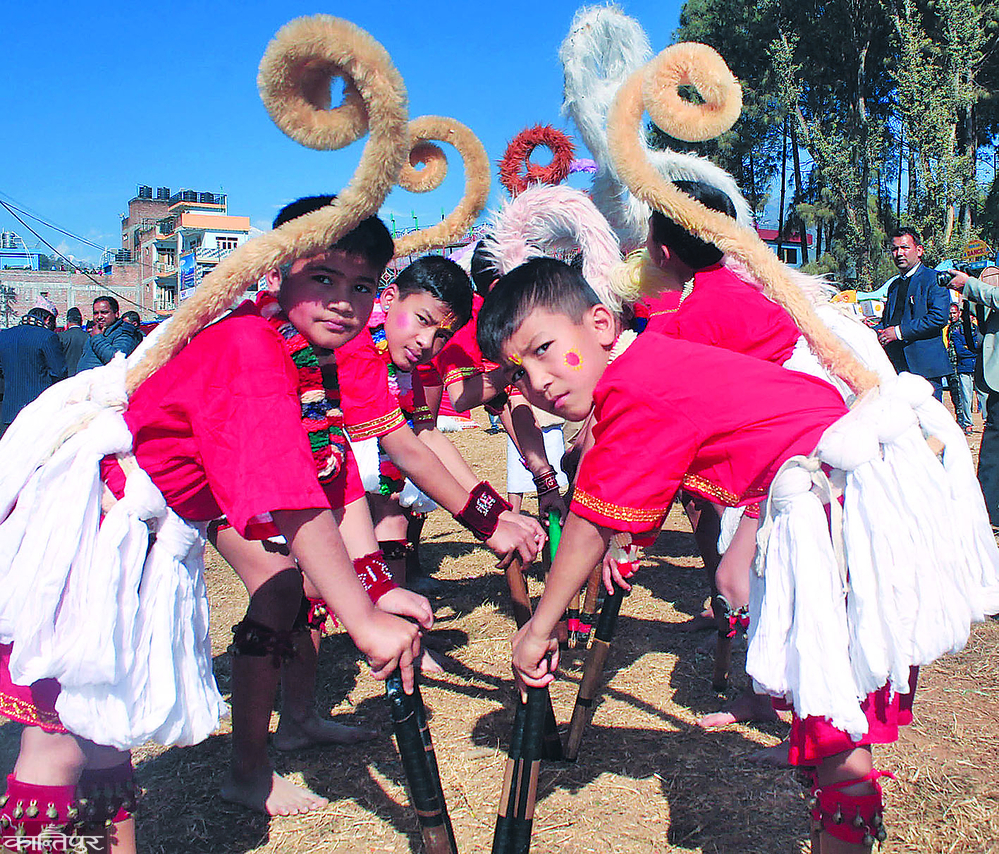
Hanuman Dance Conservation Council and researcher Prem Chota, who published a work on the matter, said that the Newars who migrated here brought many cultures with them. Among them, this is a unique and very expensive journey. Initially Hanuman Jatra was seen every year. Due to lack of artists and expenses, it was shown in odd years. This dance was performed almost 9 years after last year in Baglung on the occasion of odd year. But it has been shown in 2082 even though it was a busy year after the demand of the community increased. At least 13 pairs and at most 15 pairs form Hanuman and dance in dozens of rhythms. Before taking out Hanuman Jatra, Pooja is ritually performed at Chhahara Pandhera here. Badri Shrestha is the original priest of Hanuman place here. His sons have also been following this Jatra and Hanuman dance method for years.
The people of Baglung have started recognizing this dance, which is started from Pandhera near Baglung Bazar. The youth are trained from a month before the Jatra. A lot of rules are also taught during training as formal dances have to be finished after they start. "It is believed that worshiping Hanuman in the form of Ashtachiranjeevi and performing his dance will give you strength throughout your life," said cultural expert Prem Chota, "This dance celebrated in Bhaktapur three hundred years ago has now disappeared, it is preserved in Baglung."
Also, Hanuman Jatra is known as an example of celibacy. There is a provision that participants in Hanuman Jatra should remain celibate. It is said to be unfaithful if not seated. Also, the young man who becomes Hanuman should also stay clean throughout the Jatra period. Otherwise, Veer comes and vibrates during the dance. If there is a tremor, the priest or the leading couple sitting to dance will heal by burning incense.
From the day before starting this Jatra, the priests sit carefully and perform puja at Hanumansthan on Tuesdays after taking bath. From that place to the Ram temple at a place called Upallachaur, one has to walk backwards carrying the statue of Hanuman for about 3 km, one cannot speak. It is very difficult because they are also starving. It is also believed that Hanuman Jatra will bring harmony and inspire common citizens to be loyal and truthful. Pujari Shrestha said that a lot of money is spent on costumes, mriddang, dhokal, cymbals and other materials used for dancing.
Young people from 16 to 40 years old will be made Hanuman and it is also believed that because the young people remain celibate for a week before becoming Hanuman, the young generation can be saved from addiction. Since it is a dance based on the story of Ramayana, everyone who believes in Hinduism participates in the preservation of this culture. Even though the project was done by Newars, other castes like Brahmins, Chhetri, Magars also participated in the dance.
Since 2046, Hanuman Nach Sankara Parishad has been formed for its preservation as it is an endangered culture. "Since it is very expensive, it is not enough to preserve dance alone," said the president of the council, Parashuram Shrestha. Actors are needed to play the
cymbals. There is a rule that there will be a chief 'Kazi' who leads such artists. The Pradhan Kazi, known as the main conductor, coordinates the dance. Arrangements should also be made for other assistant kajis to organize the bhajan mandali during the dance. Being an endangered culture, this community has taken the initiative to protect it and list it in the world culture.
000
This is Jumla's Jatra description. All around are houses with mud roofs. Chandannath Bhairavnath Guthi's shera has rice stalks hanging from the tree. On top of that, the beauty of the 52 hand linga installed in the Chandananath Bhairavanath temple kept everyone's attention. You have to climb the hill to see the 52-handed lingo that is placed in the temple. Chandannath Bhairavanath Temple, which is a religious heritage of Karnali, is in danger. Ghatasthapana on the first day of Dasain. In Jumla, there is a custom to desecrate only the Lingo Ferrer of Chandannath Bhairavnath Temple. On this day, devotees from all over the district descend on Khalanga, the headquarters. It is customary to celebrate this day which happens once a year. Since there are 52 weeks in a year, it is customary to keep a lingo of 52 hands in the temple. Lingo is made by cutting green Salla trees. The lingo is covered with red and white colorful cloth. It is decorated with a label on the top. On this day, morning food is eaten only after erecting a lingo in the temple.
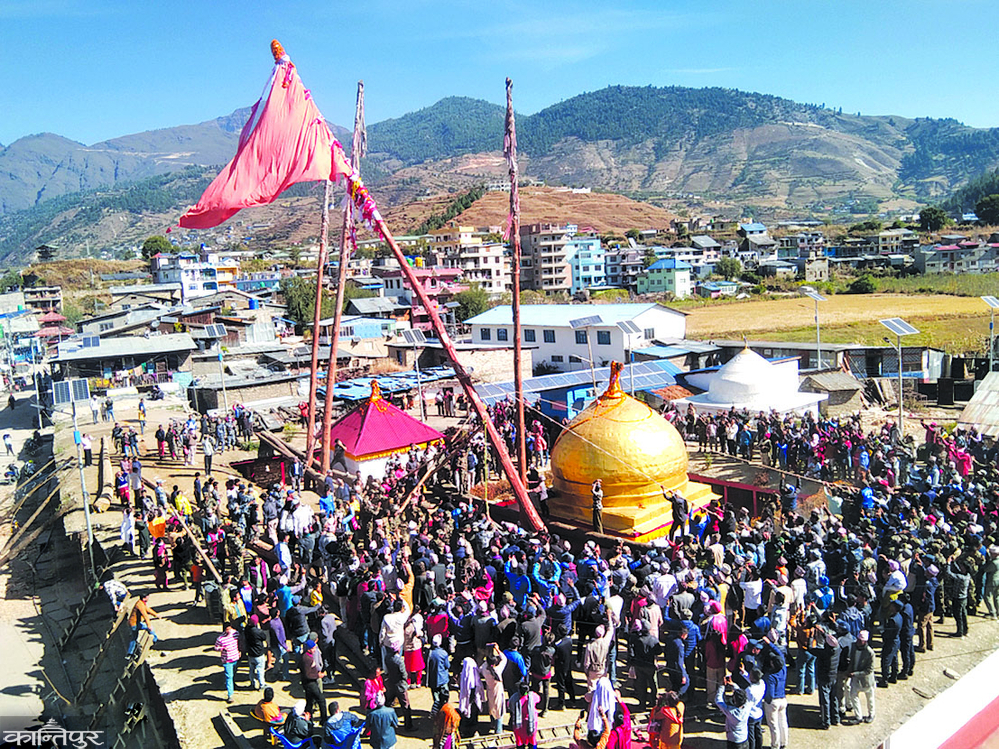
Lingo is brought from the forest within Chandannath municipality. It is believed that if the lingo is broken while pulling or pulling it, it will bring bad luck to the country. Gaurinanda Acharya, the former president of the Guthi Committee of Chandannath Bhairavanath Temple, said that there is a custom of changing the lingo with chanting of the deity and pujaarti, bhajankirtan. A lingo of 48 hands and dhwaja and neja of 48 hands are kept in Bhairavanath temple. There is a tradition of erecting two lingas along with the victory pillar in the temple. Paltane linga, (which is brought by the Nepali Army, Nepal Police and civil servants), one additional linga (which is brought only by the villagers) and another kamas linga which is brought together by all Dalits are brought together.
Earlier it was customary to bring 96 dharni of ghee from Kalikot to the temple on the day of erecting the lingo. 26 Dharni honey was collected from Humla, Aksheta from Pansay Dara, which was a paddy field in Jumla, meat, wheat and cattle were collected from Lekali settlement. Wheat used to come from the twenty-four Daras of Jumla. Even now, it is customary to give Rs.
Chandannath, Bhairavnath temple to be erected at the top of the lingo, the chauri furko is given with mugu bhote, the thetuva wrapped in mugu Khatyad, Soru and Galbhaka kshetri is given, the rope for tying the neja and dhwaja is given with humla bhote, the goat sacrificed in the temple of Chandannath Bhairavnath is given from twenty-four Rini and Kudari and China. Digging the pit for burying the lingo was the responsibility of Rini and Chhinai people. Dasain officially begins with the changing of the four lingas at the famous temple Chandannath, Bhairavanath. All over the district, they cut the small amount of rice that is about to ripen in their fields and thresh it. It is customary to eat the chiura mixed with honey and curd. But now the old custom has disappeared.
Jumlawasi eat new grain i.e. nuwagi on the day of erecting the lingo and paddy is also harvested from that day. According to local Chitralal Shrestha, it is customary for all the family members to gather together and eat nuwagi after offering it to Baba Chandannath, who brings in rice. In 670 years, the day of offering idol to Chandannath Baba is seen with special importance.
When the old lingo of Chandannath Bhairavanath temple is pulled down, people who come here take flags and nejas tied to the lingo. There is a popular belief that taking old flags and nejas will give you strength and prevent evil. When burying a lingo, the Jumlawasi people carry the dug soil and take it home. Looking at the date written on the statue of Lakshmi Narayan, which was offered in 670 years, it seems that the act of changing the gender this time has been done 2 thousand 12 times.
000
This journey of Palpa has been going on continuously for 26 years. The Sindur Yatra was started to commemorate Nepal's defeat to the British in the war. Jitgarhi festival is celebrated on Baisakh 7 in Jitgarhi, Butwal sub-metropolitan city of Ruppandehi. Khatyatra is held every year on Bhadrakrishna Navami in celebration of Nepal's victory in the Nepal-British war at Tansen in Palpa. On 7 Baisakh 1872, the army led by Colonel Ujirsinh Thapa won the victory over the British in Jitgarhi fort.
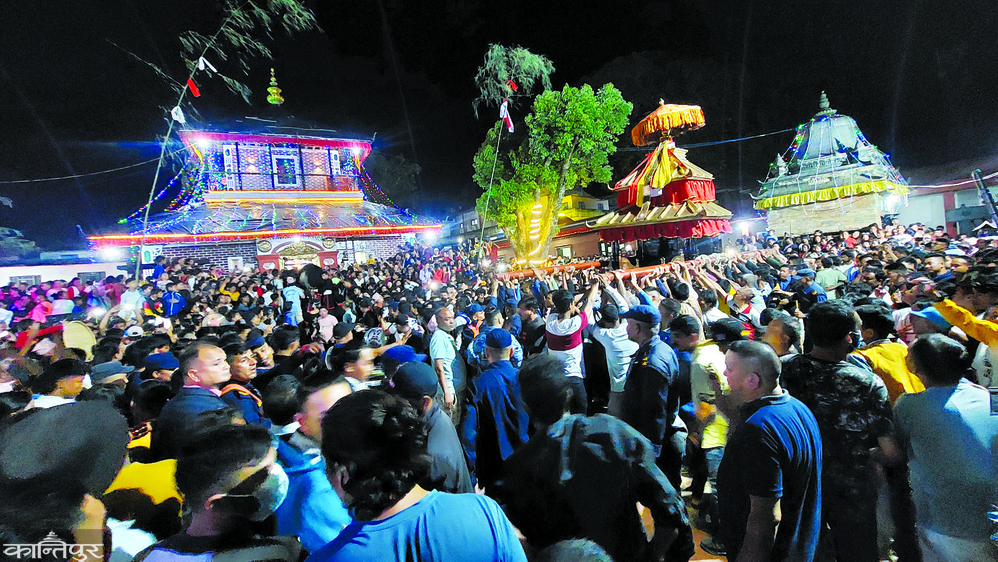
Before going to war, Colonel Thapa is believed to have vowed to Tansen-based Ranujireshwari Bhagwati. On this basis, Khatyatra has been held in Tansen Bazar for 26 years. The Nepali army defeated the British in Nuwakot (Palpa)-Jitgarhi (Rupandehi) war. Ashok Maharjan, chairman of the Guthi Management Committee, said that since 1877 Bhadra Krishna Navami day, a continuous Vijayotsav Khatayatra has been taken out in Tansen in memory of this.
Historian Nirmal Shrestha says that Bhagwati Khatyatra started in 1877 from Bhadra. There was a war with the British in Butwal's Jitgarhi twice. Colonel Ujirsinh Thapa, who led the army in the war, has a history of protecting Butwal (Jitgarhi) area from the British. It is still widely believed that Thapa vowed to build a temple of Bhagwati if he won the war.
After winning, Thapa built a temple from 1872 to 1876 in the then administrative center of Tansen. There is a history of first war in Jitgarhi region on December 15, 1871. "Before going to war, Ujirsingh made a vow and built a three-story grand temple in the belief that he had won the war. Bhagwati's Khatyatra has started going around the market since Bhadra Krishna Navami in 1877," said President Maharjan.
'We are leaving for the battlefield. Ran- May your strength and blessings be with Vijay. Thapa vowed that if there is a victory, he will replace the divine idol in a beautiful idol and conduct a yearly Khatyatra. According to historian Shrestha, Nepal became independent after the British army returned to Gorakhpur in India after being defeated by the Nepalese army. It is celebrated every year to spread the history of independence of the country all over the world.
The then Prime Minister Bhimsen Thapa sent his nephew Colonel Ujirsingh to Nuwakot Fort. At that time, Veerbhanjan Pandey was deployed for the Nuwakot-Jitgarhi war with 200 soldiers from Guru Bux Gulm and five troops from Sawooz Paltan, who had a force of about 500 soldiers (Nafri). Virbhadra Thapa's younger son Sanakaji Amarsingh Thapa was the administrator of Palpa. The eldest son Bhimsen Thapa was the Mukhtiyar of Nepal. His wife's son, Nayansingh Thapa, served with Amarsingh in the western integration campaign. Ujir Singh is the son of Nayan Singh. As Nepal's unification campaign gained momentum, the British were suspicious. After the Palpa state was merged into Nepal, they stopped looking at Nepal in a friendly way and started raising disputes about Butwal and Suraj. Also, there is a history of occupying some areas of Wutwal without declaring war.
When Amarsingh, stationed in Palpa, sent soldiers to return the occupied territory, the British declared war. In this war known as the Nepal-British war, the purpose of the British was to capture Palpa and cut off Nepal from western contact. Major General John Sullivan Ud was appointed by the British Army for the job.
1871 After the death of Amarsingh in Ashwin, Ujirsingh was given the responsibility of running the administration of Palpa. The British would first go to the hills and destroy the Nuwakot Fort. They planned to attack Palpa by destroying the other Jitgadhi and crossing the current highway. Although the British were victorious in the battles of Nalapani, Jaithak, Deuthal in the western region of Nepal, they were defeated in the battle of Jitgarhi.
It is mentioned in the history that the Nepalese army did not dare to fight with the British army which came with 24 companies and 200 cavalry soldiers. The Nepalese army remained silent until the British forces destroyed the palace by raining shells from Khasyuli (Butwal). The British assumed that there was no Nepalese army and that they were heading towards Palpa. After capturing the Jitgarhi fort and capturing the Nuwakot fort, the English army entered the river. According to the Ujer Singh in the direction of the Ujurushi in the direction of Uging and Han, Juicy bullet. & Nbsp; Someongoys of the British army was difficult for a stunnial army when the
is constantly shot dead. The Bungal Antha led to the people led by a large manpower for a small area. So he ordered the army to return. Void 1872 In April 15, Historistvindi Banami, mentioned in April 15, issue of Interviews in the book of General Bhimsen Thapa and Kigshar, Thapa, mentioned in the book of Palpa Srijan Thapa. Subal Calby Thapa remembered the vowed in the scattering of Transeen's god before going to
war. Prophy of Bhagali felt that Thapa has been made by Thapa, which has built the temple, the temple, and nbsp. & Nbsp;
Ujer Singh Thapa passed in Kathmandu. Thapa, Immetrical and Kerituraprai planned Thapa planned to run in the form of Praktha Palpa. Thapa has started the practice of God for the purpose of fulfilling his vow. Historismal Rajendra Statistical Singh said that this process has helped to develop culture and traditions. & Nbsp;

