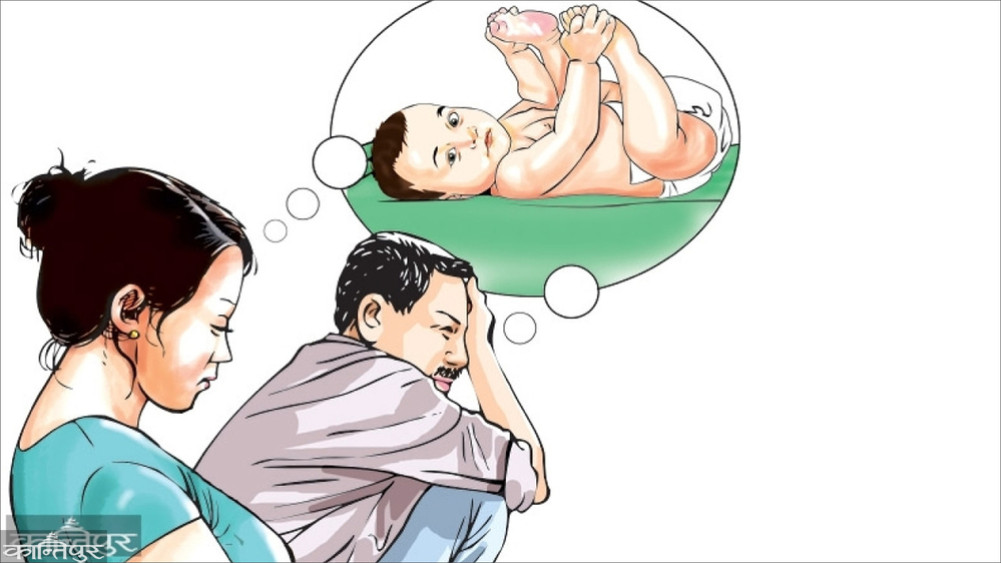
About 17.5 percent of adults in the world are infertile, and about 10 to 15 percent of married couples are infertile, according to the World Health Organization (WHO), with 1 in 6 people experiencing infertility at some point in their lifetime.
We use Google Cloud Translation Services. Google requires we provide the following disclaimer relating to use of this service:
This service may contain translations powered by Google. Google disclaims all warranties related to the translations, expressed or implied, including any warranties of accuracy, reliability, and any implied warranties of merchantability, fitness for a particular purpose, and noninfringement.
42-year-old Sarita Niraula (name changed) from Jhapa has been married for 14 years. Her husband is a driver. She is also active in the field of women's rights. They want children right after marriage. But so far, neither nature nor technology has helped.
We have not left anything from the blowing of Dhamijankri to the worship of Gods and Goddesses. We also met the doctor. He gave me medicine saying that there was no big problem, but he took it,' says Niraula, 'even the little wealth that I had earned was spent in hospitals all the way to India. If you don't have children, the village society will be disgraced, it will also be a burden in your own home.'
The Niraula couple has made many attempts to have a child. From taking herbs to taking medicines as prescribed by a doctor. "If you take medicine, you can spend up to 15,000 rupees in a month, there is no service in the government hospital, and you have to pay thousands of rupees every time you see a private doctor. After spending millions, we took medicine as the doctor told us, but we still didn't have children. How can a poor family like us who live by daily wage earners afford such an expensive treatment?
The doctor said that she has a problem with her uterus. She says that her relationship with her husband is in crisis after she found out that there is a problem with her uterus. Your desire for a child is one thing. But society and family do not accept women who cannot reproduce. I have to bear the burden of humiliation,' she adds, 'Now I am forced to bear the same pain.' She says that for childless couples like her, the government should make a law and help them get children and get treatment.
• • •
37-year-old Vinay Chaudhary (name changed) from Dang has been married for 9 years. After returning from foreign employment, he planned to have children the same year he got married. But it didn't go according to plan. Then they also consulted a doctor, took medicine. After years of unsuccessful efforts, she tried to conceive through IVF technology. But that effort for the past two years has also failed. "I have already spent more than five lakhs," Chaudhary says, "I want children, on the other hand pressure from society and family." Having or not having children makes a lot of difference in social life.' Dozens of medications, various health tests and nutritional balance. He has spent lakhs of rupees for all this. Apart from that, the doctor said that it will cost four and a half lakh rupees only for IVF. Through IVF, his sperm and his wife's egg were extracted and fertilized in the lab and placed in the uterus of wife Rekha. Doctors said that the success rate of conceiving in this way is up to 75 percent. But even with this technology, Rekha did not conceive. According to the doctor, there is a problem with the quality of Vinay's semen.
Vinay is rushing to the doctor to try this technique once again. Mrs. Rekha says that her career has become difficult due to her desire for children.
'When there is no child, it will be very difficult for the family and everyone around to listen and bear,' she says. They speak whatever comes to their mouths. They associate this with social prestige, competence and ability. They are making it difficult to stay at home and difficult to live in society.'
•
• • These two couples are just examples. The number of people suffering from the same problem of childlessness is huge. According to the World Health Organization (WHO), about 17.5 percent of adults in the world have infertility problems, and about 10 to 15 percent of married couples are childless. 1 in every 6 people has experienced infertility at some point in their life. One out of every four couples in developing countries suffers from infertility.
It is difficult to ascertain the number of victims of childlessness in Nepal. Because there has been no government survey on this so far. Not only the national census, but also other thematic surveys on reproductive health and health surveys do not collect data on childlessness. According to Article 35 of the Constitution of Nepal 2072, equal access to health services is a fundamental right of citizens. But the government, which has implemented dozens of policies, programs and plans to manage reproductive health, does not even seem to accept childlessness as a part of reproductive health.
The government has been making investments in areas such as safe motherhood, maternal and child care services, access to contraceptives, adolescent-friendly reproductive and sexual health services, and control of sexual violence. But in terms of childlessness, there is neither universally accessible treatment services, nor laws to address it. The government has not invested enough in infertility research and treatment. MP Ishwari Gharti Magar claims that the government is not providing infertility treatment services, especially women are being persecuted. It has been commented that childlessness is caused by the weakness of women. No matter how well-educated the family is, it is difficult for women to remain childless,' she says, 'childlessness is one of the main reasons for the terrible fact of violence against women. If there is no child, men divorce within 2/4 years and marry again.
In Nepali society, children are not only the desire of the couple, it is also made compulsory by clan traditions and religious and social values. Children are considered as the basis of generational transfer of individuals. Because of this, the wrong practice of stigmatizing the person who suffers from childlessness continues. On top of that, as soon as the problem of childlessness appears, it is thought that it is a woman's weakness, and most women suffer from it. Studies have concluded that it has a serious impact on the mental health of women. In 2021, a study conducted by the Women's Rehabilitation Center (OREC) on women with childlessness stated that almost 100% of women are experiencing some form of discrimination and humiliation due to childlessness. Studies have shown that most of them are afraid of being asked for divorce from their husbands due to childlessness, and they are being insulted by insulting words such as barren and aputali.
According to the International Journal of Reproductive Biomedicine, 2020, infertility is one of the leading causes of divorce. Among women with infertility, 87 percent have symptoms of NG, while about 41 percent suffer from depression. Infertility is a condition in which a couple does not have children from their natural union, even if they want to. When couples are unable to conceive through normal procedures, it is their reproductive right to get the necessary counseling and treatment. But currently, such services are not available in health institutions up to the ward level across the country, and there is no state policy to provide such services. Instead, private sector-run IVF clinics are providing services.
Ministry of Health spokesperson Dr. According to Prakash Budhathoki, the government has recently started some efforts to treat childlessness. We are running IVF clinics in all seven provinces. Now this service has been started in at least one federal hospital in the province,' said Budhathoki, 'It is cheaper, more accessible and more reliable than the private ones.' Then there is the exploration of various reproductive health treatment options. For couples who cannot conceive through natural methods, various techniques and methods have been developed to help them get children based on their fertility. But in Nepal, due to lack of necessary laws and expensive technology, such options have not been used.
According to doctors, couples who cannot conceive through natural methods can have children through methods including IVF, artificial insemination, egg freezing and surrogacy. Currently, IVF technology is being used like other health services in Nepal, but surrogacy services are stopped except secretly. Not only the lack of laws about surrogacy, but also social understanding and practical difficulties have become obstacles in the treatment of infertility.
Although many countries in the world regulate surrogacy by making laws, in Nepal the government is not interested in making laws. Instead, the government had allowed various health organizations to provide surrogacy services in the name of health tourism in 2071 without enacting a law. But less than a year after the service started, the Supreme Court overturned the government's decision on October 1, 2072. And banned surrogacy services that have become commercialized.
At that time, the Supreme Court banned commercial surrogacy and issued a directive order to the government to make a law and manage it so that Nepali couples suffering from childlessness can get services through charity surrogacy after fulfilling the necessary conditions. The decision of the Supreme Court opened the way for Nepali couples to have a child with the help of a charitable surrogate mother when they are unable to have a child from their own uterus. The Supreme Court, which imposed a complete ban on surrogacy services for foreign nationals, issued a 15-point directive order in the name of the government saying that in the case of Nepalese nationals, it should be regulated by law. But even after a decade of such a decision, the government has not regulated it by making a law.
The judgment given by the bench of Supreme Court Justices Sushila Karki and Govind Kumar Upadhyay on 30th June 2073 on the petition of advocate Pushparaj Pandey said about surrogacy, 'Usually when a woman's uterus is unable to have a child, the couple's ovum and sperm are fertilized in a test tube and the embryo is developed in another woman (surrogate). Surrogacy is a method of giving birth to a child by transplanting it into the mother's womb. Commercial surrogacy is prohibited and punishable as a criminal offense in most countries. While charitable surrogacy, the legal interests and protection of the surrogate mother, the child and the parents who want the child are regulated by the law. Banning, it was directed to create a law to provide surrogacy services only to childless married couples who are unable to have children due to poor health conditions or lack of reproductive capacity. According to the directive of the Supreme Court, in order to get a child from a surrogate mother, the consent of both childless married couples who are Nepali citizens must be obtained, the woman who wants to be a surrogate mother can earn some financial benefit and can become a surrogate mother from a professional point of view, no woman can be forced to become a surrogate mother against her will, the certainty of a surrogate mother Conditions such as age, being married, having given birth to a child before, and the approval of her husband are also mentioned.
Women's rights activists have been demanding that a law be made so that women can have their own uterus based on their own decision, while some have been demanding that a law be made with surrogacy services based on women's self-determination so that anyone from the LGBTIQ community and any single or couple can have children through surrogacy. Human rights activists say that the Supreme Court's decision has prevented those who want to earn an income using their uterus from obtaining the right to identify their labor. Senior Obstetrician Dr. Bhola Rizal says that although the Supreme Court has ordered to regulate surrogacy by making laws, many childless couples are deprived of the joy of having children because the government does not make laws.
Dr. who is also the president of Fertility Society of Nepal. Rizal said, 'There was a misunderstanding about surrogacy in Nepal saying that it should be regulated by making laws. The Supreme Court has said that surrogacy services can be provided for Nepalis in Nepal. But even now the government has not made a law about it. Many couples are suffering from childlessness.'
Although the Supreme Court's order recognizes charity surrogacy, he claims that there is no practice of surrogacy in Nepal. UML MP Gharti Magar also says that the government should make laws to make the childless couples happy about the fact that the court has already given a directive order. Don't even think about the negative aspects of surrogacy. On the other hand, we should also pay attention to the loneliness and social problems caused by childlessness in the society," she says, "Having children is the right of every couple. The government will not delay much longer to arrange this by making a law.
Meanwhile, the Ministry of Health said that no formal information has been received about the directive order of the Supreme Court regarding surrogacy. It was discussed that the supreme command was given. But we have no information. I did not have to say anything about it because the official information of the decision did not come,' said the spokesperson of the ministry. Budhathoki said. He claims that although there is no initiative for surrogacy, the government is making a lot of efforts to organize IVF services recently. IVF services are cheaper in government hospitals. There is a plan to further increase this service in seven provinces,' he said, 'initiatives are also being made to improve the legal provisions and policies to make it accessible to everyone.' He said that the work of organizing the service is going on. According to him, taking IVF service from a government hospital would be enough for one lakh rupees. But in private clinics, its cost is up to 10 lakh rupees. Senior Obstetrician Dr. According to Rizal, there are currently around 40 IVF clinics operating across the country in Nepal.
It is believed that childlessness is a curse from God. But in reality nothing like this happens, we have established that this is a health problem, there is a treatment,'' said Dr. Rizal said, “There are still some similar misconceptions about IVF and surrogacy. Children born through IVF in Nepal have reached the age of 22. So there is no need to get too confused about it now.'